 Chuckanut
 Columbia homes sit close enough to the water and the tree line that their siding takes on a steady, year-round workload most inland properties never deal with. Salt-tinged air moves in off the bay, storms drive rain sideways into walls instead of straight down, and shaded lots hold onto moisture long after a storm has passed. Siding here isn't just a finish layer — it's the thing standing between that climate and the framing underneath. This page is about one product, in one place: James Hardie fiber cement siding, installed correctly, for homes in Columbia.
What Columbia's Climate Asks of a Siding System
Three conditions do most of the damage to siding in this part of Whatcom County, and Columbia gets all three at once. Salt air off the water accelerates the breakdown of finishes and speeds up corrosion at fasteners, trim, and flashing. Wind-driven rain doesn't just fall on a wall — it gets pushed into lap joints, corners, and any gap where a finish or seal has started to fail. And shaded, tree-adjacent lots stay damp far longer after a storm than an open, sun-exposed property would, which is exactly the condition moss and mildew need to establish themselves and spread.
None of that is unique to any one house on any one street — it's the baseline climate load every wall in Columbia carries. What varies is how well a given siding system, and a given installation, is built to handle it. A product with an organic core and a field-applied finish has to fight that climate for its entire service life. A product without one doesn't have to fight it the same way.
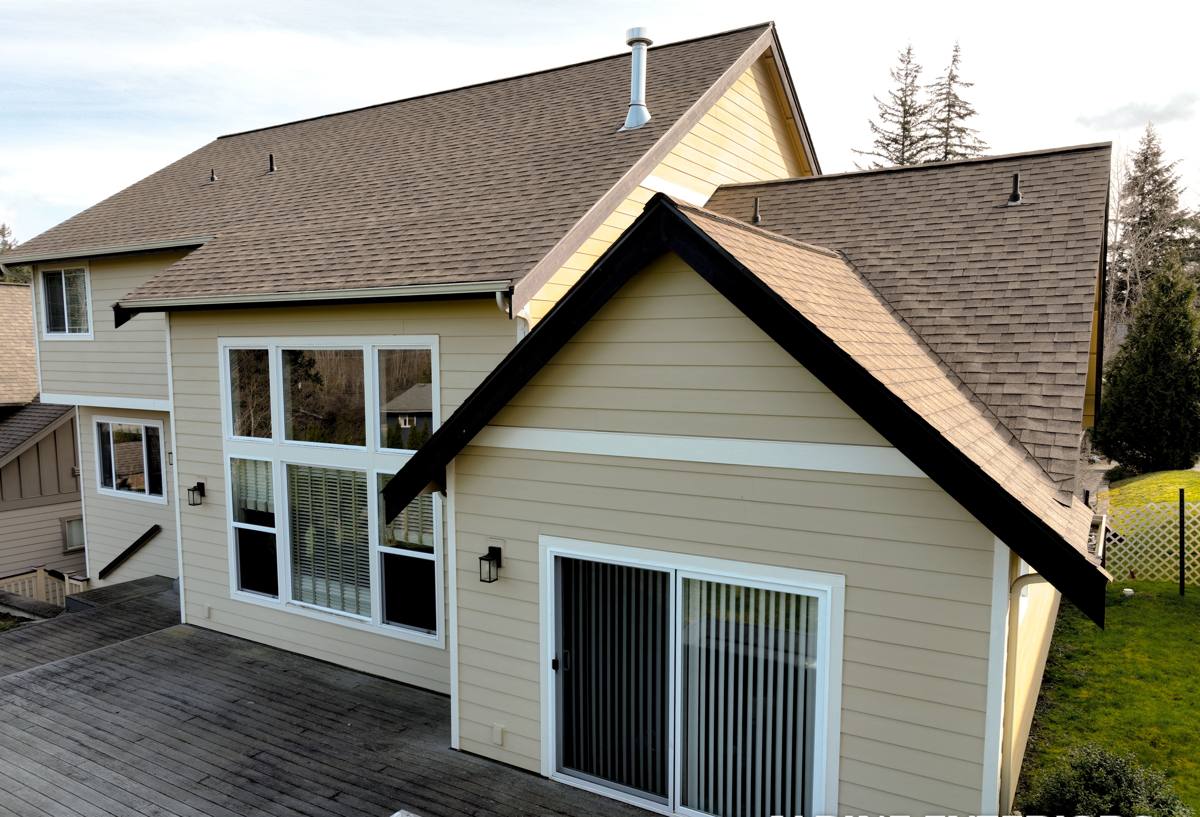
What Fiber Cement Actually Is
James Hardie siding is a cement-based composite — portland cement, sand, and cellulose fiber, formed into planks and cured. The core is inorganic. It doesn't have wood fiber that can absorb water and swell, and there's no organic material inside the board for moisture or fungus to work into over time. That single fact changes how the product behaves in a climate like Columbia's: it isn't racing a clock the way a wood-based product is, because there's no wood-based failure mode to race against.
The ColorPlus Finish, and Why It Matters Here
Most Hardie product installed in this region carries the factory-applied ColorPlus finish — a coating baked on under controlled conditions before the board ever reaches the job site, rather than brushed on in the field afterward. In a place where salt air and long gray stretches wear down field-applied paint faster than in drier regions, that difference shows up directly in how long the finish holds its color and its seal before it needs attention.
Built for This Kind of Exposure
Hardie also builds HZ product lines engineered specifically for regions dealing with sustained moisture, rather than selling a single generic formulation nationwide. For a Columbia property facing salt air, driving rain, and a moss season that can run most of the year on shaded walls, that's not a marketing detail — it's the product spec doing what a generic siding formulation wasn't designed to do.
What a Correct Installation Actually Involves
Fiber cement's durability depends on getting the installation details right, not just on the material itself. A well-engineered board installed carelessly can still let water into a wall assembly. The details that matter most in a climate like Columbia's:
- Proper clearance between the siding and grade, decks, patios, and roof lines, so splash-back and standing moisture don't sit against the bottom courses
- Correct flashing at every window, door, and roof-to-wall intersection — the most common place wind-driven rain finds a way behind siding
- Fastener spacing and placement to Hardie's spec, using fasteners rated to resist corrosion from salt-laden air
- Properly lapped and sealed joints, since a rushed joint is one of the fastest ways to undercut an otherwise correct installation
- House wrap and water-resistive barrier integration that works with the siding system, not against it
Where We See Installation Corners Get Cut
On tear-offs and service calls, the recurring problem is rarely the material — it's a detail that got skipped to save time. Clearance left too tight against a deck ledger. A joint caulked instead of properly lapped. Fasteners spaced wider than spec to save a box of nails. Each of those looks fine on installation day and only shows itself years later, usually after a wet season has had time to work into the gap. Treating those details with the same seriousness as the material choice itself is what separates an installation that lasts thirty years from one that needs attention in five.
Fiber Cement Compared to Other Siding Options
Homeowners researching a re-side usually run into a handful of other products alongside fiber cement. Here's how they stack up on the factors that matter most in Columbia's climate:
| Factor | James Hardie Fiber Cement | Vinyl Siding | Engineered Wood (e.g. LP SmartSide) | Cedar |
|---|---|---|---|---|
| Core material | Cement, sand, cellulose fiber (inorganic) | PVC plastic | Treated wood fiber | Solid wood |
| Combustibility | Non-combustible | Combustible, can deform under heat | Combustible | Combustible |
| Moisture behavior | Does not swell, rot, or delaminate | Doesn't absorb water, but seams and fasteners can trap moisture behind panels | Vulnerable at cut edges and joints | Vulnerable without diligent finish maintenance |
| Finish | Factory-baked ColorPlus finish available | Color molded through panel; fades over time, cannot be repainted easily | Factory-primed; field-painted at seams | Field-applied stain, recoated on a schedule |
| Typical warranty | Strong, often transferable when installed to spec | Varies widely by manufacturer and grade | Limited, terms vary by product line | Typically none from a manufacturer; performance tied to maintenance |
We install James Hardie exclusively — not vinyl, not engineered wood, not cedar. Each of those alternatives has real trade-offs in a climate that delivers salt air, wind-driven rain, and a long moss season, and we'd rather explain that plainly than install a product we don't believe holds up here.
How the Process Works for a Columbia Property
Every project starts the same way regardless of the home: we walk the property in person before quoting anything. That includes checking sun exposure, tree cover, and how close the walls sit to grade, since those factors change how aggressively moss and moisture will target a given elevation. From there:
- On-site walk-through and assessment of the current siding's condition, including a look for signs of moisture already behind the surface
- A written estimate that spells out scope, product line, and what tear-off is likely to reveal
- Tear-off and inspection of the sheathing underneath — this is where hidden moisture damage from years of an underperforming siding system typically shows up
- Any necessary sheathing or framing repair before new siding goes on, since installing over a compromised substrate defeats the purpose
- Installation to Hardie's fastening, flashing, and clearance specifications
- A final walk-through so you know exactly what was done and what maintenance, if any, to expect going forward
Cost Factors for a Columbia Fiber Cement Project
| Factor | What It Affects | Why It Matters in Columbia |
|---|---|---|
| Tear-off vs. overlay | Labor scope and substrate access | Tear-off is usually the honest choice here, since it's the only way to catch moisture damage hidden under older siding |
| Substrate condition | Repair costs before new siding goes on | Years of trapped moisture behind failing siding can rot sheathing, adding cost that's better found before installation than after |
| Home complexity | Labor time, trim, and flashing detail | More corners, dormers, and trim mean more joints exposed to wind-driven rain |
| Finish selection | Material cost and long-term upkeep | Factory ColorPlus finishes cost more upfront but hold up longer against salt air than field-painted alternatives |
| Site access and tree cover | Equipment needs and scheduling | Shaded, tree-adjacent lots often need extra attention to moisture management during and after installation |
Exact numbers depend on the specific home, which is why we don't quote off a generic price sheet — every estimate starts with a walk of the actual property.
Why a Crew That Already Works in Columbia Matters
Siding installation is a set of details, and a crew that's worked repeatedly in this specific area has already seen how those details perform under Columbia's actual conditions — which walls take the worst of the wind-driven rain, which lots hold moisture longest after a storm, where moss shows up first on a shaded elevation. That's not something a crew coming in cold from a different climate zone picks up on the first job. It shows up in how clearance is set near grade, how aggressively flashing is detailed at trim, and where extra attention goes during the tear-off inspection. Local, repeated experience with this exact combination of salt air, rain, and shade is what turns a generic correct installation into one that's actually tuned to the property it's on.
What to Expect After Installation
Fiber cement doesn't require the recurring finish maintenance that wood-based siding does, but "low-maintenance" isn't the same as "no attention ever." A short, honest list of what a Columbia homeowner should keep an eye on:
- Periodic rinsing to clear pollen, dust, and salt residue, especially on walls facing the water
- Visual checks after major storms for any caulk or sealant that's cracked at trim and joints
- Keeping gutters clear so overflow isn't running down and pooling against lower courses
- Trimming back vegetation that keeps a wall shaded and damp longer than necessary
- A look at fastener heads and trim periodically for any early signs of corrosion or streaking
That's a much shorter list than a wood-based product would need, and it's one of the practical reasons fiber cement holds up well against Columbia's particular mix of salt air, rain, and shade.
If you're weighing a re-side for a Columbia home, we're glad to walk the property, take a real look at your current siding's condition, and give you a straight answer about scope and cost. Reach out using the form below for a free, no-pressure estimate.