 Chuckanut
 South Hill's Exterior Challenge: Wind, Water, and Moss
South Hill sits close enough to the water and the weather patterns that roll off it that homes here take on a specific kind of punishment year-round. It's not one dramatic storm that wears down a house exterior in Whatcom County — it's the accumulation. Salt-laden air moving in off the water, driving rain that comes in sideways during winter storms, and a moss season that can run from late fall through spring depending on how wet the year is. Put those three together and you get an exterior environment that's harder on siding, trim, roofing, and even window seals than most of the country ever deals with.
Homes in this part of Chuckanut don't fail all at once. They fail one soft spot at a time — a piece of trim that stayed damp too long, a seam that let moisture behind the cladding, a roof valley that held onto moss until it started lifting shingles. Understanding that slow-failure pattern is the whole reason we approach South Hill work differently than we would on the dry side of the state.
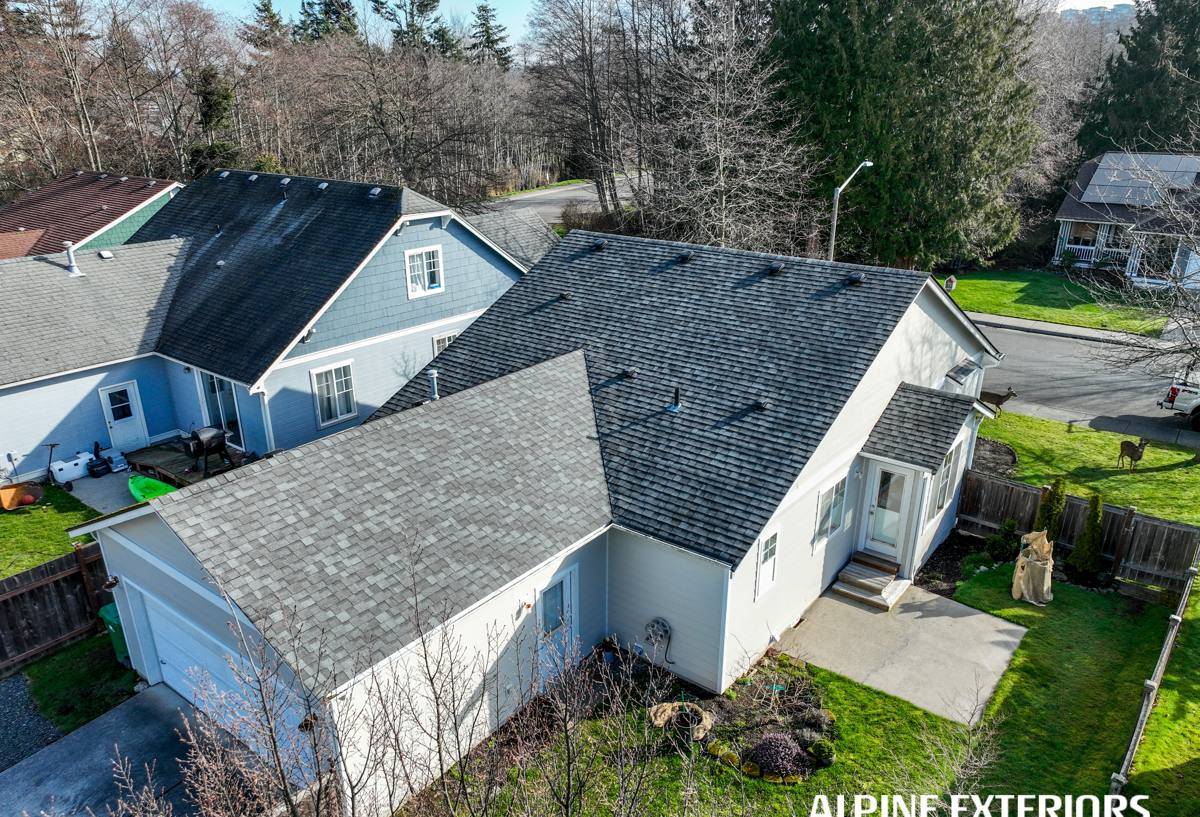
What Salt Air Actually Does to a House
Salt air is corrosive to metal fasteners, flashing, and hardware, and it's abrasive to painted and coated surfaces over time. On siding specifically, salt exposure accelerates the breakdown of paint films and can leave chalking or fading well ahead of schedule on products that weren't engineered for coastal-adjacent exposure. It's also a factor most homeowners never think about until they notice their trim looking tired years before it should.
Where salt exposure shows up first
- Fastener heads and any exposed metal trim or flashing
- South- and west-facing wall sections that catch prevailing wind and moisture together
- Paint and caulk lines around windows and doors
- Deck hardware and any exposed fasteners on outdoor structures
None of this means a house near the water is doomed to look worn out. It means material choice and installation detail matter more here than they would fifty miles inland.
Driving Rain and the Water Management Problem
Whatcom County gets a lot of rain, but the rain that does the real damage isn't the steady, vertical kind — it's wind-driven rain that hits siding at an angle and finds its way behind panels, around window flanges, and into seams that weren't sealed or lapped correctly. This is a water-management problem more than a water-volume problem. A house can handle a wet climate just fine if the siding system, flashing, and window integration are designed and installed to shed water rather than trap it.
That's the detail that separates a siding job that lasts decades from one that starts showing rot and staining within a few years. It's rarely the product alone — it's the flashing behind it, the gaps left for drainage, and whether the crew understood how water actually moves across a wall assembly in this climate.
Common water-entry points we look for on South Hill homes
- Butt joints in old siding that were caulked instead of properly flashed
- Window and door trim where sealant has failed or was never installed with a drainage plane
- Deck ledger boards attached directly to the house without a waterproof membrane
- Roof-to-wall transitions and dormers where flashing is undersized or missing
Moss Season and Why It's Not Just a Roof Issue
Moss gets blamed on roofs, but it doesn't stop at the shingle line in a climate like this. Moss and algae growth on north-facing siding, in shaded wall sections, and along ground-level trim is common in Chuckanut and across this part of Whatcom County wherever moisture lingers and sunlight is limited. On some siding materials, sustained moss and moisture contact leads to swelling, soft spots, or paint failure. On others, it's mostly a cosmetic issue that washes off without lasting damage.
That difference matters a lot when you're choosing what to put on a house that's going to sit under tree cover or face a shaded, damp side yard for half the year. It's one of the practical reasons we standardized on fiber cement rather than wood-based or vinyl siding products for this region — moisture and biological growth don't compromise the material itself the way they can with some alternatives.
Why We Only Install James Hardie Fiber Cement Here
We made a deliberate call as a company to install James Hardie fiber cement siding exclusively — not LP SmartSide, not vinyl, not Cemplank, Allura, primed spruce, or cedar. That's not a brand loyalty thing. It's a response to exactly the conditions described above.
What matters for a South Hill exterior specifically
| Climate Factor | Why It Matters Here | How Hardie Fiber Cement Responds |
|---|---|---|
| Salt air exposure | Accelerates paint breakdown and corrosion on standard finishes | ColorPlus factory-applied finish is baked on and formulated for UV and weather resistance beyond field-applied paint |
| Driving, wind-blown rain | Pushes moisture into seams and behind poorly detailed siding | Non-combustible, dimensionally stable cement composition resists moisture-driven warping and swelling |
| Extended moss/algae season | Sustained dampness can degrade wood-based products | Fiber cement doesn't rot or feed fungal growth the way wood-based siding can |
| Temperature swings | Expansion and contraction stresses joints and fasteners | HZ5 product line is engineered for cold, wet climate zones like ours |
We're upfront that fiber cement isn't the lightest or cheapest material to install, and it requires a crew that knows how to handle it correctly — proper fastening, clearances, and joint treatment matter more with Hardie than with some lighter-weight products. That installation sensitivity is exactly why the crew doing the work matters as much as the material itself.
Roofing, Windows, and Decks: The Same Climate Logic Applies
Siding doesn't work in isolation. A house exterior is a system, and in a climate like this, the roof, windows, and any exterior decking all face the same salt, rain, and moss pressures — just in different forms.
Roofing
Roof valleys, north-facing slopes, and areas under tree cover are where moss takes hold first, and where trapped moisture under moss mats can shorten a roof's service life. Regular inspection and proper flashing at penetrations and transitions matter as much as the shingle product itself.
Windows
Window flashing integration is where a lot of water intrusion problems start, especially on older homes that have been re-sided once or twice without updating the window flashing details. When we replace siding, we treat window integration as part of the water-management plan, not an afterthought.
Decks
Deck ledger connections and any wood-to-house contact points are high-risk for trapped moisture in this climate. Proper flashing, spacing, and material choice at those connections prevent the kind of hidden rot that's expensive to find later.
What a Siding Project Looks Like for a South Hill Home
Every house is different, but the practical process for a full siding replacement in this area generally follows the same shape:
- On-site assessment of existing siding, trim, window flashing, and any moisture or moss damage already present
- Removal of old siding and inspection of the sheathing underneath for hidden rot or water damage
- Repair of any compromised sheathing or framing before new material goes on
- Installation of a proper weather-resistive barrier and flashing details at every window, door, and penetration
- Installation of James Hardie fiber cement panels or planks per manufacturer fastening and clearance specifications
- Final trim, caulking at appropriate joints only, and a walkthrough of the finished work
The step people skip when hiring the wrong contractor is usually step three — what's underneath the old siding. In a climate this wet, that's often where the real problem was hiding the whole time.
Why a Local Crew Matters for This Kind of Work
A contractor who works across Whatcom County regularly, rather than someone traveling in from outside the region, has actually seen how these specific climate conditions play out on real houses over multiple seasons. That matters for judgment calls in the field — how much clearance to leave at grade level on a shaded lot, which flashing details hold up over a decade of driving rain, where moss is likely to become a recurring maintenance issue versus a one-time cleanup.
It also matters for accountability. A local crew is still around next year and the year after if a question comes up about the work.
Get a Straight Answer About Your House
If you're dealing with siding that's showing its age, moss creeping across a shaded wall, or you just want an honest read on what your South Hill home actually needs, we're happy to take a look. There's no pressure and no sales script — just a straightforward assessment and a free estimate based on what we actually see on your house.