 Chuckanut
 Exterior Contractor Serving York
York sits close enough to the water and to Chuckanut's wooded slopes that homes here deal with a specific combination of weather most inland Whatcom County properties don't see the same way: salt-tinged air moving off the water, driving rain that comes in sideways during winter storms, and a moss season that can stretch from October well into spring. None of that is exotic to us. It's the normal working environment for every siding, roofing, window, and deck job we take on in this part of the county, and it's why we build our recommendations around materials and installation details that are actually suited to it, not generic products sold the same way in Phoenix or Denver.
We're a local crew, which matters more here than it does in a lot of trades. Exterior work is not one-size-fits-all — a house facing prevailing weather off the water needs different flashing details and drainage planning than a house tucked into a tree line a half-mile inland. Knowing the difference, because you've worked on both types of homes in the same county, is the actual value a local contractor brings.
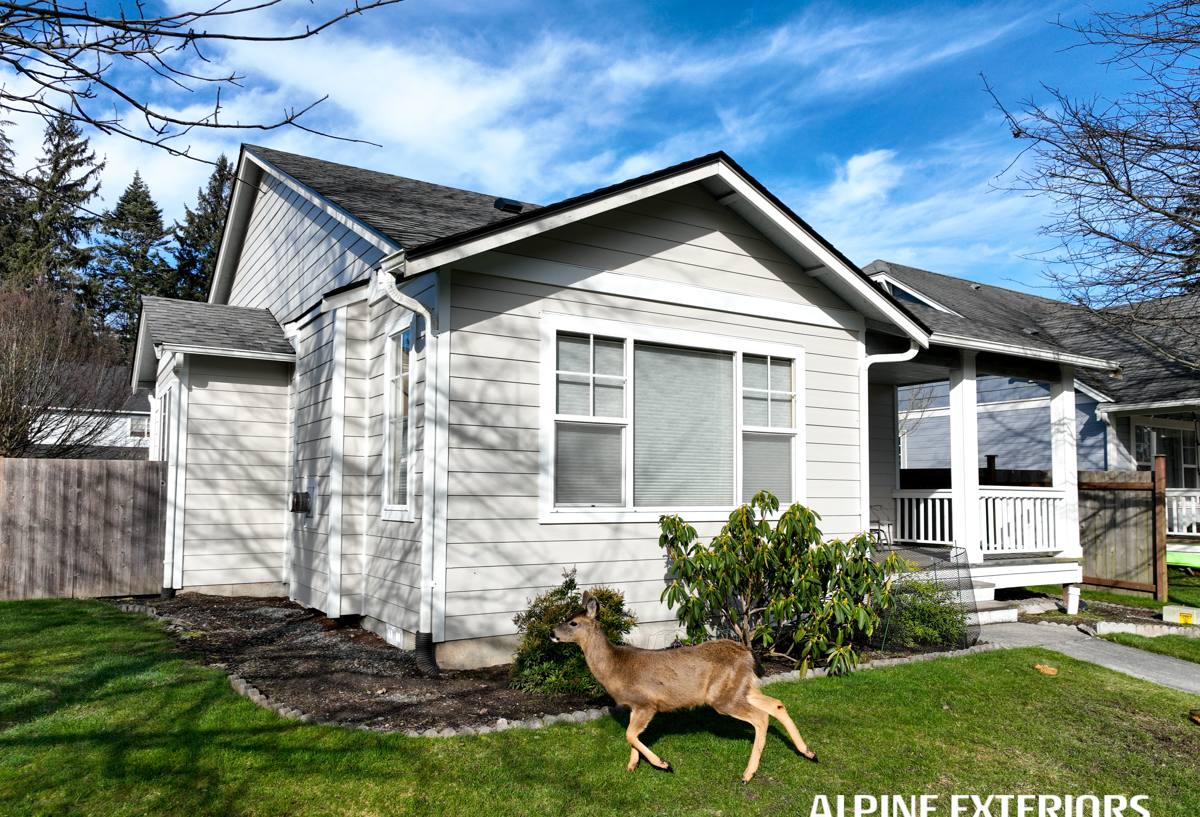
What the Climate Does to a York Home's Exterior
Salt Air
Proximity to salt water accelerates corrosion on anything metal — fasteners, flashing, gutter hardware, even lower-grade hinges and hooks. It also degrades certain paint and coating systems faster than manufacturers' standard weathering estimates assume, because those estimates are usually built around inland test conditions. Siding, trim, and fasteners chosen without salt exposure in mind tend to show their age early: chalking finishes, rust bleed at fastener heads, and premature failure at joints.
Driving Rain
Wind-driven rain doesn't just fall on a wall — it gets pushed sideways and upward into laps, seams, and penetrations that would stay dry in a calmer climate. That's a water-management problem as much as a material problem. Housewrap details, flashing at windows and doors, kick-out flashing at roof-to-wall intersections, and proper caulking practices all matter more here than in drier parts of the state. A product that resists rot but is installed with sloppy water management will still fail — just from moisture intrusion behind the cladding instead of within it.
Moss and Prolonged Dampness
Whatcom County's long wet season keeps roofs, north-facing siding, and shaded deck boards damp for extended stretches. Moss and algae don't just look bad — they hold moisture against the surface underneath them, which shortens the service life of roofing materials and can trap dampness against siding and deck boards long after a storm passes. Homes with heavy tree cover, which describes a lot of properties in and around York, see this more than open lots.
Siding: Why We Install Only James Hardie
We install James Hardie fiber cement siding exclusively. We don't install vinyl, LP SmartSide, Cemplank, Allura, or unfinished wood siding like primed spruce or cedar. That's not a marketing position — it's a standard we hold to because of what we've seen these products do, and not do, in coastal Pacific Northwest conditions over time.
The short version of why
- Vinyl expands and contracts with temperature swings, can distort in heat, and cracks in cold — its seams and J-channels give wind-driven rain an easy path if installation isn't precise.
- Engineered wood siding (LP SmartSide and similar) resists moisture better than raw wood but still relies on wood fiber at its core; any breach in the factory coating or field-cut edge sealing creates a path for the kind of sustained dampness this area produces.
- Primed spruce or cedar looks great on day one but requires ongoing maintenance — repainting, caulk checks, moisture monitoring — that most homeowners underestimate, especially with salt air accelerating coating breakdown.
- James Hardie fiber cement is non-combustible, dimensionally stable across temperature and moisture swings, and comes with a factory-applied ColorPlus finish engineered to hold color and resist the kind of coastal weathering this area produces.
Hardie's HZ5 product line is formulated specifically for climates that see more moisture and freeze-thaw cycling, which fits York's conditions well. The company backs its products with a strong, transferable limited warranty — but that warranty, and the material's real-world performance, both depend on correct installation: proper clearances, fastener patterns, and flashing details. That installation discipline is a bigger factor in how the siding performs over 20-plus years than most homeowners realize going in.
Roofing for Wet, Mossy Conditions
Roofing in this part of Whatcom County has to account for sustained rain volume and the moss and algae growth that comes with shade and dampness. We look at ventilation, underlayment quality, and flashing at valleys, chimneys, and roof-to-wall transitions as closely as we look at the shingle or roofing material itself, because those details determine whether a roof sheds water cleanly or holds it. For homes with heavy tree cover, we also talk through moss-resistant material options and realistic maintenance expectations — moss is manageable, but ignoring it shortens a roof's life.
Windows: Sealing Out Sideways Rain
Wind-driven rain finds weak points at window openings faster than almost anywhere else on a house. Window replacement here is as much about flashing and integration with the water-resistive barrier as it is about the window unit itself. A high-quality window installed with poor flashing will leak; a modest window installed correctly, with proper head flashing and sill pan drainage, generally won't. We size window upgrades around energy performance too — better glazing and frame sealing reduce the drafts and condensation that come with a long, damp winter.
Decks: Built for Standing Dampness
Deck boards in shaded or water-adjacent lots stay damp longer than decks in open, sunny yards, which accelerates rot in lower-grade lumber and holds moss and algae against the surface. Framing details — proper spacing for drainage, ledger flashing where the deck meets the house, and fastener selection resistant to salt-air corrosion — matter as much as the decking material choice itself. We build decks with those realities in mind rather than defaulting to whatever's cheapest at the yard.
What Working With a Local Crew Looks Like
Being local means we're not learning Whatcom County's weather patterns on your house. We've seen how salt air treats exposed fasteners over a few winters, how driving rain finds gaps in flashing that look fine on installation day, and how moss builds up differently on a shaded lot near the trees versus an open one closer to the water. That experience shapes small decisions — fastener spec, flashing sequence, product line selection — that don't show up in a sales brochure but show up in how the exterior performs a decade later.
It also means straightforward communication and accountability. If we tell you a repair versus a replacement, or one product line versus another, the reasoning is specific to your house and this area's conditions, not a generic script.
Cost Factors to Understand Before You Commit
Every exterior project's cost depends on a handful of variables that are worth understanding up front, even before we walk your property and give you specifics.
| Factor | Why It Matters Here |
|---|---|
| Home size and wall complexity | More corners, dormers, and transitions mean more flashing detail work and labor time |
| Existing substrate condition | Hidden moisture damage behind old siding or around old window openings adds repair scope |
| Tree cover and shade | Heavier moss and dampness exposure may call for additional ventilation or moisture-resistant detailing |
| Proximity to water | Greater salt exposure pushes toward corrosion-resistant fasteners and hardware |
| Product line selection | Hardie's HZ5 versus standard lines, and trim/color choices, affect material cost |
| Access and site conditions | Sloped lots, tight setbacks, or limited equipment access affect labor and staging |
Signs Your Exterior Needs Attention
A quick self-check can tell you whether it's time to have someone take a closer look:
- Visible moss or dark streaking on north-facing siding or roof sections
- Rust staining at fastener heads or metal flashing
- Soft spots, bubbling, or peeling paint on wood-based siding
- Drafts, fogging, or visible gaps around window frames
- Deck boards that stay damp long after rain has stopped, or visible surface rot
- Water stains on interior ceilings or walls near exterior walls, a sign of a flashing failure upstream
Any one of these on its own might be minor. Several together usually means water is finding a path somewhere, and it's worth having it looked at before a small repair becomes a larger one.
How We Approach an Estimate
We start with a walk-through of the exterior — siding, roof, windows, and any deck or structural wood — looking specifically for the moisture and wear patterns common to this area: moss accumulation, fastener corrosion, flashing gaps, and substrate condition where siding or trim has been compromised. From there we talk through what we're seeing, what your options actually are (with Hardie fiber cement as our siding recommendation and the reasoning behind it), and give you a straightforward cost picture with no pressure to decide on the spot.
If you're in York or nearby and want an honest look at what your home's exterior needs, we're happy to come out for a free estimate — no obligation, no upsell script, just a clear read on your house and what it would take to get it standing up to the weather here for the long run.