 Chuckanut
 A Company Standard, Not a Sales Pitch
Every siding crew has to decide what they're willing to put their name on. Ours is simple: James Hardie fiber cement, installed to Hardie's specifications, on every home we side. We don't carry vinyl, LP SmartSide, Cemplank, Allura, primed spruce, or cedar on the truck. That's not because those products don't have a place in the market — it's because after years of tearing old siding off homes around Chuckanut and the rest of Whatcom County, we got tired of seeing the same failure patterns, and we decided to stop installing products that invite them.
This page explains the reasoning in plain terms: what fiber cement actually is, what this stretch of coastline does to a house, how Hardie's product lines are engineered for it, and what "correct installation" really means. No hype, no invented numbers — just the honest case for why this is the one material we stand behind.
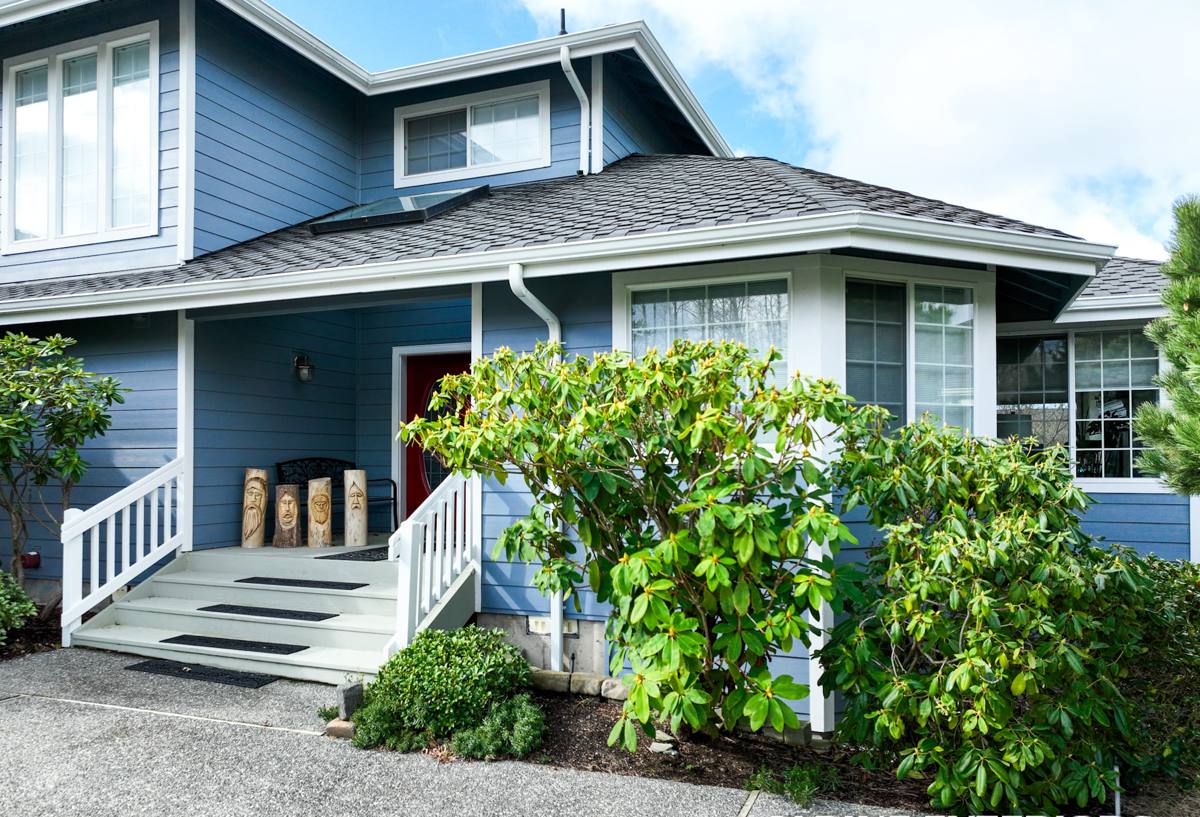
What James Hardie Fiber Cement Actually Is
James Hardie siding is made from a mix of Portland cement, sand, cellulose fiber, and water, cured under pressure and heat. The result is a dense, rigid board that behaves almost nothing like wood or vinyl once it's on a wall:
- It's non-combustible — it won't ignite or contribute fuel to a fire, which matters in a region that has seen more wildfire smoke and dry-season risk in recent years.
- It doesn't rot, delaminate, or feed insects the way wood-based products can when moisture gets behind them.
- It holds its shape in heat and cold far better than vinyl, which softens, warps, and can visibly ripple in direct sun.
- It's heavy and rigid enough to resist the kind of wind-driven impact damage that cracks thinner composite panels.
None of that makes it maintenance-free or foolproof — no siding is. But it gives you a much wider margin for error against the specific conditions this part of Washington throws at a house.
What Chuckanut's Climate Does to a House
Chuckanut sits right where the forested slopes above Chuckanut Bay meet the water, and that combination is tougher on exterior materials than most homeowners realize. Three things stack up here:
Salt Air
Proximity to Samish Bay and the broader Salish Sea means airborne salt is a constant, low-grade presence. Salt accelerates corrosion of fasteners and trim metal, and it degrades cheap paint and coatings faster than inland exposure does. A siding system needs corrosion-resistant fastening and a finish built to hold up under that exposure, not just look good on install day.
Driving Rain
Storms coming off the water don't just fall straight down — wind pushes rain sideways into wall assemblies, especially on gable ends and upper stories with less overhang protection. That means water is testing every seam, joint, and penetration in your siding dozens of times a year, not occasionally.
A Long Moss Season
The dense tree cover along Chuckanut Drive and the surrounding hillsides keeps a lot of siding in permanent shade, and shade plus moisture equals moss and algae growth for a good chunk of the year. Moss holds water against a surface, and a siding material that absorbs or degrades under sustained dampness will show it — cupping, staining, softening — well before a material that doesn't.
Put those three together and you get a climate that punishes siding choices that looked fine in a showroom. It rewards products engineered specifically for wet, coastal, low-light conditions.
Why We Don't Install the Alternatives
Each of these products has legitimate uses elsewhere. Here's the honest trade-off that led us to leave them off our install list for this climate.
Vinyl Siding
Vinyl is inexpensive and low-maintenance in mild, dry climates. But it's a thin plastic product that expands, contracts, and can warp with temperature swings, and it has no real fire resistance. In driving rain it relies almost entirely on a water-resistive barrier behind it doing all the work, since vinyl itself isn't a sealed water barrier — it's designed to shed, not block. Over enough wet seasons on an exposed elevation, that adds up.
LP SmartSide and Other Engineered Wood
Engineered wood siding has improved a lot over the decades, but it's still a wood-fiber product with a resin binder, which means its long-term performance is more sensitive to sustained moisture exposure than fiber cement. In a climate with a real moss season and driving rain, that sensitivity is exactly the wrong trade-off to make.
Cemplank and Allura (Other Fiber Cement Brands)
These are legitimate fiber cement competitors, not inferior materials in a general sense. Our reason for not installing them is narrower and more practical: we've standardized our crews, fastening schedules, and warranty relationships around one manufacturer's system so installation quality stays consistent job to job, and because James Hardie's ColorPlus finish and HZ5 climate engineering are specifically built out for the Pacific Northwest.
Primed Spruce and Cedar
Real wood siding can look excellent, and cedar in particular has a long history in this region. But solid wood requires the most ongoing maintenance of anything on this list — regular repainting or restaining, careful caulking, and vigilance about any spot where moisture sits. Given the moss and rain load around Chuckanut, we don't think it's a fair product to sell homeowners as a low-maintenance long-term siding without heavy caveats, so we don't install it as our standard product.
The Hardie Product Lines We Use
James Hardie makes several distinct products, and matching the right one to the wall is part of doing the job correctly.
HardiePlank Lap Siding
The classic horizontal lap board, available in several exposure widths and textures (smooth, cedarmill). This covers the majority of homes we side.
HardiePanel Vertical Siding
Full sheet panels used for board-and-batten looks, gable accents, or modern vertical facades — often paired with lap siding for visual contrast.
HardieShingle
Staggered or straight-edge shingle panels for homes going for a coastal or craftsman shingle look without the maintenance burden of real cedar shingles.
HardieTrim
Fiber cement trim boards for corners, window and door casing, and fascia — keeping the whole exterior system, not just the field siding, in one consistent, moisture-resistant material.
HZ5 Climate Engineering
James Hardie engineers its products in different formulations for different climate zones. HZ5 is the formulation built for wetter, colder regions like ours, with performance testing specifically around moisture and freeze-thaw cycling — this is what we specify for Chuckanut installs, not a generic national product.
ColorPlus Finish vs. Field-Applied Paint
One of the most underrated parts of the Hardie system is the ColorPlus factory finish. Instead of raw boards painted on-site, ColorPlus boards are baked with a multi-coat finish under controlled factory conditions before they ever reach the job site. That matters for a few concrete reasons:
- Factory-cured finish adheres more consistently than paint applied outdoors in variable temperature and humidity — a real concern during our wetter install seasons.
- The finish carries its own manufacturer warranty separate from the substrate warranty, covering fading and peeling.
- Touch-up paint is color-matched and available for the rare nick or scratch, without repainting a whole elevation.
You can still special-order primed Hardie boards for field painting if a custom color demands it, but for the vast majority of homes, ColorPlus is the better long-term bet, especially given the salt air's effect on lesser coatings.
Installation Is Where Fiber Cement Succeeds or Fails
Fiber cement's biggest weakness isn't the material — it's bad installation. Hardie publishes detailed installation specs, and skipping them is the single most common reason fiber cement siding underperforms:
- Correct fastener type and spacing, driven flush (not overdriven, which crushes the board's edge and creates a moisture entry point).
- Proper clearance from grade, roofing, and decks — Hardie specifies minimum gaps precisely because trapped moisture at these transitions is the top real-world failure point.
- Correct overlap and gapping at butt joints, with the right sealant compatible with ColorPlus finish.
- Flashing integrated correctly at windows, doors, and penetrations — the siding is only one layer of a larger water-management system.
- Painting or caulking any field-cut edges that expose raw substrate.
A crew that cuts corners on any of these can make even the best material perform poorly. That's a large part of why we treat installation training as seriously as material selection.
Warranty: What You're Actually Getting
James Hardie backs its fiber cement substrate with a long-term limited warranty, and ColorPlus finishes carry their own separate coverage for finish integrity. Warranties are also transferable to a subsequent homeowner within the terms of the manufacturer's documentation, which matters for resale value — a buyer's inspector or agent recognizing Hardie siding with an intact warranty is a tangible selling point in this market.
It's worth understanding that manufacturer warranties typically require installation according to Hardie's published instructions to remain valid — another reason installation quality and warranty value are directly linked, not separate issues.
Comparing the Options Honestly
| Material | Moisture Resistance | Fire Resistance | Typical Maintenance | Relative Upfront Cost |
|---|---|---|---|---|
| James Hardie Fiber Cement | High, especially HZ5 | Non-combustible | Low — occasional wash, ColorPlus touch-up | Mid-to-higher |
| Vinyl | Moderate, relies on barrier behind it | Combustible | Low, but can warp/fade | Lower |
| LP SmartSide / Engineered Wood | Moderate, sensitive to sustained wetting | Combustible | Moderate — seam and edge sealing over time | Mid |
| Cedar / Primed Spruce | Lower without diligent upkeep | Combustible | High — regular refinishing | Higher |
These are general, honest comparisons, not a scare campaign — plenty of homes around the country wear vinyl or engineered wood successfully in milder climates. Our point is narrower: given the salt air, driving rain, and moss season specific to Chuckanut and Whatcom County, fiber cement's profile fits this environment better than the alternatives, and that's the standard we chose to build our business around.
Keeping Hardie Siding Looking Right for Decades
Low-maintenance doesn't mean zero-maintenance. A simple annual routine keeps a Hardie exterior performing the way it's designed to:
- Rinse the siding with a garden hose and soft brush once or twice a year, more often on shaded, moss-prone elevations.
- Keep gutters clear so overflow doesn't run down the face of the siding.
- Trim back vegetation and tree cover that keeps a wall permanently damp and shaded — a leading contributor to moss buildup here.
- Inspect caulking at trim joints, windows, and butt joints every couple of years and re-caulk as needed.
- Address any impact damage or exposed edges promptly with color-matched touch-up rather than letting raw substrate sit exposed.
If you're weighing siding options for a home in Chuckanut or elsewhere in Whatcom County, we're happy to walk your property, point out what your specific exposure and shade conditions mean for material choice, and put together a straightforward, no-pressure estimate — no obligation either way.