 Chuckanut
 Water Is the Problem, Not the Weather
Homeowners tend to blame siding failure on "the weather" in general — wind, sun, temperature swings. In Whatcom County, the real culprit is almost always water, and specifically water that gets behind the siding and stays there. Wood and wood-based materials don't rot from getting wet once. They rot from staying wet, cycling between damp and dry, over months and years, in a spot with no way to dry out.
That distinction matters because it changes what you should actually worry about. A house near Chuckanut Bay isn't in danger because it rains here — every house in this region deals with rain. It's in danger when water finds a path behind the cladding and the wall assembly behind it can't shed that moisture faster than it accumulates.
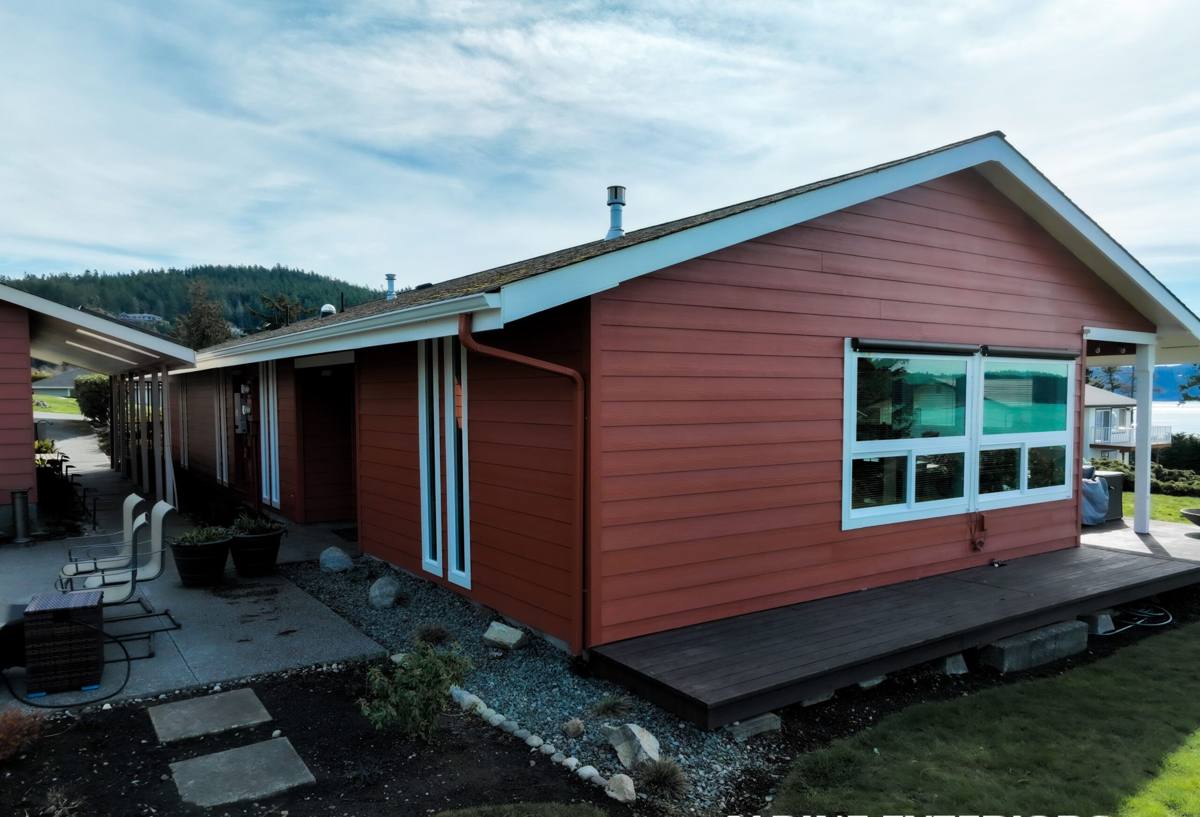
How Water Actually Gets Behind Siding
Rot almost never starts because siding failed to shed rain on its face. It starts at the details — the places where water is directed, trapped, or allowed to sit. The most common entry points we find on this coastline include:
- Butt joints and seams in lap siding that were caulked instead of flashed, and the caulk eventually cracked
- Window and door trim where flashing was skipped or installed backward, letting water run behind the siding instead of over it
- Missing or undersized kickout flashing where a roofline meets a wall, dumping roof runoff straight down the wall cavity
- Deck ledger boards and other penetrations where fasteners created a path through the water-resistive barrier
- Siding installed tight to grade, a walkway, or a deck surface with no clearance to dry
- Nail penetrations driven at the wrong angle or depth, opening a gap around the fastener head
- Old caulk joints at corners and trim that were never maintained and failed years ago, quietly, with no visible sign from the ground
Every one of these is an installation or maintenance issue, not a siding-material issue. That's worth sitting with, because it means the siding material alone can't save a house from bad flashing details — but it can make a real difference in how much damage a small leak does before anyone notices.
Why Chuckanut's Climate Raises the Stakes
Every siding material in the country deals with some moisture exposure. What makes Chuckanut and the rest of Whatcom County tougher on siding is the combination of factors, not any single one:
Salt air. Homes closer to Chuckanut Bay and the Puget Sound shoreline take on airborne salt that accelerates the breakdown of exposed fasteners, caulk, and unprotected wood fiber. Salt-laden moisture doesn't evaporate as cleanly as fresh water, so surfaces stay damp longer.
Driving rain. Storms off the water frequently come in sideways rather than straight down, which pushes water into laps, seams, and trim joints that were only ever designed to handle vertical rainfall. This is the single biggest reason flashing detail quality matters more here than in drier inland climates.
A long moss and mildew season. Whatcom County's mild, wet stretch from fall through spring gives moss, algae, and mildew months to establish themselves on north-facing and shaded siding. Beyond the cosmetic issue, moss holds water against the surface and keeps it from drying between rain events — extending exactly the kind of prolonged dampness that lets rot organisms take hold.
None of this means a house here is doomed to rot. It means the margin for error on flashing, sealing, and material choice is smaller than it would be in Spokane or Bend.
What's Actually Happening Inside the Wall
Wood-destroying fungus needs moisture content in wood to stay above roughly 20% for an extended period. Below that threshold, most fungi can't establish themselves. The trouble is that once water gets behind siding and into sheathing or framing, that wall cavity often has poor airflow and stays above 20% for weeks at a time, especially through a Whatcom County winter.
The damage sequence usually looks like this: water enters at a flashing or fastener failure, soaks into the sheathing or framing behind the siding, and because there's no ventilation gap or drainage plane to let it escape, it just sits there. Fungal growth begins, breaking down the wood's structural fibers. By the time discoloration, soft spots, or a musty smell show up on the interior or exterior finish, the rot has typically been developing for a year or more, out of sight.
This is why rot repair costs so much more than people expect. The visible siding damage is rarely the extent of it — the sheathing underneath, sometimes the framing, and occasionally insulation and interior finishes are affected too.
Early Warning Signs Worth Checking
Most homeowners don't discover rot until it's advanced, simply because they don't know what to look for. A few minutes walking the exterior a couple of times a year can catch problems while they're still cheap to fix.
- Paint or ColorPlus finish that's bubbling, peeling, or discoloring in one localized spot rather than evenly across a wall
- Siding that feels soft or spongy when you press on it, especially near the bottom courses or below windows
- Visible gaps opening up at butt joints, corners, or trim that used to be tight
- A musty or earthy smell near an exterior wall from inside the house
- Dark streaking, moss buildup, or persistent damp patches that don't dry out between rain events
- Warping, buckling, or waviness in the siding profile itself
- Insect activity — carpenter ants and certain beetles are drawn to damp, softened wood
If you find any of these, the next step is a physical check, not a guess. A contractor with a moisture meter can probe suspect areas and tell you whether you're looking at surface staining or an active moisture problem behind the wall.
Not All Siding Materials Handle Moisture the Same Way
Material choice doesn't replace good flashing and installation — but it does change how forgiving the wall assembly is when something inevitably goes slightly wrong over 20 or 30 years of Pacific Northwest weather.
| Material | Moisture behavior | Long-term concern in this climate |
|---|---|---|
| Cedar / primed spruce | Absorbs and releases moisture readily; performance depends heavily on ongoing sealing and paint maintenance | Cupping, splitting, and rot at end grain and fastener points if maintenance lapses |
| Engineered wood (LP SmartSide and similar) | Wood-strand core resists moisture better than raw wood but is still an organic substrate; edges and cut ends are vulnerable if not field-sealed correctly | Swelling and edge deterioration if caulking and touch-up sealing aren't kept current |
| Vinyl | Doesn't absorb water itself, but doesn't manage moisture in the wall assembly either — water that gets behind it can be trapped by the panel | Can mask a moisture problem developing behind it rather than preventing one |
| Fiber cement (James Hardie) | Cement-based composition doesn't swell, rot, or support fungal growth; factory-applied ColorPlus finish resists moisture intrusion at the surface | Still requires correct flashing and a drainage plane — no siding is rot-proof if water is allowed to pool behind it |
The honest takeaway from that table: fiber cement removes the material itself as a moisture-and-rot risk, but it doesn't remove the need for correct installation. That's true of any siding. The difference is what happens when a flashing detail is imperfect or ages over 20 years — an organic substrate behind bad flashing rots; fiber cement behind the same flashing issue is far more likely to simply stay intact while the underlying leak gets found and fixed.
Installation Details That Matter More Than the Brand on the Box
We've said it above and it's worth repeating on its own: the highest-quality siding material installed with poor flashing will still let water into the wall. A few details separate a wall assembly that dries out from one that doesn't:
Drainage plane and rainscreen gap
A properly installed water-resistive barrier behind the siding, ideally with a ventilated gap, gives any water that does get past the cladding a path to drain and air to dry it out rather than sitting against sheathing.
Flashing at every transition
Windows, doors, deck ledgers, roof-to-wall intersections, and horizontal trim all need metal or membrane flashing that directs water outward and downward — not caulk alone, which degrades and cracks over time.
Kickout flashing
Anywhere a sloped roof edge meets a sidewall, a kickout flashing diverts roof runoff away from the wall instead of letting it pour down behind the siding. This single detail is missing on a surprising number of older homes in this area and is one of the most common sources of concentrated, severe rot.
Clearance at grade and hard surfaces
Siding should sit above grade, decking, and roofing with a visible gap — not buried in soil, mulch, or resting on a patio slab where it never fully dries.
What to Do If You Suspect Rot Already
If you're seeing any of the warning signs above, resist the urge to just re-caulk or re-paint over the spot. That treats the symptom and leaves the moisture source in place. A proper assessment involves probing the area with a moisture meter, checking flashing at the nearest window, door, or roofline, and in some cases pulling a small section of siding to look at the sheathing directly. Only after finding the entry point does it make sense to talk about repair versus a broader siding replacement — patching over an active leak just delays and hides the damage.
Why We Install Only James Hardie
This is the reason our company standardized on James Hardie fiber cement and doesn't install vinyl, LP SmartSide, Cemplank, Allura, primed spruce, or cedar. In a climate defined by salt air, driving rain off the water, and a moss season that runs half the year, we want a cladding material where moisture isn't a slow-motion threat to the material itself. Hardie's fiber cement composition doesn't provide food for rot organisms and doesn't swell or delaminate the way organic substrates can. Its factory-applied ColorPlus finish is baked on under controlled conditions, which holds up better against the kind of prolonged damp exposure that breaks down field-applied paint faster. And Hardie's HZ5 product line is engineered specifically for wet, freeze-prone climates like ours.
We still treat flashing, drainage planes, and correct fastening as non-negotiable on every job, because material alone never solves a moisture problem. But when we're deciding what to put on a home that has to survive decades of Whatcom County winters, we want the siding itself working with us, not adding to the risk.
If you're seeing signs of moisture damage, or you just want an honest look at how your current siding is holding up, we're glad to come take a look. Reach out for a free, no-pressure estimate using the form below.