 Chuckanut
 Exterior Work for Homes Along Chuckanut
Larrabee sits in one of the more exposed and beautiful pockets of Whatcom County — tucked along Chuckanut Drive where the forested slopes of Chuckanut Mountain meet the shoreline of Samish Bay. It's a setting most homeowners chose on purpose: big trees, water views, quiet. But that same setting is hard on a house. Homes here take a steady combination of salt-laden air off the bay, driving rain funneled through the gaps in the hillside, and deep shade that keeps north and east-facing walls damp long after a storm has passed. That combination is exactly what shortens the life of ordinary siding, and it's why exterior work in this pocket of the county needs to be approached differently than it would be for a house in a dry, open subdivision twenty minutes inland.
We work this area regularly and size every job — siding, roofing, windows, or decks — around what the Chuckanut corridor actually does to a building envelope over the years, not around a generic spec sheet.
What the Chuckanut Climate Does to a House
Salt Air
Even a few hundred yards from the water, airborne salt settles on exterior surfaces and accelerates corrosion on fasteners, flashing, and any siding product that isn't built to resist it. Over time it also breaks down paint films faster than inland exposure would, which shows up as chalking, fading, and peeling well ahead of a product's rated repaint interval.
Driving Rain
Chuckanut Drive's terrain — steep slopes dropping to the water — creates wind patterns that drive rain sideways into wall assemblies rather than letting it fall straight down and shed off. Siding, trim, and window flashing all take more direct water intrusion here than they would on a flatter, more sheltered lot, which raises the stakes on installation detail: laps, caulk joints, and flashing sequencing have to be right, because water will find any shortcut.
Moss and Shade
Tree cover keeps a lot of Larrabee's roofs and north walls in shade for large stretches of the year. Combined with the region's long wet season, that shade means moss and algae get a real head start on any surface that stays damp — roofing especially, but also siding on the shaded side of a house, decks under tree canopy, and window sills that don't get enough sun to dry out between rains.
None of this is unusual for the area — it's simply what building here involves. The point of good exterior work is designing and installing for it, not hoping the weather cooperates.
Why We Install Only James Hardie Fiber Cement
We made a decision as a company to install James Hardie fiber cement siding exclusively — not LP SmartSide, not vinyl, not Cemplank or Allura, not primed spruce or cedar. That's not a marketing position; it's a practical one, built around what holds up in exactly the conditions Larrabee homes face.
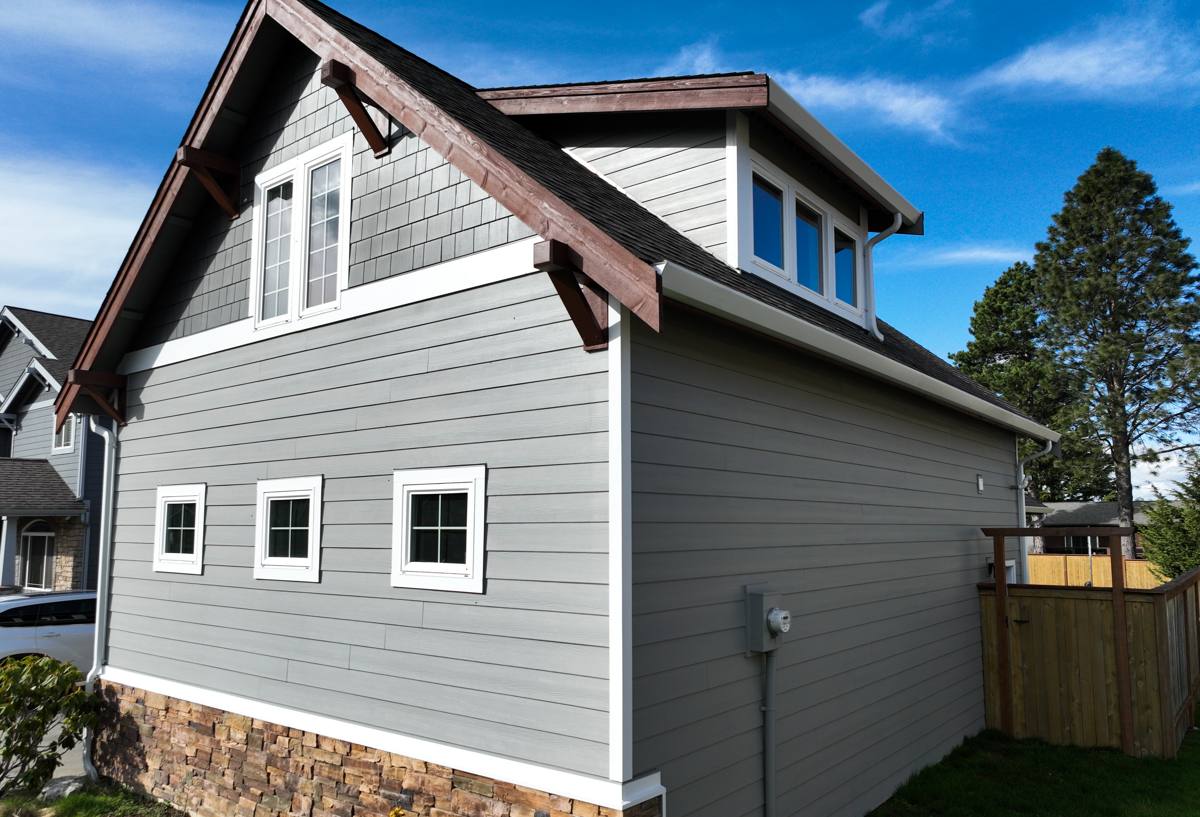
Fiber cement is non-combustible, which matters increasingly across Western Washington. It doesn't feed moisture into engineered wood substrates the way wood-based composite sidings can if a seam or cut edge is left exposed to weather. James Hardie's ColorPlus finish is factory-applied and baked on under controlled conditions, which gives it better fade and adhesion performance in salt-air, high-UV, and heavy-rain exposure than most field-applied paint systems achieve — an advantage that matters more here than in a dry inland climate. Hardie also engineers regional product lines (HZ5, for example) specifically for climates with heavy moisture exposure, and backs the product with a strong, transferable limited warranty.
That doesn't mean other products are without merit — vinyl is inexpensive and low-maintenance in mild climates, and engineered wood sidings have real strengths on the right project. But for the specific combination of salt air, wind-driven rain, and shade this stretch of coastline delivers, we've seen enough real-world performance differences to standardize on one product system rather than install something we'd be hesitant to warranty in these conditions.
How Siding Options Compare for a Site Like This
| Material | Salt Air / Moisture Resistance | Maintenance | Fire Resistance | Typical Warranty Structure |
|---|---|---|---|---|
| James Hardie Fiber Cement | Engineered for heavy-moisture regions (HZ5) | Low — factory finish, occasional wash | Non-combustible | Strong, transferable limited warranty |
| Vinyl | Doesn't rot, but can warp/fade with UV and temperature swings | Low, but color fades over time | Combustible, can deform in heat | Varies widely by manufacturer/grade |
| LP SmartSide / Engineered Wood | Vulnerable at cut edges and seams if not sealed and maintained | Moderate — needs field-painted seams monitored | Combustible | Often conditional on maintenance schedule |
| Cedar / Primed Wood | Absorbs moisture, prone to rot and moss in shaded, damp exposure | High — regular repainting and sealing | Combustible | Typically product-only, not workmanship |
Beyond Siding: Roofing, Windows, and Decks
Most of the homes we work on in the Larrabee area need more than one system addressed at the same time, since roofing, siding, windows, and decks all take the same weather and often show wear together.
Roofing
Shaded roof planes here hold moss and organic debris longer than sun-exposed roofs elsewhere in the county, which accelerates granule loss and can back water up under shingles at valleys and eaves. Good flashing detail at penetrations and valleys matters as much as the roofing material itself.
Windows
Wind-driven rain puts real pressure on window flashing and the seal between the window unit and the wall assembly. Older windows in this area often show water staining or soft trim below the sill — usually a flashing or sealant failure rather than a problem with the window itself, but it's worth having checked whenever siding comes off a wall.
Decks
Decks under tree canopy see slower drying between rains, which speeds up moss growth and, on wood decking, rot at fastener points and board ends. Material choice and airflow underneath the deck both make a real difference in how long a deck stays sound in this kind of exposure.
Because we handle all four trades, we can look at a Larrabee home's exterior as one connected system — siding, roof edges, window flashing, and deck ledger connections all interact, and a weakness in one often shows up as damage in another.
What Working With a Local Crew Looks Like
A crew that works Whatcom County regularly already knows how this corridor behaves — where wind-driven rain tends to concentrate, which orientations hold moss longest, what kind of flashing detail actually holds up here versus what looks fine on paper. That local knowledge shows up in small decisions during a project: how laps are shingled, where extra flashing gets added even if it's not strictly required, how a crew sequences work around the area's rain patterns instead of guessing.
It also matters for warranty support after the job is done. A crew based in the region is available to come back and look at something years later, not just during the install.
A Practical Checklist Before You Hire for Exterior Work in Larrabee
- Ask what siding product line is being installed and whether it's rated for coastal or high-moisture exposure
- Confirm who is responsible for flashing at windows, doors, and roof-to-wall transitions — this is where most water intrusion starts
- Check whether the contractor carries manufacturer certification for the siding system they're proposing
- Ask how the crew handles moss and shade exposure differently on north-facing versus south-facing walls
- Get a clear answer on warranty structure — product warranty versus workmanship warranty are not the same thing
- Walk the property and ask the contractor to point out specific problem areas they see, not just a general estimate
Maintenance Realities for This Climate
Even the best siding product benefits from basic upkeep in a climate like this. James Hardie's factory finish reduces the maintenance burden significantly compared to field-painted products, but a Larrabee home still benefits from an occasional gentle wash to keep salt residue and organic buildup from accumulating, and from keeping gutters and downspouts clear so water isn't sheeting down wall surfaces during heavy rain events. Trimming back vegetation that keeps a wall shaded and damp also goes a long way toward slowing moss growth, on siding, trim, and roofing alike.
None of this is heavy maintenance — it's the kind of periodic attention that makes sense for a coastal, tree-covered lot, and it's a lot less than what wood or engineered-wood siding would ask for in the same conditions.
Planning a Project in Larrabee
Whether you're dealing with siding that's showing its age, a roof that's holding moss longer each year, windows with signs of water intrusion, or a deck that needs attention before another wet season, it helps to have someone look at the whole exterior rather than just the one visible problem. Conditions here tend to affect more than one system at a time, and catching a flashing or drainage issue early is a lot less costly than repairing the damage it eventually causes.
If you'd like a second opinion on your home's exterior or a straightforward estimate for siding, roofing, window, or deck work in the Larrabee area, we're glad to come take a look — no pressure, just an honest assessment of what your home actually needs. There's a form below to get that started.