 Chuckanut
 Exterior Work Built for Blanchard's Climate
Blanchard sits in that stretch of Northwest Washington where the terrain does a lot of the talking — timbered hillsides, close proximity to saltwater, and weather that rolls in off the water and gets funneled and squeezed by the surrounding high ground. Homes out here don't face the same conditions as a house in a dry inland valley. They face salt-laden air, driving rain that comes in sideways during a fall or winter blow, and a moss season that can run most of the year in the shadier spots. If you own a home in or near Blanchard, your siding, roof, windows, and decks are working harder than the manufacturer's spec sheet usually assumes.
We're a local exterior contractor serving the Chuckanut and greater Whatcom County area, and Blanchard is part of our regular service territory. That matters more than it sounds like it should. A crew that shows up once from out of the area doesn't know which side of your house takes the worst of the weather, doesn't know how the moisture behaves under your specific tree cover, and won't be around in three years if a flashing detail needs a second look.
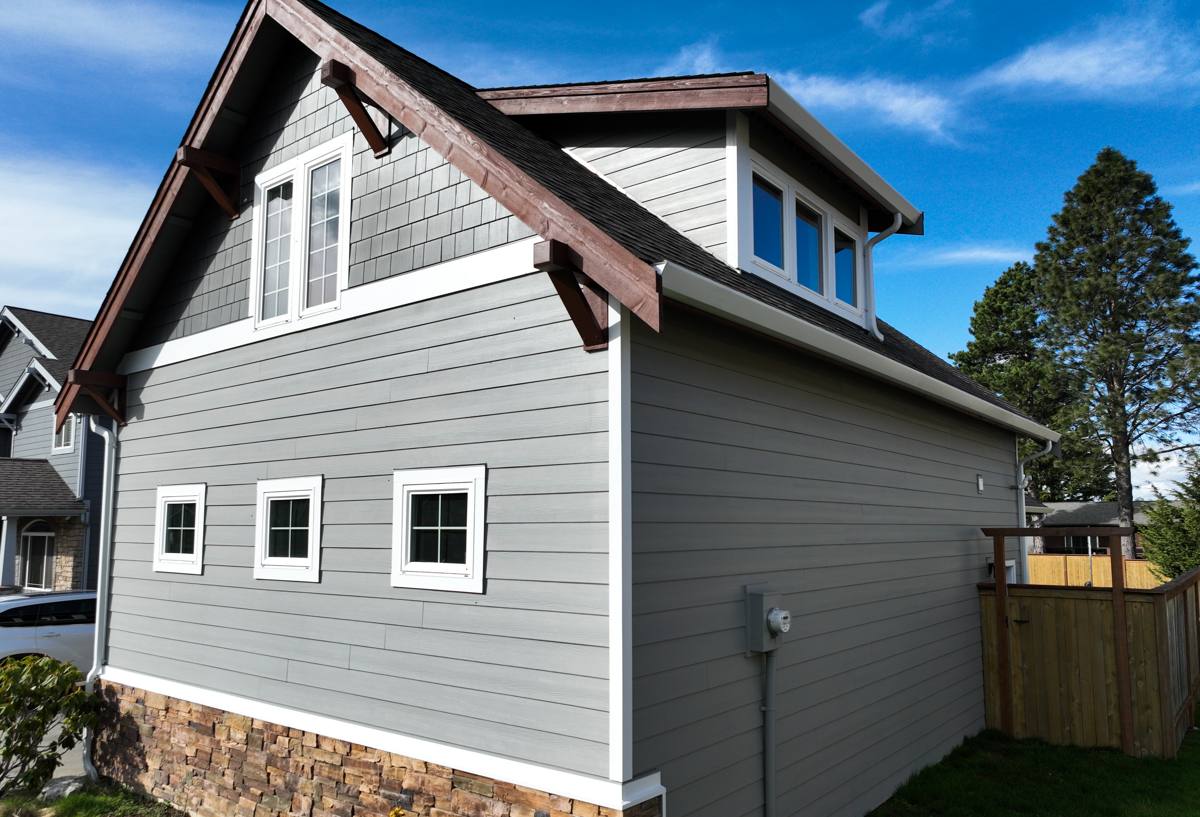
What the Local Climate Does to a House
Salt Air and Corrosion
Even a few miles inland from the water, salt-bearing air travels on the wind and settles on exterior surfaces. Over years, it accelerates corrosion on fasteners, hardware, and any exposed metal trim. It also breaks down certain paints and coatings faster than a manufacturer's warranty documentation assumes for a "typical" climate zone. Materials and finishes rated for average conditions often underperform here — not dramatically, but enough that a homeowner notices premature fading, chalking, or rust bleed at fastener heads a few years earlier than expected.
Driving Rain and Wind-Driven Moisture
This part of Washington doesn't just get rain — it gets rain pushed sideways by wind, especially during fall and winter storm systems moving through the Chuckanut corridor. Wind-driven rain finds every gap in flashing, every under-caulked joint, and every piece of siding that wasn't lapped correctly. It's a different stress than a straight-down rain, and it's the reason flashing details and water management planes matter as much as the siding material itself.
Moss, Mold, and Shade
Wooded lots and homes tucked under tree canopy — common around Blanchard — stay damp longer after a storm than a home in the open. Less direct sun means slower drying, and slower drying means moss and mold get a longer window to establish themselves on roofing, siding, and deck surfaces. This is less about any one product failing and more about the site conditions: shade plus moisture plus time equals biological growth, on almost any exterior material if it isn't detailed and maintained correctly.
Why We Only Install James Hardie Fiber Cement Siding
We made a decision as a company to install James Hardie fiber cement siding exclusively — not vinyl, not LP SmartSide, not Cemplank, not Allura, not primed spruce or cedar. That's not a marketing angle; it's a standard we hold because of what we've seen play out on homes in exactly this kind of climate over time.
- Non-combustible core. Fiber cement doesn't contribute fuel to a fire the way some wood-based or engineered-wood products can, which matters for insurance conversations and long-term peace of mind.
- Moisture resistance by design. Hardie's fiber cement formulation is engineered to resist swelling, rot, and moisture-driven degradation in a way that wood-based composite sidings, by their nature, are more vulnerable to.
- ColorPlus factory finish. The factory-applied finish is baked on under controlled conditions, which gives more consistent color retention and adhesion than field-applied paint — especially relevant where UV and salt air both work against a coating.
- Climate-engineered HZ product lines. Hardie makes region-specific formulations (HZ5 for colder, wetter climates) rather than a one-size-fits-all product, which lines up with what this area actually experiences.
- A strong, transferable warranty backed by a manufacturer with decades of fiber cement manufacturing behind it.
We're not saying every other product on the market is without merit — vinyl, LP SmartSide, and wood siding all have legitimate uses and loyal installers. We're saying that for the specific combination of salt air, wind-driven rain, and shaded, slow-drying lots common around Blanchard, we decided fiber cement done right is the standard we're willing to put our name behind.
Siding Installed to Actually Perform Here
Material choice is half the equation. Installation is the other half, and it's where a lot of exterior problems actually originate — not from the siding itself, but from shortcuts in the water management details behind it.
What Correct Installation Involves
- A properly lapped weather-resistive barrier behind the siding, not just a stapled-up housewrap
- Correct flashing at every window, door, and roof-to-wall transition — the places wind-driven rain actually gets in
- Manufacturer-specified fastener spacing, type, and penetration depth (under- or over-driven nails are a common cause of early siding failure)
- Proper clearance at grade and at horizontal trim to keep the bottom edge of the siding from sitting in standing moisture
- Caulking and sealant only where Hardie's installation instructions call for it — over-caulking traps moisture just as badly as under-caulking lets it in
We follow James Hardie's published installation specifications closely, because that's also what keeps their product warranty valid. A beautiful siding job that voids the manufacturer's warranty because of a fastener shortcut isn't a good outcome for anyone.
Roofing, Windows, and Decks — The Rest of the Envelope
Siding doesn't work in isolation. It's one piece of a building envelope that includes your roof, windows, and any exterior decking, and in a climate like this, all four need to work together.
Roofing
Roofs here deal with the same wind-driven rain and moss pressure as siding, plus the added stress of standing water at low-slope transitions and valleys. Flashing quality and ventilation matter as much as the roofing material choice.
Windows
Old or poorly flashed windows are one of the most common points of water intrusion we find during siding replacement. If a window's flashing has failed, new siding installed around it just hides the problem instead of solving it — which is why we check window flashing as part of any siding project.
Decks
Exterior decks in shaded, damp lots take the brunt of moss and mildew growth. Proper board spacing, ledger flashing, and drainage underneath the deck structure all reduce how fast that growth comes back after cleaning.
Comparing Siding Options for This Climate
| Material | Moisture Behavior | Maintenance | Typical Lifespan Here |
|---|---|---|---|
| James Hardie Fiber Cement | Engineered resistance to moisture and rot; HZ5 formulation for wet climates | Occasional wash; factory finish holds color well | 30+ years with correct install |
| Vinyl Siding | Doesn't rot but can warp, crack, or gap in wind-driven rain and temperature swings | Low, but damage often means panel replacement, not repair | 20-30 years, variable |
| LP SmartSide / Engineered Wood | Wood-based core is more moisture-sensitive; edge sealing is critical | Moderate — edge and joint inspection matters | 20-30 years if maintained closely |
| Cedar / Primed Spruce | Natural wood; absorbs and releases moisture, prone to rot without upkeep | High — regular refinishing and inspection | 15-25 years depending on care |
These are general tendencies, not guarantees — installation quality and site conditions (shade, drainage, exposure) shift these numbers in either direction for any material.
Why a Local Crew Matters in Blanchard
A crew that works this area regularly builds up a working knowledge of the details that don't show up in a manufacturer's install guide — which sides of a house catch the worst wind-driven rain, which lots hold moisture longest under tree cover, and which older homes in the area were built with details that need extra attention during a re-side. That knowledge comes from being local, not from a sales brochure.
It also matters for warranty and service. If a question comes up two or three years after installation, you're calling a company that's still working in your neighborhood, not chasing down a crew that came through once from out of town.
A Simple Pre-Project Checklist for Homeowners
- Walk your exterior after a heavy rain and note any spots where water pools or drains slowly
- Check for moss or dark streaking on siding, roofing, or deck surfaces, especially on shaded sides
- Look at caulking and trim joints around windows and doors for cracking or gaps
- Note any soft or discolored siding, which can indicate moisture getting behind the surface
- Ask any contractor you're considering which specific product lines they install and why
Getting Started
If your home in Blanchard is due for new siding, a roof, replacement windows, or deck work, we're happy to take a look and talk through what your property specifically needs — no pressure, no scare tactics about the products we don't install. Reach out for a free estimate and we'll walk the exterior with you and give you an honest read on where things stand.