 Chuckanut
 Fairhaven sits close enough to the water that its houses live with salt air, wind-driven rain, and shade year-round in a way that inland Whatcom County neighborhoods don't. If you own a home here, you already know the signs: paint that gives out early, north-facing walls that never quite dry out, trim that goes soft at the corners. Siding in this part of Chuckanut and greater Bellingham has to do more work than siding somewhere drier, and it shows in how fast the wrong product fails and how well the right one holds up.
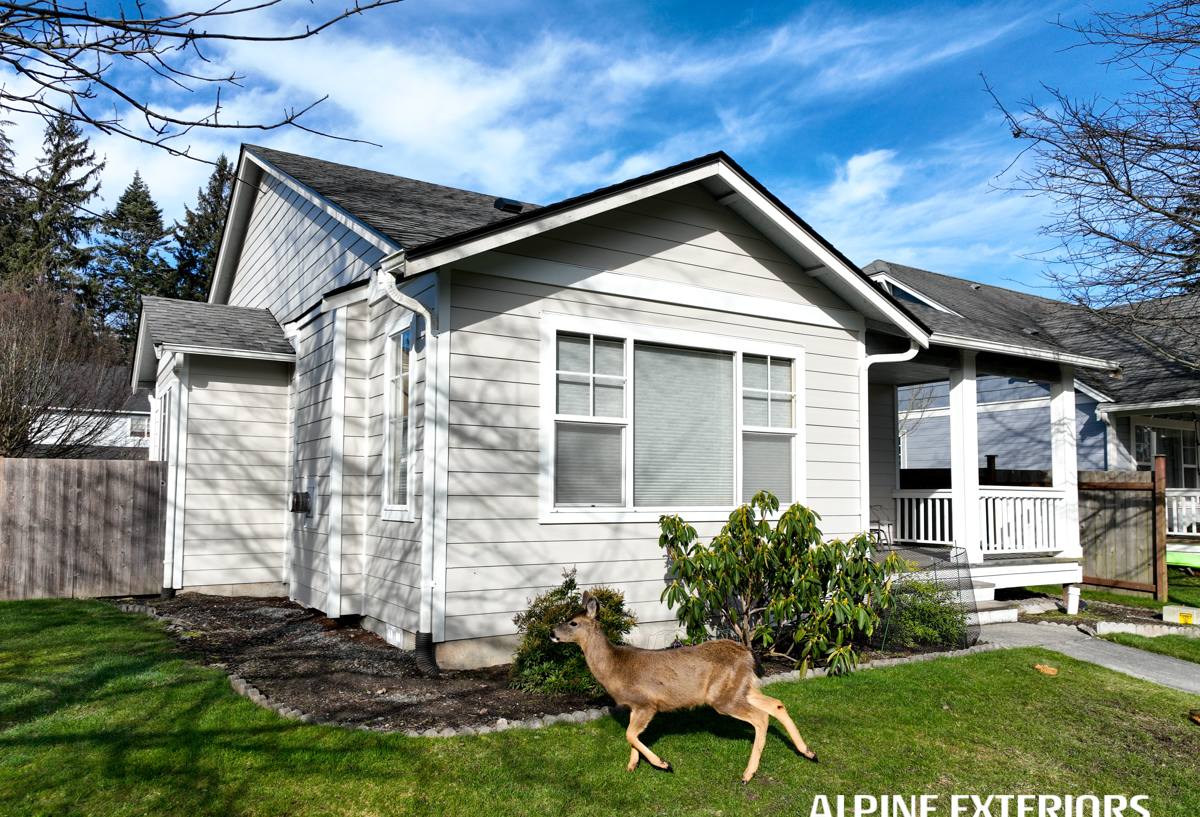
We install James Hardie fiber cement siding exclusively — no vinyl, no LP SmartSide, no cedar, no primed wood. That's not a marketing angle, it's a standard we hold because we've seen what this climate does to the alternatives over a full ownership cycle, not just the first few years.
What Fairhaven's Climate Does to a House
Three things define the exterior environment here, and they compound each other:
Salt-laden air
Proximity to Bellingham Bay means airborne salt settles on every exterior surface. Salt is hygroscopic — it pulls moisture out of the air and holds it against whatever it's sitting on. On bare or poorly sealed wood trim, that means slower drying and faster rot at fastener points and end grain. On metal fasteners and flashing, it accelerates corrosion if the wrong hardware was used to begin with.
Driving rain
Storms coming off the Strait push rain sideways, not straight down. That matters because most siding failures aren't caused by water landing on a wall — they're caused by water getting driven behind laps, around trim, or into seams that were never designed to shed rain hitting them at an angle. A house here needs cladding and flashing details that assume wind-driven water, not just gravity.
Shade and moss
Mature trees and marine cloud cover keep a lot of Fairhaven's north and west walls damp well into the afternoon, most months of the year. That extended dampness is exactly what moss, algae, and mildew need to establish themselves on a wall surface. Once organic growth takes hold on a porous or absorbent material, it holds even more moisture against the substrate underneath — a cycle that gets worse each season it's left alone.
Why We Don't Install Vinyl, LP SmartSide, or Cedar Here
Every siding product has a use case somewhere. In Fairhaven's specific combination of salt, wind-driven rain, and shade, each of the common alternatives has a real weakness worth being honest about:
- Vinyl expands and contracts with temperature swings and can warp or pull away from fastening points over time, opening gaps that let wind-driven rain track behind the panel. It also doesn't hold paint, so a homeowner is stuck with whatever color it shipped in as it fades.
- LP SmartSide is an engineered wood product — it performs well when installation and caulking are kept up perfectly, but any breach in the factory coating exposes wood fiber that swells and deteriorates faster in a damp, shaded, salt-air environment than in a drier climate.
- Cedar is a beautiful, honest material, but it's also organic — it's the literal food source for the moss and mildew this area produces in abundance. Keeping bare or lightly finished cedar looking good here means a real, ongoing maintenance commitment: cleaning, re-staining, and watching for soft spots.
We're not saying these products are junk — we're saying that after installing and later repairing all of them, we standardized on the one product line that holds up here with the least maintenance and the fewest callbacks.
Why James Hardie Fiber Cement Fits This Property
James Hardie siding is a cement-based composite, not wood and not vinyl. That distinction matters directly for the three climate stressors above:
- It doesn't feed organic growth. Fiber cement isn't a food source for moss or mildew the way wood is, so growth that does land on the surface sits on top of it rather than into it, and washes or brushes off much more easily.
- It handles moisture cycling without warping. Fiber cement is dimensionally stable across wet and dry cycles, which matters on walls that stay damp for extended stretches under tree cover or on the shaded side of a house.
- ColorPlus factory-applied finish is baked on under controlled conditions and is more resistant to fading and moisture intrusion at the finish layer than field-applied paint on wood or the color-through-the-panel approach of vinyl.
- HZ5 formulations in Hardie's product line are engineered specifically for wetter, harsher climates like the Pacific Northwest coast — this isn't a general-purpose product retrofitted for our conditions.
How Correct Installation Protects Against Wind-Driven Rain
Fiber cement only performs as well as its installation. In a wind-driven-rain environment like Fairhaven, a few details separate a wall system that sheds water for decades from one that traps it:
Water-resistive barrier and flashing
A continuous, properly lapped weather barrier behind the siding, with flashing integrated at every window, door, and penetration, gives incidental water a path down and out instead of a place to pool.
Rainscreen gap
A small airspace between the siding and the wall assembly lets any moisture that does get past the cladding drain and dry out, rather than sitting against the sheathing. This is especially valuable on the shaded, slower-drying elevations common in Fairhaven's tree cover.
Fastener and joint detailing
Correct fastener spacing, caulking at butt joints, and manufacturer-specified clearances at grade and roof lines keep the panel system doing what it's engineered to do. Skipping these details is the single most common cause of premature siding failure we see on repair calls, regardless of the product installed.
What a Siding Project Looks Like Here
| Stage | What Happens | Why It Matters in This Climate |
|---|---|---|
| Inspection | Assess existing siding, trim, and sheathing for hidden moisture damage | Salt air and shade can mask rot behind an intact-looking surface |
| Prep & barrier | Remove old cladding, repair sheathing, install weather barrier and flashing | This is the layer that actually stops wind-driven rain intrusion |
| Siding install | Hardie panels, planks, or shingle-style siding per manufacturer spec | Correct fastening and gapping prevent the failures we see on unmaintained homes |
| Trim & sealing | Factory-finished trim, caulking at joints and penetrations | Closes the entry points salt-laden moisture would otherwise use |
| Final walk-through | Review with homeowner, confirm warranty registration | Documents the installation for the transferable warranty |
Roofing, Windows, and Decks in the Same Environment
Siding doesn't work in isolation — the same salt air, rain, and shade affect every other exterior system on a Fairhaven home, so we look at the whole envelope, not just one component.
Roofing
Moss on a roof isn't just cosmetic; retained moisture under moss growth shortens the life of roofing material and can back up water at flashing points. Roof and siding flashing details need to work together, especially at wall-to-roof transitions.
Windows
Window flashing integration is one of the most common failure points we find during siding tear-offs. If windows are original to an older home, a siding project is often the right time to address flashing or consider replacement units while the wall is open.
Decks
Decks facing the water or sitting under tree cover deal with the same moisture and moss exposure as walls, just horizontally, which tends to accelerate wear on fasteners and structural framing if not addressed.
Why a Local Crew Matters
A crew that works Chuckanut, Bellingham, and the rest of Whatcom County regularly knows which walls on a given lot orientation stay damp longest, where moss pressure is worst, and how local wind patterns drive rain into a wall assembly. That's knowledge you build from repeat jobs in the same conditions, not from a general specification sheet. It also means someone is reachable locally if a warranty question or maintenance question comes up years down the road, rather than a phone number that traces back to a franchise office somewhere else.
Simple Maintenance Checklist for Fairhaven Homes
- Rinse siding annually, focusing on shaded north and west walls where moss pressure is highest
- Keep gutters clear so overflow doesn't run down and saturate wall sections below
- Trim back vegetation that keeps a wall surface shaded and slow to dry
- Inspect caulking at trim joints and window edges every couple of years
- Address any soft trim or discoloration early — moisture problems in this climate compound quickly if ignored
Warranty and Long-Term Value
James Hardie backs its siding with a strong, transferable limited warranty, which matters both for your own peace of mind and for resale — a documented, professionally installed Hardie exterior is a selling point in a market where buyers are increasingly aware of what coastal exposure does to lesser materials. Between the product warranty and our own installation standards, a Hardie exterior on a Fairhaven home is built to be a long-term answer, not a five-year fix.
If you're weighing a siding, roofing, window, or deck project on a Fairhaven property, we're happy to walk the exterior with you and give you a straight assessment — no pressure, no obligation. Fill out the form below to schedule a free estimate.