 Chuckanut
 Larrabee's Terrain Puts Extra Demands on a House's Skin
Homes around Larrabee sit in a stretch of Whatcom County where Chuckanut Bay's salt air meets thick tree cover and steep, shaded lots. That combination is harder on exterior siding than most inland neighborhoods ever see. Salt-laden air corrodes fasteners and finishes over time, the surrounding evergreens keep large sections of a home's exterior in shade for most of the day, and driving rain off the water tends to hit walls at an angle rather than straight down. Any siding material installed here has to handle all three conditions at once, not just one of them.
Board and batten siding — vertical boards with narrow strips (battens) covering the seams — has real advantages in this setting when it's built and installed correctly. It also has real failure points when it isn't. This page focuses specifically on what that looks like for Larrabee properties, not board and batten in general.
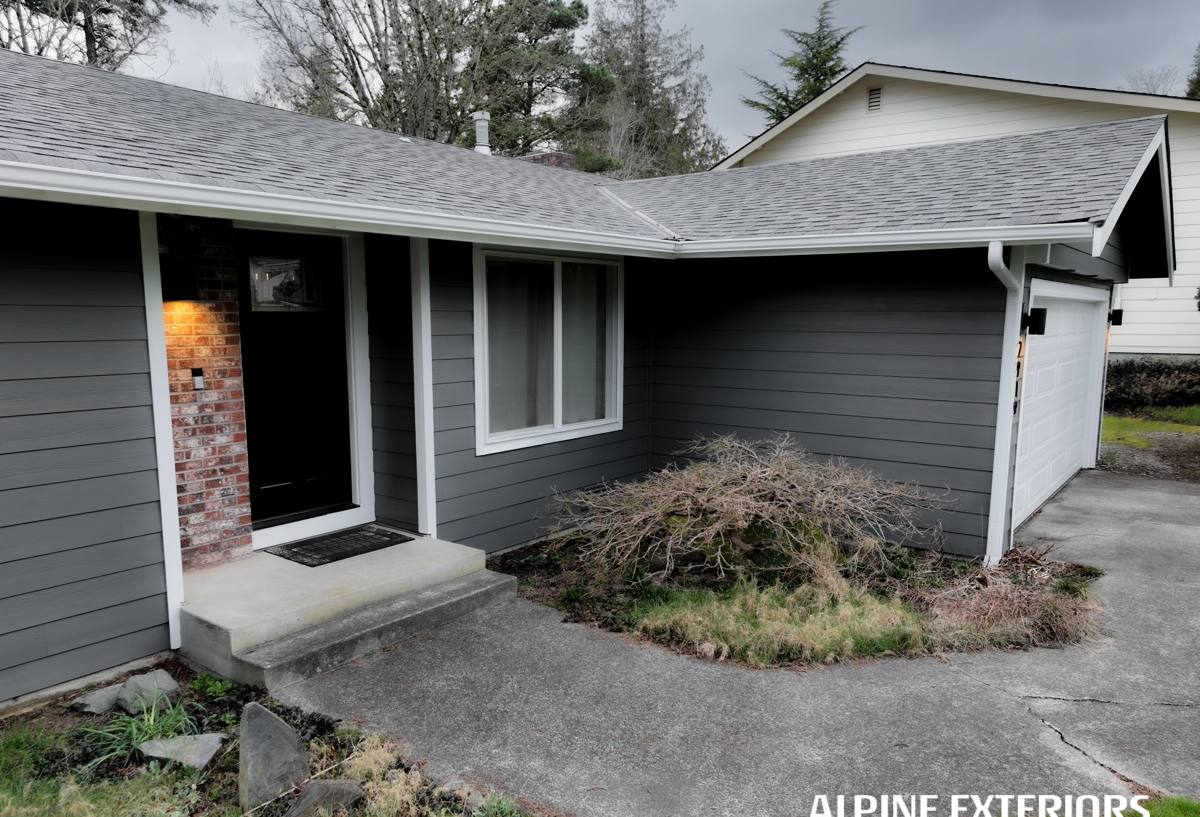
Why Board & Batten Fits This Kind of Site
The vertical lines of board and batten siding shed water down and off the wall rather than letting it pool along horizontal laps, which matters on a home that catches driving rain from the bay. It's also a style that reads well against the wooded, semi-rural character of Larrabee — a lot of homes in this pocket of the county lean toward a craftsman or modern-farmhouse look, and vertical siding suits that better than traditional lap siding.
The style also has a practical upside on shaded lots: because the battens create a rhythm of raised and recessed surfaces, minor color or texture variation from moss growth or mildew is far less visible than it would be on a flat lap profile. That doesn't mean the siding is immune to moss — it means the material and finish underneath the battens have to be chosen specifically to resist it, which is where the material decision becomes the whole ballgame.
The Three Climate Factors We Design Around
Salt Air
Proximity to Chuckanut Bay means airborne salt settles on siding, trim, and especially fasteners. Untreated or lightly coated steel fasteners corrode faster here than they would ten miles inland, and corroding fasteners are one of the most common causes of premature siding failure — streaking, loosening boards, and rust bleed through paint. Every fastener we use on a Larrabee job is chosen with that exposure in mind.
Driving Rain
Wind off the bay drives rain sideways into walls rather than letting it fall straight down, which pushes water into seams, laps, and penetrations that a calmer climate wouldn't test as hard. This is a water-management problem as much as a material problem — flashing details, house wrap integration, and batten spacing all matter more here than they would in a drier part of the state.
Moss Season
Heavy tree cover means long stretches of shade, damp bark debris, and slow-drying wall surfaces — ideal conditions for moss and algae growth on siding that doesn't have a factory-cured, moisture-resistant finish. Moss season in this area isn't a short window; on north-facing and heavily shaded walls it's close to year-round.
What a Correct Board & Batten Job Actually Involves
Substrate and Water Barrier
Before a single board goes up, the wall needs a continuous weather-resistive barrier with properly lapped and taped seams, and flashing at every window, door, and penetration that directs water out and away from the sheathing. On a driving-rain site like Larrabee, this layer is doing as much work as the siding itself — a beautiful board and batten job over a poorly detailed water barrier will still leak.
Batten Spacing and Fastening
Battens need consistent spacing that matches the underlying board layout, and fasteners have to land in solid backing at the correct depth — too shallow and boards work loose in wind, too deep and you crush the fiber cement and create a moisture entry point. We use fasteners rated for coastal/corrosive exposure rather than standard-grade hardware, specifically because of the salt air here.
Joints, Corners, and Clearances
Every board-to-board joint, inside and outside corner, and bottom termination point is a place water can get behind the siding if it's not detailed correctly. Board and batten siding also needs proper clearance off decks, patios, and grade — a common mistake on shaded, damp lots is running siding too close to the ground or a hardscape surface, which traps moisture against the bottom edge and accelerates moss and rot at exactly the point where it's hardest to inspect.
Finish
The factory finish on the boards matters more here than almost anywhere else in the county, because it's fighting salt exposure and constant shade-driven moisture at the same time. A finish that's only rated for general exterior use will chalk, fade, or grow moss faster on a Larrabee lot than the same product would on an open, sunny site.
Material Comparison for This Site
We install James Hardie fiber cement exclusively, and on a site with salt air, driving rain, and heavy shade, the material choice has more real consequences than usual. Here's an honest look at how the common board and batten materials hold up under these specific conditions:
| Material | Salt air / fastener corrosion | Moisture behavior in shade | Moss/algae resistance |
|---|---|---|---|
| James Hardie fiber cement (HZ10 line) | Non-combustible, dimensionally stable; we pair it with coastal-rated fasteners | Won't swell, rot, or delaminate from prolonged dampness | Factory ColorPlus finish is baked-on and formulated to resist mildew growth far longer than field-applied paint |
| Cedar | Needs regular refinishing to hold up; fasteners and cedar's natural tannins can interact over time | Absorbs moisture, prone to cupping and rot in prolonged shade | Naturally rot-resistant but still grows moss/algae readily in damp, shaded conditions without upkeep |
| Vinyl | Fasteners are less exposed, but panels can warp or become brittle over time regardless of climate | Doesn't rot, but traps moisture behind it if installation details are off | Moss and algae attach easily to vinyl's surface texture; cleaning can scratch the finish |
| Primed spruce/engineered wood | Same fastener concerns as cedar; primer coat is only as good as the field paint job that follows | Wood-based core is vulnerable to swelling and edge failure if moisture gets past the coating | Requires consistent repainting to keep resistance up; gaps in coating become moss entry points |
This isn't a knock on the other materials in general use — cedar has real appeal and vinyl has its place. But on a lot that combines salt exposure, constant shade, and driving rain the way Larrabee does, fiber cement's dimensional stability and factory-cured finish hold up with meaningfully less maintenance, which is why it's the only material we put on homes.
Our Process for a Larrabee Board & Batten Project
- Site walk and water-management assessment. We look at grade, roof drainage, tree cover, and prevailing wind/rain direction specific to the lot before we talk about siding at all.
- Tear-off and substrate inspection. Removing existing siding lets us check sheathing for hidden moisture damage — common on shaded walls that have been trapping water for years without visible signs.
- Water barrier and flashing installation. Continuous weather-resistive barrier, properly lapped, with flashing at every penetration.
- Board and batten installation. Coastal-rated fasteners, consistent batten spacing, correct clearances at grade and hardscape.
- Final inspection and walkthrough. We review the finished work with the homeowner, including where the water barrier and flashing sit behind the finish siding.
Maintenance in a Salt Air, High-Moss Environment
Even the right material needs some upkeep on a site like this. What we tell Larrabee homeowners to actually watch for:
- Rinse siding annually (garden hose pressure is enough) to clear salt residue and organic debris before it builds up in batten seams.
- Keep gutters and downspouts clear — clogged gutters on a heavily treed lot are one of the top causes of concentrated water damage on one section of wall.
- Trim back branches and vegetation that keep any wall section in constant shade or contact with the siding.
- Check caulking at trim and penetrations every couple of years; it's the first thing to give out under constant damp-dry cycling.
- Watch north-facing and heavily shaded walls specifically — that's where moss establishes first and where it's easiest to miss until it's widespread.
Why a Crew That Already Works This Area Matters
Siding details that work fine on a dry, open lot elsewhere in Whatcom County can fail quietly on a shaded, salt-exposed Larrabee property — wrong fastener grade, wrong clearance at grade, a flashing detail that assumes rain falls straight down instead of sideways. A crew that has actually installed and later revisited board and batten siding on homes in this specific pocket near Chuckanut Bay knows which details are non-negotiable here and which are just general best practice elsewhere. That local pattern recognition is worth more than a generic installation manual, because it comes from having seen what actually goes wrong on lots like this one.
If you're weighing board and batten siding for a home in Larrabee, we're glad to walk the property, look at your specific exposure and tree cover, and give you a straight answer on what the job involves and what it costs. Reach out for a free, no-pressure estimate using the form below.