 Chuckanut
 Larrabee's Marine Climate Is Harder on Siding Than Most Homeowners Realize
Homes in Larrabee sit close to the saltwater shoreline along Chuckanut Bay, tucked under heavy tree cover on steep, north-facing slopes. That combination — salt-laden air, wind-driven rain off the Salish Sea, and dense shade from Douglas fir and bigleaf maple — creates one of the more demanding siding environments in Whatcom County. It's not that the weather here is more extreme than anywhere else in the Pacific Northwest. It's that three stressors stack on top of each other at the same time, year-round, and most siding products were never engineered to handle all three at once.
Salt Air
Airborne salt from the bay settles on exterior surfaces and accelerates corrosion of fasteners, trim flashing, and any metal components in a siding system. It also breaks down surface coatings faster than inland exposure does, which is why paint and lower-grade finishes on homes near the water tend to chalk, fade, and peel years ahead of schedule.
Driving Rain
Chuckanut's terrain funnels wind off the water directly into hillside homes, and that wind carries rain sideways into wall assemblies, not just straight down onto roofs. Siding that isn't detailed correctly at laps, seams, and penetrations lets that wind-driven moisture behind the cladding, where it can sit against sheathing for months at a time under the tree canopy.
A Long Moss Season
Deep shade and constant moisture mean moss, algae, and lichen get a longer growing window here than on homes out in the open. Once organic growth establishes itself on a wall, it holds moisture against the surface even between rain events, which is exactly the condition that rots wood-based products and stains lesser cladding permanently.
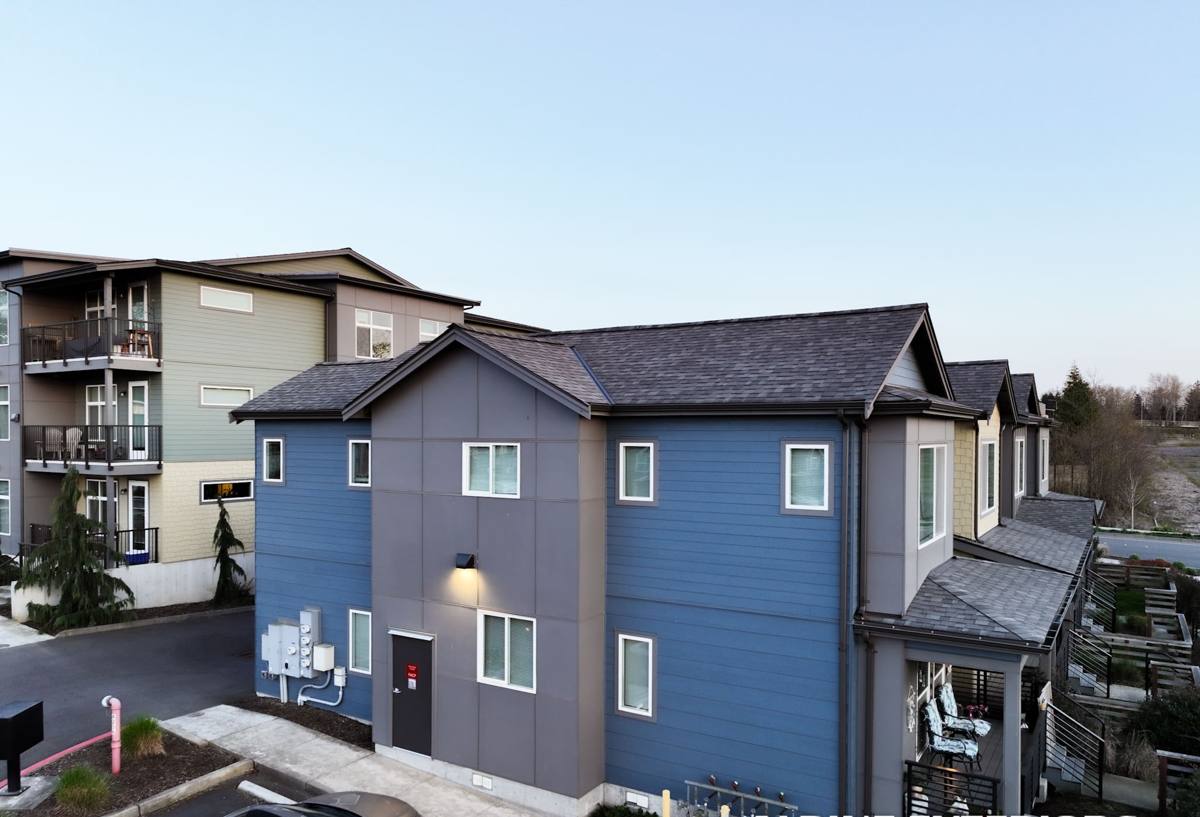
Why "Standard" Siding Installation Isn't Enough Here
A siding job that would hold up fine on an open lot in Ferndale or Lynden can fail early in Larrabee. The failure points are predictable: fastener corrosion at the coast, water intrusion at poorly flashed penetrations, and moss establishing itself in shaded, rarely-dried wall sections. None of these are exotic problems — they're the direct, foreseeable result of installing a generic product with generic detailing in a specific microclimate that doesn't forgive shortcuts.
That's the gap we're closing on every Larrabee project: matching the product and the installation detail to the actual conditions on that lot, not to a national average.
Why We Install Only James Hardie Fiber Cement
We don't install vinyl, LP SmartSide, primed spruce, cedar, or other fiber cement brands like Allura or Cemplank. That's a deliberate standard, not a sales preference, and it matters most in an environment like Larrabee's.
Non-Combustible, Won't Rot
James Hardie fiber cement is made primarily from cement, sand, and cellulose fiber. It has no wood content to feed rot or insect damage, and it doesn't soften or delaminate the way engineered wood products can when moisture sits against them under tree cover for extended periods.
ColorPlus Factory Finish
Instead of field-applied paint, Hardie's ColorPlus finish is baked on in a controlled factory process, cured harder and more evenly than paint applied on-site. In a salt-air environment, that finish holds its color and its bond to the substrate significantly longer than typical site-applied coatings, which matters when the alternative is repainting a coastal-facing wall every few years.
HZ5 Engineering for This Climate
Hardie manufactures its siding in climate-specific HZ (HardieZone) formulations. The HZ5 line is engineered for colder, wetter climate zones like ours, with moisture and freeze-thaw performance built into the product itself rather than relying entirely on field detailing to compensate.
Warranty Backing
Hardie backs its products with a strong, transferable limited warranty — real protection for a homeowner who wants the investment to hold up, and a selling point if the home changes hands.
What a Correct Installation Looks Like in a Salt-Air, High-Moisture Setting
The product only performs as well as the installation behind it. In Larrabee specifically, a few details separate a siding job that lasts from one that doesn't:
| Detail | Why It Matters Here |
|---|---|
| Rainscreen gap behind the siding | Lets wind-driven moisture that gets past the cladding drain and dry out instead of sitting against the sheathing under shade |
| Stainless or coated fasteners | Resists salt-air corrosion that eats through standard fasteners over time near the water |
| Correct flashing at windows, doors, and penetrations | Keeps wind-driven rain from tracking behind the siding at the exact points where most water intrusion starts |
| Proper starter strip and clearance at grade | Keeps the bottom course out of splash-back moisture and standing dampness common on shaded, sloped lots |
| Factory-cut, sealed panel edges | Field-cut edges left unsealed absorb moisture faster and are the first place moss and staining take hold |
Skip any one of these and the siding may still look fine for a season or two — the problems in this climate tend to show up two, five, or ten years in, not on day one.
Our Process for Larrabee Siding Projects
- On-site assessment: we walk the home, check existing siding and sheathing condition, note shade patterns, drainage, and any areas already showing moss or moisture staining.
- Product and color selection: we help you choose the right Hardie line and ColorPlus color for the site's sun exposure and your home's style.
- Tear-off and sheathing check: old siding comes off and we inspect sheathing for hidden rot or moisture damage before anything new goes on — this step gets skipped by crews trying to move fast, and it's the one that matters most.
- Weather-resistive barrier and rainscreen installation: a properly lapped moisture barrier and drainage gap go in before any siding panel.
- Flashing at every penetration: windows, doors, vents, and hose bibs all get individually flashed, not just caulked.
- Siding installation to Hardie's fastening and clearance specifications: correct fastener type, spacing, and grade clearance, following manufacturer instructions rather than shortcuts.
- Final walkthrough: we review the completed work with you and point out any maintenance basics specific to your home's site conditions.
Cost Factors for Siding Installation in Larrabee
Every home is different, but these are the main variables that move the price of a siding installation project in this area:
| Factor | How It Affects Cost |
|---|---|
| Home size and wall complexity | More square footage, corners, and roof lines mean more cutting, flashing, and labor time |
| Current siding removal | Tear-off of old wood, vinyl, or damaged cladding adds labor and disposal cost |
| Sheathing repair, if needed | Hidden rot found during tear-off has to be repaired before new siding goes on — this is site-specific and can't be quoted sight unseen |
| Access and site conditions | Steep, wooded, or tight-access lots common around Chuckanut Drive can add setup and staging time |
| Hardie product line and trim details | Panel vs. lap siding, trim board selection, and color all factor into material cost |
We give firm, itemized numbers after an on-site look — not a phone estimate — because so much of the real cost on a Larrabee home depends on what's actually behind the existing siding.
Living With Hardie Siding in a Moss-Prone, Salt-Air Area
Correctly installed Hardie siding is low-maintenance, but "low-maintenance" doesn't mean "zero-maintenance" in an environment this shaded and wet. A short seasonal routine keeps it performing the way it's designed to:
- Rinse the north- and shade-facing walls annually to knock down early moss and algae growth before it establishes
- Keep tree branches and shrubs trimmed back a few inches from siding to improve airflow and drying
- Clear debris out of the rainscreen weep gaps at the bottom of walls if you notice buildup
- Check caulking at trim joints and penetrations every year or two and re-caulk as needed
- Watch for any soft spots, staining, or gaps at flashing points and address them early rather than waiting
None of this is heavy work — it's the kind of upkeep that takes a homeowner an hour or two a year and prevents the small issues that turn into real repairs if ignored under constant shade and moisture.
Why It Matters That We Already Work in This Area
Siding detailing that's correct for a sunny, open lot in Bellingham's flatlands isn't automatically correct for a shaded, sloped, saltwater-adjacent property in Larrabee. A crew that regularly works the Chuckanut corridor already knows to plan for wind-driven rain angles, to spec corrosion-resistant fasteners without being asked, and to expect — and check for — hidden moisture behind older siding on shaded walls. That local pattern recognition is the difference between an installation that's technically to code and one that's actually built for the site it's on.
If you're planning a siding project on a Larrabee home, we're happy to take a look and walk you through what your specific site needs — no pressure, no obligation. Fill out the form below and we'll set up a time to come out and give you a straight answer.