 Chuckanut
 Why Sehome Roofs Wear Out Faster Than the Manufacturer's Warranty Suggests
Every asphalt shingle sold in this country carries a warranty written for average American weather. Sehome doesn't get average weather. Sitting close to Bellingham Bay and the greater Puget Sound airshed, homes here deal with a steady drift of salt-laden moisture, wind-driven rain that gets pushed sideways under standard flashing details, and a wet, shaded moss season that can run eight or nine months out of the year. None of that is dramatic on its own. It's the accumulation that gets people — a roof that "should" last 25 years quietly loses five or ten of them to conditions the shingle was never tested against.
We've replaced enough roofs in this part of Whatcom County to know the failure pattern is consistent: granule loss happens early on south and west-facing slopes exposed to driving rain, moss gets a foothold on the shaded north slopes first, and fasteners and flashing corrode faster near the water than they would ten or fifteen miles inland. A roof replacement done right for Sehome accounts for all three of those things from the start, not as an afterthought.
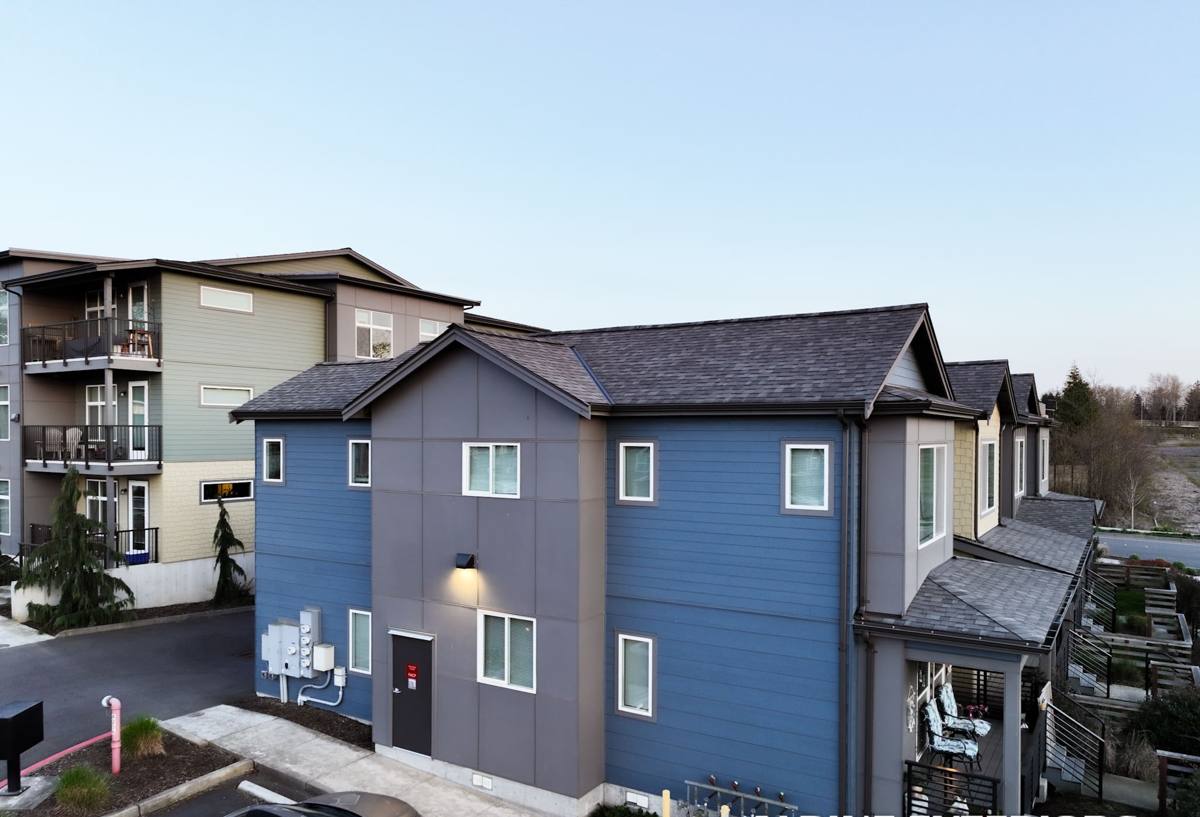
Signs It's Time to Replace, Not Just Repair
Repair makes sense when the damage is isolated — a cracked pipe boot, a handful of wind-lifted shingles, a flashing leak at a chimney. Replacement becomes the honest recommendation when the roof's underlying materials have aged out everywhere, not just at one visible spot. Here's what we look for before telling a homeowner it's time:
- Granules collecting in gutters or at downspout outlets, especially after a hard rain
- Shingles that feel brittle or crack when lifted for inspection rather than flexing
- Moss or algae staining that returns within a season or two of cleaning
- Soft or spongy decking felt underfoot in the attic or during a walk-on inspection
- Daylight visible through the roof deck from inside the attic
- Multiple past repairs in different locations rather than one contained problem
- A roof already at or past 18-20 years old for asphalt composition shingle
If you're only seeing one or two of these, a repair may genuinely be the right call — we'll tell you that instead of pushing a full replacement you don't need yet.
What a Correct Roof Replacement Actually Involves
A roof replacement is more than swapping old shingles for new ones. The parts homeowners can't see from the ground are usually what determine whether the new roof performs well in this climate or repeats the old roof's problems in half the time.
Tear-Off and Deck Inspection
We remove the old roofing down to bare decking rather than layering over it. That's the only way to actually see the plywood or OSB underneath — and in a marine climate, hidden moisture damage at valleys, eaves, and old flashing points is common enough that skipping this step is how new roofs end up failing early. Any soft or delaminated decking gets replaced before anything new goes down.
Underlayment and Moisture Protection
Given how much wind-driven rain this area sees, underlayment choice matters more here than in drier climates. We use synthetic underlayment across the field for its tear resistance and water resistance, with self-adhered ice-and-water membrane at the vulnerable spots — eaves, valleys, and roof penetrations — where wind can push rain up and under standard shingle laps.
Ventilation
A roof that can't breathe traps moisture in the attic, and trapped moisture is exactly what accelerates deck rot and interior mold in a wet climate. We check and correct intake and exhaust ventilation as part of every replacement — this is frequently the single most overlooked factor in why an otherwise decent roof failed prematurely.
Flashing and Edge Details
Chimneys, skylights, sidewalls, and roof-to-wall transitions are where most leaks originate, not the open field of shingles. We replace flashing rather than reuse it, and we pay particular attention to any point where the roof meets siding, since a poorly flashed transition there sends water into the wall assembly, not just the attic.
Matching the Roofing Material to Sehome's Climate
There's no single "best" roofing material — there's the material that fits your home, your budget, and how much long-term maintenance you're willing to stay on top of. Here's how the common options actually compare for a coastal Whatcom County home:
| Material | Moss & Moisture Resistance | Typical Lifespan Here | Maintenance Reality |
|---|---|---|---|
| Asphalt composition shingle | Moderate — needs periodic cleaning to prevent moss buildup | 18-25 years | Lowest upfront cost; benefits most from annual moss checks |
| Architectural/laminate shingle | Better than 3-tab due to denser mat and algae-resistant granules | 25-30 years | Still needs moss monitoring on shaded slopes |
| Metal (standing seam or panel) | Excellent — moss struggles to get purchase, sheds water fast | 40-50+ years | Very low; occasional debris clearing |
| Cedar shake/shingle | Poor without diligent upkeep — retains moisture, feeds moss and rot | Highly variable | High; we generally steer clients away from this in shaded, wet lots |
We don't install cedar roofing in the shaded, moisture-heavy lots common around Sehome. It's not that cedar is a bad product everywhere — it's that in a climate this wet, with tree cover holding moisture against the roof, it demands a maintenance schedule most homeowners underestimate, and the warranty structure on cedar assumes drier conditions than we actually get. For most homes here, a quality architectural shingle or metal roof gives a far better return on the investment.
Moss: Whatcom County's Slow Roof Killer
Moss doesn't cause dramatic failures — it causes slow ones. Spores settle into the shaded, north-facing slopes first, particularly under tree cover or where roof valleys hold moisture longer after rain. Left alone, moss holds water against the shingle surface, lifts shingle edges as it grows, and works its way under the roofing over a moss season that, in this region, can realistically run from fall through late spring.
A new roof replacement is the best time to get ahead of this. We can install zinc or copper strips near the ridge on request, which release trace metal ions that inhibit moss growth on the slopes below as rain washes over them — a low-maintenance option worth discussing if your lot has heavy tree cover. Beyond that, the two things that matter most are keeping branches trimmed back from the roofline so slopes get more light and air movement, and having moss gently removed (never pressure-washed, which strips granules) before it has a chance to establish.
Our Process, Start to Finish
- On-site inspection. We walk the roof and attic, check decking condition, ventilation, and flashing points, and take photos to document what we find.
- Written estimate. You get a clear breakdown of material options, scope of work, and price — no vague allowances or surprise line items added later.
- Material selection. We help you weigh shingle, architectural, or metal options against your budget and how the roof is shaded and exposed.
- Scheduling around the weather. Roofing in this climate means watching forecasts closely and building in realistic timelines rather than rushing a tear-off into a rain window that closes early.
- Tear-off and deck repair. Old roofing comes off, decking is inspected, and any compromised sections are replaced before new materials go down.
- Installation. Underlayment, ice-and-water membrane, flashing, and final roofing go on in that order, with ventilation corrected along the way.
- Cleanup and final walkthrough. We magnet-sweep for stray fasteners, clear debris, and walk the finished roof with you before calling the job done.
What Affects the Cost
Every roof is priced on its own specifics, but the factors that move the number up or down are consistent. Being upfront about these helps you understand a quote rather than just comparing a bottom-line number between contractors.
- Roof size and the number of facets, valleys, and penetrations to flash
- Roof pitch and accessibility — steeper or harder-to-reach roofs take more time and safety setup
- Whether decking replacement is needed once the old roofing comes off
- Material choice — architectural shingle and metal cost more upfront than basic asphalt but generally cost less per year of service life
- Extent of ventilation correction required
- Layers of existing roofing to remove
- Any additional moss-prevention measures like zinc strips
Be cautious of any quote that's dramatically lower than others for the same scope of work — in our experience that usually means underlayment, flashing, or ventilation corrections have been left out of the price, not that the contractor found a shortcut.
Why Hiring a Crew That Already Works in Sehome Matters
Roofing crews who mainly work drier, inland areas sometimes bring standard details that simply aren't built for what this coastline throws at a house. A crew that regularly works Sehome and the surrounding Whatcom County neighborhoods already knows which slopes hold moss longest, where wind-driven rain tends to find weak flashing, and how to sequence a tear-off around a marine weather pattern that can turn on short notice. That familiarity shows up in fewer callbacks and a roof that's actually built for the conditions it has to survive, not just the conditions it was designed for on paper.
It also matters for permitting and code compliance specific to the county, and for knowing which material and ventilation choices hold up locally versus which ones look fine on a spec sheet but underperform once they've been through a real Pacific Northwest winter.
If your roof is showing its age — or you just want an honest read on whether repair or replacement makes more sense for your home — we're happy to take a look. Fill out the form below for a free, no-pressure estimate.