 Chuckanut
 Asphalt Shingle Roofing Built for York's Weather, Not Just Any Weather
York sits close enough to the water that salt air is part of daily life, and close enough to the hills and tree cover that moss season lasts longer than most homeowners expect. Add in the driving, wind-pushed rain that comes through Whatcom County several months a year, and you have a roofing environment that punishes shortcuts. An asphalt shingle roof that would hold up fine in a drier inland climate can start showing granule loss, moss colonization, and edge lifting within a few years out here if it wasn't installed with these specific conditions in mind.
We work on homes in and around York regularly, and the patterns repeat: north-facing slopes that stay damp longer, valleys and eaves that collect windblown debris, and shingles that were installed correctly on paper but without the underlayment, flashing, and ventilation details that actually matter this close to the coast. This page covers what a correct asphalt shingle roof looks like for a York home, what our process involves, and why local experience changes the outcome.
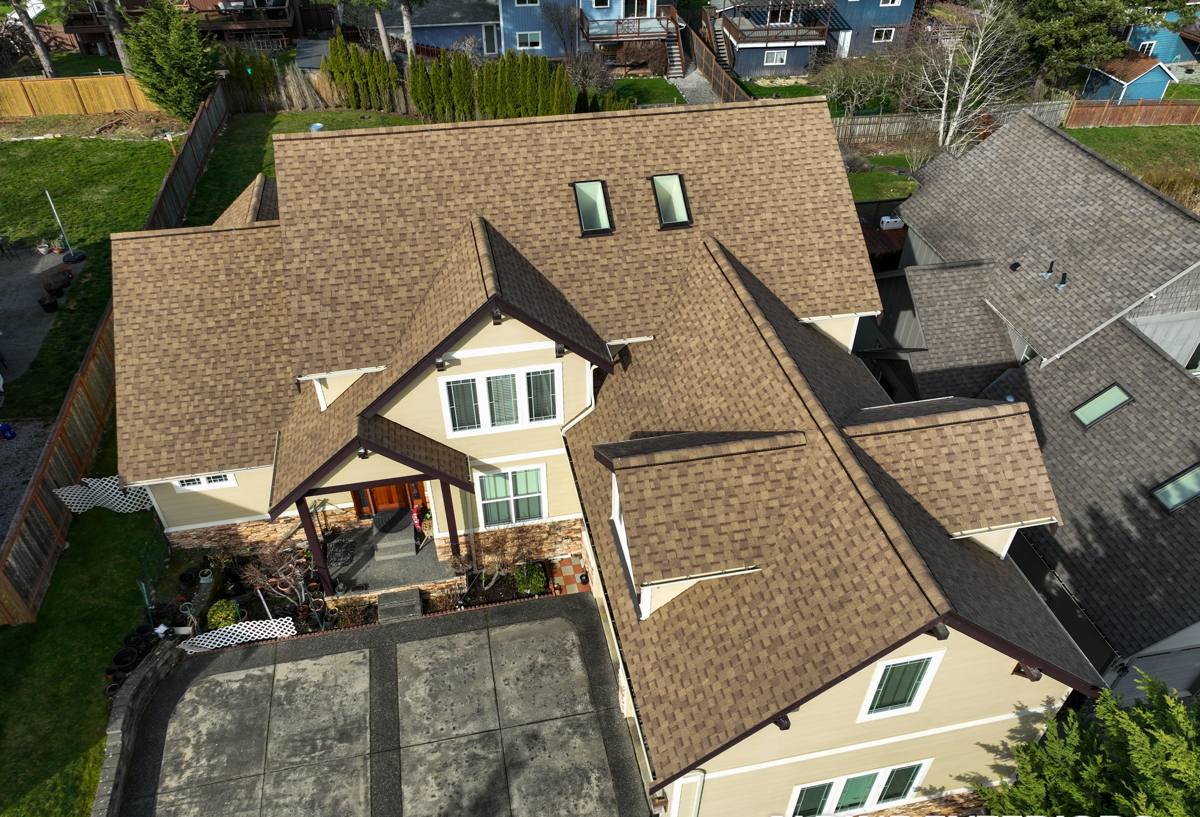
What Chuckanut's Climate Actually Does to a Shingle Roof
Salt Air and Metal Fatigue
Salt-laden air accelerates corrosion on exposed metal — nail heads, flashing, drip edge, and roof vents. Cheaper galvanized fasteners and thin-gauge flashing corrode faster near the water, which is one reason we pay close attention to fastener and flashing spec on every York job rather than defaulting to whatever's standard inland.
Driving Rain and Wind-Driven Water
Rain that comes in sideways doesn't behave like rain that falls straight down. It can work its way under shingle tabs, around poorly sealed valleys, and into any gap in the underlayment that a vertical-rain roof would never expose. This is why underlayment choice and lap direction matter more here than in drier, calmer climates.
Moss, Shade, and Slow-Drying Surfaces
Tree cover and marine humidity mean shaded roof sections can stay damp for days after a storm. Moss and algae take hold in that moisture, and once established, moss lifts shingle edges as it grows — which is exactly where wind-driven rain finds its way in. A roof that dries out slowly is a roof that ages faster, regardless of how good the shingles themselves are.
What a Correct Asphalt Shingle Job Involves Here
Asphalt shingles are a proven, cost-effective roofing material, but "correct installation" means something more specific in a coastal, wet climate than it does elsewhere. The shingles are often the least important variable — what's underneath and around them determines how long the roof actually lasts.
- Ice-and-water or high-quality synthetic underlayment at eaves, valleys, and penetrations — not just field-standard felt everywhere
- Corrosion-resistant fasteners and flashing rated for coastal exposure, not the cheapest option that meets code minimums
- Proper valley and step flashing at every roof-to-wall and roof-to-roof transition, sealed and lapped in the correct direction for prevailing wind and rain
- Balanced attic ventilation (intake at the eaves, exhaust at the ridge) so moisture doesn't condense under the deck and shorten the roof's life from underneath
- Drip edge on all edges, not just the eaves, to keep wind-driven rain from wicking back under the shingle edge
- Correct nailing pattern and shingle exposure per manufacturer spec — under-nailing is one of the most common causes of early wind and rain damage we see on re-roofs
Skip any one of these and the roof may still look fine for a year or two. The failures show up later, usually as leaks that are hard to trace back to their real cause because the water has traveled before it becomes visible.
Our Process for a York Roofing Project
1. On-Site Assessment
We walk the roof and attic, not just the ground. That means checking deck condition, existing ventilation, flashing detail at every penetration and transition, and any signs of past moss or moisture damage. Shade patterns and roof orientation get noted too, since they tell us which sections will need extra attention to drainage and moss resistance.
2. Honest Scope and Options
We explain what's actually needed versus what's optional — deck repair, added ventilation, upgraded underlayment in vulnerable areas — so you can make an informed decision rather than guessing at what a quote covers.
3. Tear-Off and Deck Inspection
Full tear-off lets us inspect the deck itself for rot or soft spots, which is common on older York homes where a previous roof trapped moisture without anyone knowing until the shingles came off. Any damaged decking gets replaced before anything new goes down.
4. Underlayment, Flashing, and Ventilation First
This is where most of the long-term performance is decided. We install underlayment and flashing to the standard described above before a single shingle goes on, and we correct ventilation issues rather than roofing over them.
5. Shingle Installation
Shingles go down to manufacturer nailing and exposure specs, with extra attention at valleys, ridges, and any area with prevailing wind exposure.
6. Final Walkthrough
We walk the finished roof with you, confirm everything from flashing to cleanup, and answer any questions about maintenance going forward — particularly around moss prevention, which is an ongoing task rather than a one-time fix.
Choosing the Right Shingle for a Coastal, Wet Climate
Not all asphalt shingles perform the same in this environment. Algae-resistant (AR) shingles, which use copper-infused granules, are worth the modest upgrade in cost for a York roof given the moisture and shade most properties deal with. Architectural (dimensional) shingles also tend to shed water more effectively than three-tab shingles because of their layered profile, and they hold up better to wind uplift — a real consideration given how exposed some York lots are to weather coming off the water.
| Shingle Type | Typical Lifespan Here | Best Suited For |
|---|---|---|
| Standard 3-tab | 15-20 years | Budget-conscious projects, less wind/shade exposure |
| Architectural/dimensional | 25-30 years | Most York homes; better wind and water shedding |
| Algae-resistant (AR) architectural | 25-30 years, slower moss/algae onset | Shaded roofs, north-facing slopes, homes near tree cover |
| Impact-resistant (Class 4) | 25-30+ years | Homes wanting added durability against debris and hail |
These are general ranges, not guarantees — actual lifespan depends on installation quality, roof slope, shade, and ongoing maintenance as much as the product itself.
Why We Don't Push Certain Shortcuts
Some contractors will roof directly over an existing layer, skip upgraded underlayment to save on cost, or use minimum-code flashing details to keep a bid low. We don't take those shortcuts on York projects, and it's worth explaining why rather than just saying "trust us."
Roofing over an existing layer traps moisture and hides deck problems that will eventually need to be dealt with anyway, usually at greater expense once they've caused damage. Minimum underlayment coverage saves a modest amount up front but leaves the roof more exposed to exactly the wind-driven rain pattern this area sees regularly. These aren't claims about any particular product being defective — they're trade-offs in installation approach, and in a climate like this one, the cheaper approach tends to cost more over the life of the roof.
Maintenance That Actually Extends Roof Life Here
A well-installed asphalt shingle roof still needs upkeep in this climate, especially around moss and debris.
- Clear gutters and valleys of needles and debris at least twice a year — clogged drainage is one of the fastest paths to shingle and deck damage
- Have moss treated or removed before it spreads across a slope, not after it's established
- Check attic ventilation periodically, since blocked soffit vents reduce the airflow that keeps the deck dry from underneath
- After major windstorms, do a visual check (or have us do one) for lifted or missing shingles, particularly along ridges and edges
- Avoid pressure washing shingles — it strips protective granules and shortens their life rather than cleaning them safely
Why Local Experience in York Matters
A roofing crew that hasn't worked this specific stretch of Whatcom County doesn't necessarily know which slopes hold moisture longest, how far salt exposure reaches inland from the water, or which flashing details actually get tested by a real Pacific Northwest winter versus a mild one. We've built our process around what actually fails on roofs in this area, not a generic checklist. That shows up in the details — where we add extra underlayment, how we handle valleys, which fastener spec we use — and those details are the difference between a roof that needs attention again in five years and one that goes the distance.
If you're planning a re-roof, dealing with an aging roof that's starting to show moss or granule loss, or just want an honest read on what your current roof needs, we're glad to take a look. Reach out for a free, no-pressure estimate — we'll walk the roof, tell you what we actually find, and give you options rather than a hard sell.