 Chuckanut
 Siding Repair Built for Bellingham's Climate, Not a Generic Checklist
Bellingham sits close enough to the water that homes here take a different kind of beating than siding fifty miles inland. Salt-laden air moves off Bellingham Bay and works into seams, fastener heads, and any spot where the finish has thinned. Wind-driven rain off the Sound doesn't just wet the surface of a wall — it gets pushed sideways and upward into laps, corners, and trim joints that were never designed to shed water moving in that direction. And because this part of Whatcom County stays cool and damp for long stretches of the year, moss and algae get a head start every fall and don't fully let go until well into summer. A siding repair that ignores any one of those three factors tends to fail again within a couple of years.
We repair siding on Bellingham homes regularly, and we treat repair work with the same discipline as new installation: find the actual cause of the damage, not just the visible symptom, and fix it in a way that holds up through another wet season.
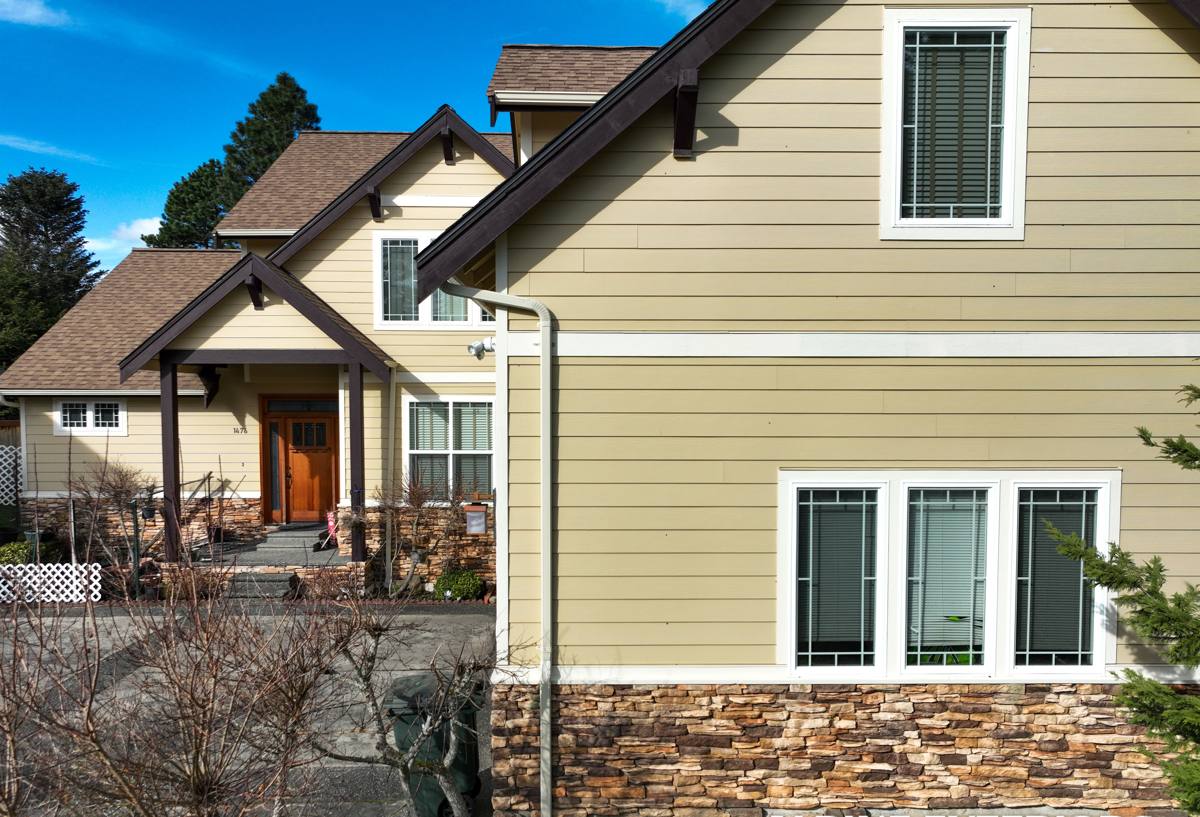
Signs Your Bellingham Home Needs Siding Repair
Some damage is obvious. Some hides behind paint or caulk until it's already spread. Here's what we look for on a typical inspection:
- Soft, spongy, or crumbling siding when pressed — usually a sign moisture has been sitting behind the surface
- Dark streaking, green or black film, or a persistent damp smell near ground-level walls or shaded corners
- Cracked, bubbled, or peeling paint that keeps coming back in the same spot no matter how many times it's touched up
- Gaps or separation at butt joints, corners, or where siding meets window and door trim
- Warped, cupped, or bowed boards, especially on north- and west-facing walls that see the most weather
- Rust streaks below fastener heads or visible corrosion on nails, screws, or metal trim pieces
- Soft trim or fascia near the roofline, which often points to a flashing problem feeding water down the wall
Moisture Damage vs. Cosmetic Damage
Not every mark on a wall means the siding has failed. Surface staining from moss or road film is a maintenance issue — it can usually be cleaned and the finish restored. The distinction that matters is whether water has gotten past the siding's surface and into the material or the wall assembly behind it. That's the difference between a repair that lasts and one that just covers up a problem that keeps working underneath. Part of our job on every inspection is telling a homeowner honestly which one we're looking at, even when that means the answer is "this doesn't need repair yet."
What's Actually Causing the Damage in This Part of Whatcom County
Salt Air Near Bellingham Bay
Homes closer to the water deal with airborne salt that accelerates corrosion on fasteners, flashing, and any exposed metal trim. Once a fastener starts rusting, the hole around it widens slightly, water finds an easier path in, and the cycle speeds up. Repairs near the shoreline need corrosion-resistant fasteners and flashing details, not just a patch of the same materials that failed the first time.
Wind-Driven Rain
Bellingham gets a lot of rain, but it's the sideways rain — pushed by wind off the Sound — that causes the real damage. It drives water up under laps and into joints that a straight-down rain would never reach. Siding and flashing that rely on gravity alone to shed water are the first to show problems in these conditions.
A Long Moss and Algae Season
Cool, damp, and shaded conditions for much of the year give moss and algae plenty of time to establish themselves, especially on north-facing walls and anywhere tree cover blocks the sun. Left alone, moss holds moisture against the siding surface far longer than open air would, which is exactly the condition that leads to soft wood, failed paint, and eventually rot.
Repair or Replace? How We Make That Call
Homeowners often assume any visible damage means a full re-side. That's frequently not true — but sometimes it is, and pretending otherwise just delays a bigger repair bill. We look at the extent of the damage, not just the number of spots.
| Factor | Usually points to repair | Usually points to replacement |
|---|---|---|
| Extent of damage | Isolated to one or two boards or a single wall section | Spread across multiple walls or the whole exterior |
| Cause | Localized issue — a failed caulk joint, one damaged board, a flashing gap | Systemic issue — wrong siding for the climate, failed original installation, widespread moisture intrusion |
| Age of existing siding | Siding is otherwise in good shape and mid-lifespan | Siding is near or past its expected service life |
| Material match | Replacement boards can be closely matched in profile and finish | Original material is discontinued, mismatched, or a product we don't stand behind long-term |
| Underlying sheathing | Sheathing and moisture barrier test dry and sound | Sheathing shows rot or the barrier has failed in multiple areas |
We'll always tell you plainly which category your home falls into, along with the reasoning behind it, before any work starts.
Why We Repair Homes With — and Recommend — James Hardie Fiber Cement
We install James Hardie fiber cement exclusively, and that shapes how we approach repairs too. Fiber cement doesn't absorb and swell with moisture the way wood-based products can, and it doesn't corrode or become brittle in salt air the way some other materials do over time. Hardie's ColorPlus factory finish is also formulated to hold up under UV exposure and the kind of persistent damp that Whatcom County sees for much of the year, which matters a great deal when you're trying to match new repair boards to siding that's been on the wall for a few years.
When we're called to repair vinyl, LP SmartSide, cedar, or primed spruce siding on an existing home, we'll do that work honestly and competently. But we won't install those products new, and we'll say so plainly if a repair is really the first sign of a bigger problem with the material itself rather than a one-time installation flaw. That's not a sales pitch — it's the same standard we hold ourselves to on every job.
Matching Existing Siding on a Repair
Good repair work is invisible from the sidewalk. That means matching board profile, exposure width, and color as closely as possible. Hardie's factory-finished color lines make this more predictable than field-painted materials, since the new boards come off the line with the same finish process as the ones already on the wall, rather than relying on a paint match years after the original job.
Our Siding Repair Process in Bellingham
- Inspection. We look at the damaged area and the surrounding siding, plus flashing, trim, and any signs the problem originates somewhere other than where it's visible.
- Diagnosis. We identify the actual cause — moisture intrusion, failed flashing, fastener corrosion, impact damage, or material fatigue — and explain it in plain terms.
- Scope and estimate. You get a clear, honest scope: what's being repaired, what it involves, and a straightforward cost range before anything is scheduled.
- Repair. Damaged material is removed back to sound substrate, the moisture barrier and flashing are corrected where needed, and new material is installed to manufacturer specification.
- Finish and check. Joints are sealed appropriately, fasteners and trim are matched, and we walk the repair with you before calling it done.
What a Correct Repair Actually Involves
A siding repair that only replaces the visible board and skips everything behind it is a repair that fails again. The parts that don't show are usually the parts that matter most:
- Water-resistive barrier: If the barrier behind the damaged siding was torn, punctured, or improperly lapped, replacing the board without fixing the barrier just resets the clock on the same failure.
- Flashing: Window heads, corners, and butt joints all rely on flashing to direct water back out and away from the wall. Damaged or missing flashing is one of the most common root causes we find behind repeat repair calls.
- Fastening: Corrosion-resistant fasteners, driven correctly and to the right depth, matter more near the water and in a climate with this much sustained moisture exposure.
- Caulking and sealant: Used correctly at joints designed to be sealed — and left out where siding is designed to shed water on its own, since over-caulking can trap moisture instead of releasing it.
- Clearances: Proper gaps at grade, decks, and roof lines so water and debris don't sit against the bottom edge of the siding.
Why Hiring a Crew That Already Works in Bellingham Matters
Siding repair isn't just a technical skill — it's a judgment call about how a specific house, in a specific spot, has been weathering for years. A crew that regularly works Bellingham and the surrounding Whatcom County shoreline has already seen how salt air behaves on this side of the Sound, how far wind-driven rain actually travels up a wall, and which orientations grow moss fastest in this particular microclimate. That local pattern recognition is the difference between a repair that addresses the real cause and one that just replaces a board and waits to see what happens next winter.
It also means someone who understands regional permitting norms, typical construction types in the area, and how local weather timing affects when repair work can reasonably be scheduled — rain-heavy stretches aren't the best time to open up a wall, and a crew that works here knows how to plan around that.
Get an Honest Look at Your Siding
If you're seeing soft spots, persistent staining, cracked paint, or gaps in your siding, it's worth getting an honest opinion before the damage spreads further into the wall. We offer free, no-pressure estimates for siding repair in Bellingham and the surrounding area — we'll tell you straight whether you're looking at a targeted repair or something larger, with no obligation either way. Use the form below to get started.