 Chuckanut
 Blanchard's Siding Problem Isn't Hypothetical
If you own a home in Blanchard, you already know your siding works harder than siding fifty miles inland. This stretch of the Chuckanut corridor in Whatcom County sits close enough to saltwater that airborne salt settles on exterior surfaces, gets driving rain off Samish Bay and the Salish Sea funneled straight at west- and southwest-facing walls, and spends a good chunk of the year shaded and damp enough that moss and algae take hold on anything that stays wet too long. None of that is unusual for this part of Washington. What's unusual is how many siding jobs in this area are installed the same way you'd install siding in Spokane or Yakima, with no real accounting for what marine exposure does to a wall assembly over ten or twenty years.
This page is about one job: installing fiber cement siding correctly on a home in Blanchard, given the specific combination of salt exposure, wind-driven rain, and moss pressure this area deals with. It's not a general overview of siding materials. It's what we think a Blanchard homeowner needs to know before hiring anyone for this job.
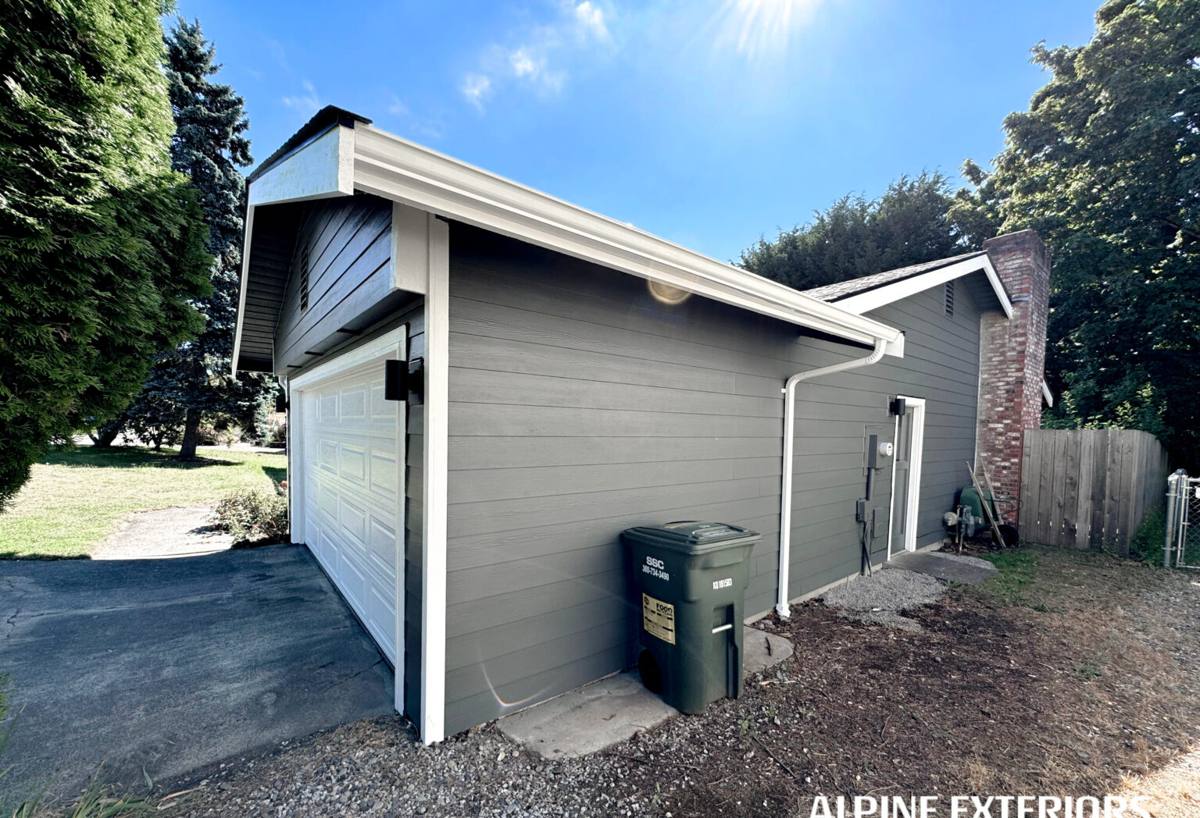
What Salt Air, Driving Rain, and Moss Actually Do to a Wall
Salt air
Airborne salt is corrosive to exposed metal fasteners, flashing, and hardware, and it accelerates the breakdown of unprotected wood and lower-grade paint finishes. Over years, homes closer to the water tend to show fastener bleed, corroded trim hardware, and paint that chalks and fades faster than the same product would inland.
Driving rain
Rain that falls straight down is rarely the problem. Rain that gets pushed sideways by wind off the water is. Wind-driven rain finds every seam, every lap joint, and every penetration in a wall that isn't detailed to shed water actively rather than just resist it. A siding job that looks fine in dry weather can still be letting water behind the cladding during a January southwesterly.
Moss and biological growth
Shaded, north-facing, and tree-adjacent walls in this climate stay damp longer after every rain event, which is exactly what moss, lichen, and algae need to establish. Once organic growth takes hold on a wall, it holds moisture against the surface even longer, which is a self-reinforcing problem on the wrong material.
Why Fiber Cement Is the Right Answer for This Exposure
Fiber cement siding is cement, sand, and cellulose fiber, and it simply doesn't behave like wood or vinyl in the conditions described above. It won't rot from trapped moisture the way wood-based products can. It doesn't soften, delaminate, or become a food source for the biological growth that thrives on organic siding materials. It's dimensionally stable across the temperature and humidity swings typical of a marine climate, which means fewer seam and caulk failures over time. That's the core reason we install James Hardie fiber cement exclusively and don't offer wood composite, vinyl, or primed wood alternatives — those products each carry moisture-related trade-offs that show up faster in an environment like Blanchard's than they would somewhere drier.
Fiber cement isn't magic, though. It's only as good as the installation behind it. A poorly flashed, poorly gapped fiber cement job in this climate will still let water in — it just won't rot the siding board itself the way it might rot a lesser material. The water problem moves to whatever's underneath.
What a Correct Installation Involves
This is the part most homeowners never see, because it's covered up by the time the job looks finished. It's also the part that determines whether the siding performs for thirty years or needs attention in five.
- A continuous weather-resistive barrier installed shingle-style so every layer drains down and out, not into the wall
- Rigid flashing at every horizontal penetration — windows, doors, hose bibs, vents, electrical — installed to actively shed water rather than rely on caulk alone
- Correct fastener placement and depth, per Hardie's published fastening specifications, since over-driven or under-driven fasteners are a leading cause of siding callbacks
- Proper clearance gaps at the foundation, roofline, and any horizontal trim, so the board can't wick standing water
- Rainscreen or drainage gap detailing where the wall assembly benefits from an air space behind the cladding, letting incidental moisture drain and dry instead of sitting against the sheathing
- Factory-primed and factory-finished boards (ColorPlus) rather than field-painted cut edges left unsealed
None of this is exotic. It's all in James Hardie's installation manual. The problem is that it takes real time and real attention to detail to do all of it correctly on every wall of a house, and it's the first thing that gets skipped when a crew is trying to move fast.
Product Lines That Make Sense for Blanchard
James Hardie engineers its siding by climate zone (HZ), and that matters here. Homes in wetter, more moisture-exposed regions like this one are matched to the HZ5 product line, which is formulated and tested for higher-moisture climates rather than the drier zones used in parts of the interior West. On top of that, ColorPlus factory finish is baked on under controlled conditions and backed by its own finish warranty, which matters in a climate where field-applied paint tends to fail faster from UV, salt exposure, and repeated wet-dry cycling.
| Product | Best use | Why it fits this climate |
|---|---|---|
| HardiePlank lap siding | Primary wall cladding | Engineered for moisture exposure; factory finish resists salt-air fading |
| HardiePanel vertical siding | Accent walls, gable ends | Fewer horizontal laps means fewer water-entry points on exposed elevations |
| HardieTrim boards | Corners, window and door trim | Dimensionally stable; won't cup or split the way wood trim can in wet-dry cycling |
| HardieShingle | Accent/architectural detail | Matches traditional Northwest coastal aesthetics without the wood maintenance burden |
Signs Your Current Siding Is Already Losing the Fight
If you're on the fence about whether this is worth addressing now, a few signs are worth walking your house to check for:
- Dark green or black staining that returns within weeks of pressure washing, especially on shaded or north-facing walls
- Paint that's chalking, peeling, or bubbling, particularly around seams and trim edges
- Soft spots or visible warping on wood-based siding, especially near the bottom courses and around window sills
- Rust streaks running down from fasteners or metal flashing
- Caulk joints that have shrunk, cracked, or pulled away from the siding
- Visible gaps at seams that weren't there when the home was newer
Any one of these on its own might just mean it's time for maintenance. Several together, especially on the weather-exposed side of the house, usually mean the wall assembly is already taking on more moisture than it should.
How We Approach a Blanchard Project
1. Site walk and exposure assessment
We look at which elevations take the most wind-driven rain, which ones stay shaded and damp longest, and whether the current siding, trim, and flashing are already showing exposure-related wear. This shapes both the product choice and the detailing plan before we ever write an estimate.
2. Tear-off and sheathing inspection
Once the old siding comes off, we inspect the sheathing underneath. This is often the first time hidden moisture damage from a prior installation becomes visible, and it needs to be addressed before new siding goes back on — covering over damaged sheathing just resets the clock on the same problem.
3. Weather barrier and flashing installation
This is the step that determines long-term performance more than any other. We install the weather-resistive barrier and flashing system to actively drain water at every seam and penetration, not just resist it.
4. Fiber cement installation to spec
Boards are installed with correct fastener spacing, clearance gaps, and lap details per James Hardie's published requirements for this climate zone.
5. Final walkthrough
We walk the finished job with you, elevation by elevation, before considering it done.
What This Costs, and What Drives the Range
Every home is different, but a few factors reliably move the price of a fiber cement re-side up or down. This isn't a quote — it's a way to understand what you're actually paying for when estimates vary.
| Cost factor | Why it matters |
|---|---|
| Sheathing condition underneath old siding | Hidden moisture damage found at tear-off adds repair scope before new siding goes on |
| Home size and wall complexity | More corners, dormers, and trim details mean more labor per square foot |
| Trim and accent choices | HardieTrim, shingle accents, and custom color combinations add cost versus a single lap-siding elevation |
| Existing siding removal | Multiple layers of old material or asbestos-era siding require more careful, sometimes specialized removal |
| Access and site conditions | Steep lots, limited staging area, or landscaping close to the walls add labor time |
Why Hiring a Crew That Already Works This Area Matters
A crew that installs siding across a lot of different climates tends to default to a generic approach. A crew that regularly works Blanchard and the surrounding Chuckanut area already knows which elevations on a typical local lot take the worst of the weather, already accounts for moss and salt exposure in the products and finishes it recommends, and isn't guessing at flashing details for the first time on your house. That familiarity shows up in fewer callbacks and a wall assembly that's actually built for the conditions it has to survive, not just the conditions on a spec sheet.
It also matters for something more basic: showing up. Homes in this area sometimes have longer driveways, tree cover, or seasonal access considerations that a crew unfamiliar with the region hasn't planned for. Local experience isn't just a talking point — it affects scheduling, staging, and how smoothly a multi-day tear-off and install actually goes.
Maintenance Once It's Installed
Fiber cement with a factory finish is low-maintenance, not no-maintenance, especially in a climate that grows moss. A simple annual routine keeps it performing:
- Rinse the exterior yearly, focusing on shaded and north-facing walls where moss and algae take hold first
- Check caulk joints at trim, windows, and corners for cracking or shrinkage, and re-caulk before gaps let water in
- Keep gutters clear so overflow isn't running down the wall face during heavy rain
- Trim back vegetation that keeps a wall section shaded and damp longer than the rest of the house
- Watch for any staining or discoloration that returns quickly after cleaning — that's usually a sign moisture is getting behind the surface, not just sitting on top of it
The Warranty Behind the Product
James Hardie backs its siding with a long, non-prorated limited warranty on the substrate, and ColorPlus factory-finished products carry a separate finish warranty covering fade and peel performance. Both are transferable to a subsequent owner within the terms of the warranty, which matters for resale value in an area where buyers increasingly ask about siding condition and material before making an offer. Warranty coverage assumes installation to Hardie's published specifications, which is another reason correct flashing, fastening, and clearance detail isn't optional — it's what keeps the manufacturer's warranty intact if something ever does go wrong.
If your Blanchard home is due for new siding, or you're seeing early signs of moisture or moss damage on the walls that take the worst of the weather, we're happy to walk the property with you and give you a straightforward, no-pressure estimate using the form below.