 Chuckanut
 Bow's Climate Puts Real Demands on Siding
Bow sits close enough to the water that salt air is a constant, not an occasional nuisance. Combine that with the driving rain that comes off the Salish Sea through fall and winter, and you get a siding environment that punishes anything less than a fully weather-tight assembly. Add a moss season that can run half the year in the shaded, damp pockets common to this part of Whatcom County, and you have three separate stressors working on a home's exterior at the same time: salt corrosion, wind-driven moisture intrusion, and organic growth that holds water against the wall longer than it should sit there.
None of these stressors are dramatic on their own. The damage they cause is slow and cumulative — a fastener that corrodes a little faster than it should, a butt joint that wicks moisture for years before anyone notices swelling, a north-facing wall that stays damp under moss long enough for rot to start behind the cladding. By the time it's visible, the fix is usually bigger than it needed to be. Siding for a Bow home has to be chosen and installed with all three of these realities in mind from day one, not treated as a generic materials decision.
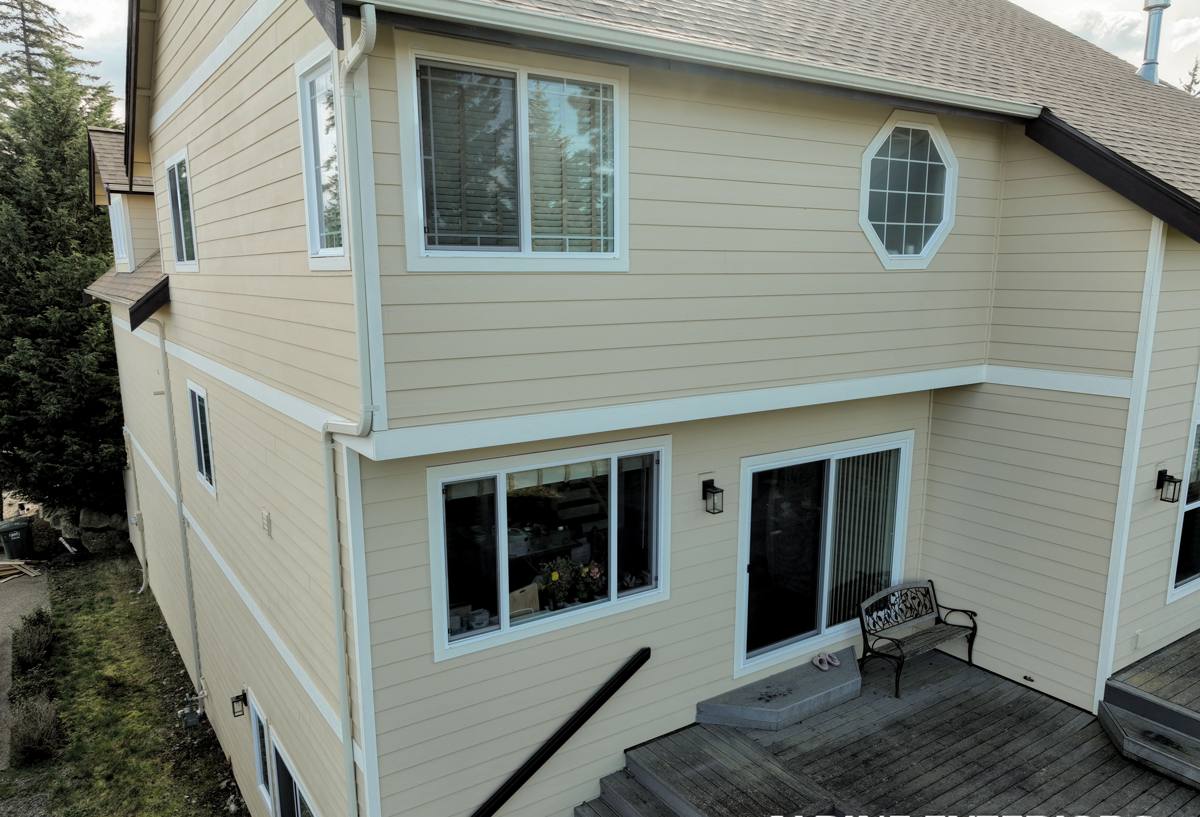
Why Fiber Cement Is the Right Material for This Location
Fiber cement handles this combination of conditions better than the alternatives, for reasons that are specific to what salt air, rain, and moss actually do to a wall.
- It doesn't rot. Cement, sand, and cellulose fiber don't feed fungal growth the way wood does, so moss and mildew sitting on the surface aren't slowly consuming the material underneath.
- It's dimensionally stable. Fiber cement doesn't swell and shrink with moisture cycling the way wood-based products can, which matters on a coastline where humidity swings are frequent.
- It's non-combustible. Not a climate factor specific to Bow, but a real advantage over vinyl and engineered wood products regardless of location.
- The factory finish resists salt-air fade and chalking far longer than field-applied paint, which is the part of a coastal siding job that fails first on painted materials.
We install James Hardie fiber cement exclusively. We don't install vinyl, LP SmartSide, primed wood, cedar, or other fiber cement brands like Allura or Cemplank, and we're upfront about why: Hardie's ColorPlus factory-baked finish, its HZ5 climate-engineered formulation for the Pacific Northwest, and its transferable limited warranty are the combination we're willing to put our name behind in a climate this demanding. Other products aren't dishonest choices — they're just not the standard we've decided to build our business on.
What a Correct Fiber Cement Job Actually Involves
The material is only half the equation. Most fiber cement failures we get called to look at aren't material failures — they're installation shortcuts that let water get behind the siding, where fiber cement can't dry out as fast as it should. A correct install in a wet, salty climate like Bow's includes:
A drainage plane that actually drains
A weather-resistive barrier and a rainscreen gap behind the siding give any moisture that gets past the cladding somewhere to go besides your sheathing. On a home exposed to driving, wind-pushed rain, this gap is what separates a wall that dries out from one that stays damp.
Correct fastening
Fiber cement has specific nailing patterns and fastener requirements. Corrosion-resistant fasteners matter everywhere, but they matter more here, where salt air accelerates corrosion on anything not rated for it.
Proper clearances and flashing
Manufacturer-specified gaps at the ground, roofline, windows, and trim keep water from wicking into the bottom edge of a board or pooling where two surfaces meet. This is also where moss tends to establish first — in the shaded, slower-drying transitions around trim and window heads — so getting these details right does double duty against both moisture and organic growth.
Factory-cut and factory-primed edges wherever possible
Field cuts expose raw fiber cement that needs to be sealed. Minimizing field cuts, and properly sealing the ones that are unavoidable, keeps the factory finish's protection intact at every edge.
Fiber Cement Compared to Other Siding Options
| Material | Salt Air Resistance | Moss/Moisture Behavior | Typical Lifespan Here |
|---|---|---|---|
| James Hardie Fiber Cement | Strong — factory finish resists fade and chalking | Doesn't rot; correct install sheds water and dries fast | Decades, per warranty terms |
| Vinyl Siding | Can become brittle and discolor faster in salt-heavy, UV-heavy coastal exposure | Doesn't rot, but seams and laps can trap moisture behind panels | Variable; shorter in harsh coastal exposure |
| Primed Wood / Cedar | Requires ongoing painting to hold up against salt and moisture | Susceptible to rot and moss-driven decay without diligent upkeep | Shorter without consistent maintenance |
| LP SmartSide (engineered wood) | Moderate; finish maintenance is more frequent than fiber cement | Wood-based core is more moisture-sensitive than cement-based product | Shorter than fiber cement in wet climates |
This table reflects general material behavior, not a claim that every installation of these products fails — installation quality affects every material's real-world performance. It's why we focus as much on how a job is done as on what material goes up.
Our Process for a Bow Home
- On-site assessment. We look at your home's exposure — how much direct wind-driven rain it takes, which walls stay shaded and damp longest, where moss and mildew are already showing, and the condition of what's behind the current siding.
- Plan the drainage and flashing details specific to your home's roofline, window placement, and grade, not a one-size-fits-all approach.
- Remove old siding and inspect sheathing for hidden moisture or rot before anything new goes up. This step catches problems that would otherwise get sealed behind the new siding.
- Install the weather-resistive barrier, rainscreen, and flashing to manufacturer spec.
- Install the Hardie siding with correct fastening, clearances, and joint treatment.
- Final walkthrough covering caulking, trim details, and what routine upkeep will look like on your specific exposure.
Maintaining Fiber Cement Siding in a Salt Air, Moss-Prone Climate
Fiber cement is low-maintenance compared to wood, but "low-maintenance" isn't "no-maintenance," especially this close to the water. A short annual routine keeps a correctly installed job performing the way it should for the long haul.
- Rinse salt residue and general grime off the siding once or twice a year, focusing on shaded and north-facing walls where buildup sits longest.
- Keep gutters clear so water isn't overflowing and running down the siding face.
- Trim back vegetation and tree cover that keeps any wall section shaded and slow to dry — the single biggest factor in moss establishing on a wall.
- Check caulking at trim, window, and door transitions every year or two, and recaulk where it's cracked or pulled away.
- Address any moss or mildew growth early with a gentle wash rather than letting it build up and hold moisture against the surface.
- Walk the exterior after major storms to catch any impact damage or loosened trim before it becomes a moisture entry point.
Cost Factors for a Fiber Cement Project in Bow
| Factor | Why It Matters Here |
|---|---|
| Home size and wall complexity | More corners, dormers, and trim details mean more flashing and cut work |
| Condition of existing sheathing | Moisture-damaged sheathing found during tear-off adds repair scope before new siding goes on |
| Exposure level | Walls that take the brunt of wind-driven rain or salt spray may warrant extra attention to flashing and drainage details |
| Siding profile and Hardie product line | Lap width, shingle-style panels, and trim selections affect material cost |
| Access and site conditions | Grade, landscaping, and structure height affect labor time |
We give exact numbers only after seeing the home in person — anyone quoting a firm price over the phone for a job like this is skipping the assessment that actually determines cost.
Why It Matters to Hire a Crew That Already Works in Bow
A siding crew that mainly works drier, inland areas can install fiber cement competently and still miss the details that matter most on this stretch of coastline — how much clearance a specific wall needs given its salt exposure, which orientations need extra attention to keep moss from establishing, how local moisture patterns should shape flashing decisions. A crew that already works Bow and the surrounding Chuckanut area has seen how these homes actually perform through a full wet season, not just how they look the day the job wraps.
That familiarity shows up in small decisions — a slightly wider rainscreen gap on a west-facing wall, extra attention to a flashing detail above a window that catches more wind-driven rain than most — that don't show up on a spec sheet but make a real difference over the life of the siding.
If you're weighing your options for a Bow home, we're happy to take a look and walk you through what correct fiber cement installation looks like for your specific house and its exposure. There's no pressure and no cost to get our assessment — just fill out the form below to request a free estimate.