 Chuckanut
 Why Roofs in Bow Wear Differently Than Roofs Inland
Bow sits close enough to the water that the air itself is part of the maintenance equation. Salt-laden air off the coastline settles on exposed roofing day after day, and it doesn't take a storm to do damage — it's the slow, constant exposure that corrodes fasteners, breaks down sealants, and accelerates granule loss on asphalt shingles years before a warranty would suggest. Add in Whatcom County's long, wet winters and the shaded, tree-lined lots common in this area, and you get roofs that grow moss faster and dry out slower than roofs just a few miles inland.
None of this means a roof in Bow needs to be exotic or over-built. It means the replacement has to account for moisture that lingers, wind-driven rain that finds gaps a drier climate would never expose, and organic growth that thrives in shade and humidity. A roof designed and installed with those conditions in mind will simply outlast one that wasn't, regardless of what material sits on top.
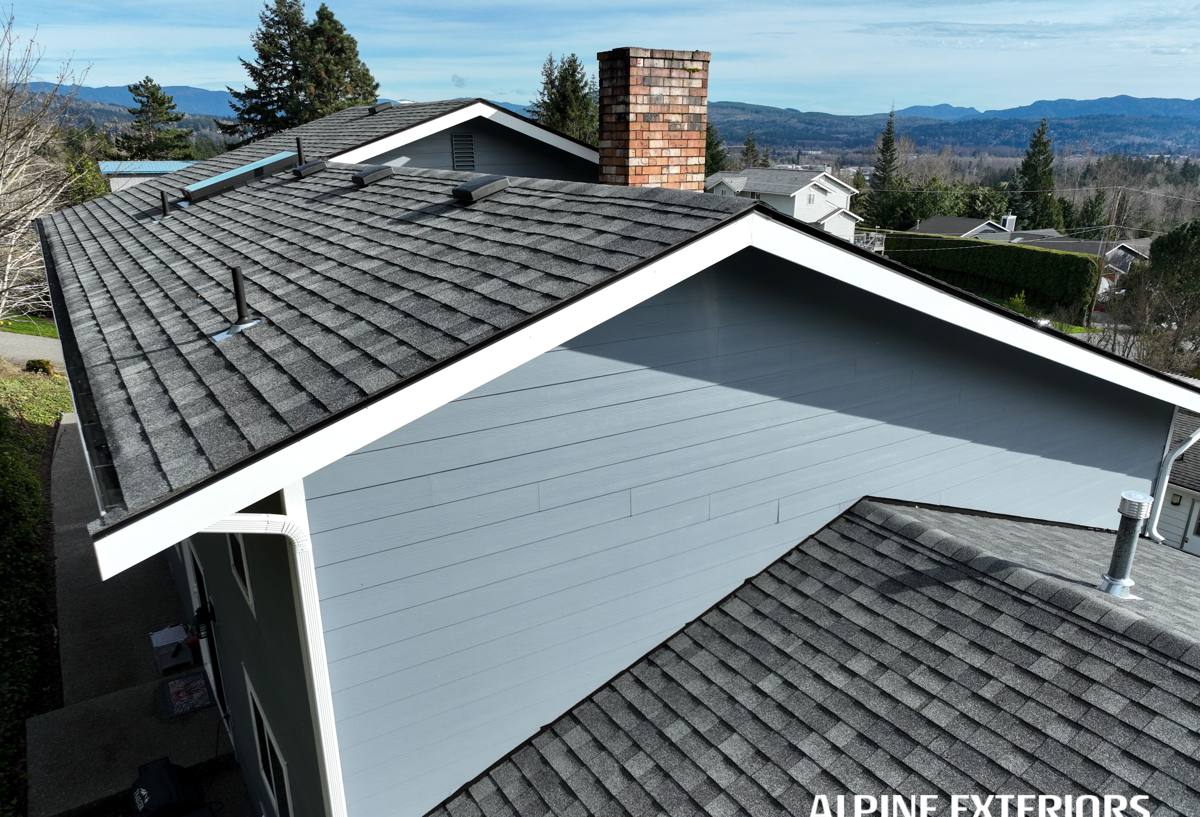
Signs a Bow Roof Needs Replacement, Not Another Repair
Most homeowners call about a leak or a missing shingle and assume a patch will do. Sometimes it will. But on coastal Whatcom County homes, a few conditions usually mean the roof has reached the point where repair is a short-term fix on a system that's already failing underneath.
- Granules collecting in gutters or at downspout outlets in noticeable amounts, especially on a roof past 15-18 years old
- Moss established thickly enough that it's lifting shingle tabs rather than just staining the surface
- Soft or spongy spots in the decking when walked, usually found near valleys or old flashing points
- Rusted, pitted, or failed metal flashing around chimneys, skylights, and roof-wall intersections
- Daylight or water staining visible in the attic along the ridge or at roof penetrations
- Multiple past repairs in different spots, suggesting the underlayment is failing broadly, not locally
If you're seeing two or more of these, it's worth getting a straightforward inspection before spending more money chasing individual leaks. A roof that's failing at the underlayment or deck level can't be fixed shingle by shingle.
What a Correct Replacement Involves in This Area
Tear-Off and Deck Inspection
We remove the existing roofing down to the deck rather than layering over it. Layering hides problems and voids most manufacturer warranties, but more importantly, it skips the one chance to actually see the plywood or plank decking underneath. In a climate like this, that's where moisture damage shows up first — soft spots, delamination, or staining that tells us water has been getting in longer than the surface suggested. Any damaged decking gets replaced before anything new goes down; nailing new roofing over compromised sheathing just guarantees a repeat job in a few years.
Underlayment and Ice-and-Water Protection
Given how much wind-driven rain this stretch of coastline sees, we don't treat underlayment as an afterthought. Self-adhering ice-and-water membrane goes down at eaves, valleys, and around every penetration — the spots where wind can push water sideways or backward under the shingles. The rest of the deck gets a synthetic underlayment rather than old-style felt, because synthetic holds up better to the intermittent wet-dry cycling that's normal here and doesn't tear as easily during install on a windy day, which is common working this close to the water.
Flashing, Fasteners, and Ventilation
Flashing is where most roof failures near the coast actually start, not in the field of the roof itself. We install new step flashing, counter-flashing, and valley metal rather than reusing old pieces, and we use fasteners rated to resist the corrosion that salt air accelerates. Ventilation gets checked and corrected as part of the job, not treated as separate — more on why that matters below.
Choosing a Roofing Material for Salt Air and Moss
There's no single "best" roofing material for Bow — there's a best material for your roof's pitch, your home's exposure, and your budget. Here's how the common options actually perform under these specific conditions.
| Material | Moss & Moisture Behavior | Salt Air Durability | Typical Lifespan Here |
|---|---|---|---|
| Architectural asphalt shingle | Moss-resistant algae-shield versions help, but still need periodic cleaning in shaded areas | Good with corrosion-resistant fasteners and flashing | 20-30 years |
| Standing seam metal | Sheds moisture fast, very little surface for moss to grip | Very good with a marine-grade coating and correct fastener spec | 40-60 years |
| Synthetic/composite shingle | Resists moisture absorption well; some products include algae resistance | Good; check manufacturer's coastal warranty terms | 30-50 years |
| Wood shake or shingle | Highest moisture retention and moss risk without diligent upkeep | Requires the most ongoing maintenance in salt air | Varies widely with upkeep |
We don't push one material on every homeowner. If your home's design and budget point toward asphalt, we'll spec the right underlayment and ventilation to make it perform well here. If you're after the lowest long-term maintenance and can absorb the higher upfront cost, metal earns its price on a roof exposed to this much salt air and rain. What matters most is matching the install details — flashing, ventilation, fastener spec — to whatever material you choose, since a premium material installed with generic details will still underperform.
Our Process, Start to Finish
- On-site assessment — we walk the roof and attic, note deck condition, ventilation, and any moss or moisture patterns specific to your lot's exposure and shade.
- Written estimate — a clear scope covering tear-off, decking allowance, underlayment, flashing, material, and disposal, so there are no surprise line items mid-job.
- Scheduling around weather — we plan tear-off for windows where the deck won't sit exposed overnight longer than necessary, which matters more here than in drier climates.
- Tear-off and deck repair — full removal, deck inspection, and replacement of any compromised sheathing before anything new is installed.
- Underlayment, flashing, and ventilation correction — the details covered above, done before the finish material ever goes down.
- Installation — material installed to manufacturer spec, with attention to fastener pattern and exposure at ridges, valleys, and edges.
- Site cleanup and magnetic sweep — full cleanup of debris and stray fasteners from the property and surrounding ground.
- Final walkthrough — we review the finished roof with you, including care and maintenance guidance specific to your home's exposure.
Ventilation and Moisture: The Step Homeowners Don't See
A new roof surface can still fail early if the attic underneath isn't ventilating correctly. In a humid coastal climate, warm moist air trapped in an attic condenses against cold roof decking, and over a few seasons that moisture rots sheathing from the underside — invisible from the roof and easy to miss during a quick visual inspection. Correcting intake and exhaust balance, usually with a mix of soffit vents and ridge or box venting, keeps that air moving instead of settling. It's not an upsell; it's part of why some replacements last three decades and others need re-decking after twelve years.
Living With the Roof After Installation
A properly installed roof still benefits from some basic seasonal attention, especially in an area with a long moss season and heavy tree cover. None of this requires a professional every time, but a few habits go a long way.
- Clear gutters and downspouts at least twice a year, more often under mature trees
- Have moss growth removed gently — soft washing or manual removal, not pressure washing, which can strip granules
- Trim back overhanging branches to reduce shade and debris buildup on the roof surface
- Check attic ventilation intake points aren't blocked by insulation or debris
- Walk the roofline visually after major windstorms for lifted shingles or dislodged flashing
- Schedule a professional check every few years, even without an obvious problem, especially past year ten
Cost Factors for a Bow Roof Replacement
Every roof is priced on its own specifics, but the factors that move the number the most in this area are fairly consistent.
| Factor | Why It Matters Here |
|---|---|
| Roof pitch and complexity | Steeper roofs and multiple valleys/dormers add labor and material for proper flashing |
| Deck condition | Moisture-related decking replacement is more common near the coast and can only be scoped after tear-off begins |
| Material choice | Asphalt, synthetic, and metal carry different upfront costs and different long-term maintenance demands |
| Ventilation upgrades | Correcting inadequate attic ventilation adds modest cost but protects the investment |
| Access and site conditions | Tree cover, slope, and driveway access affect equipment staging and labor time |
As a broad range, most straightforward asphalt shingle replacements in this area land in the mid-to-upper five figures for an average single-family roof, with metal running higher upfront and complex rooflines pushing any material toward the top of its range. We won't give a real number without seeing the roof, but we'll never pad an estimate with vague allowances either.
Why a Crew That Already Works This Coastline Matters
Roofing crews that mostly work drier, inland areas sometimes treat coastal jobs like any other roof with a nicer view. That approach shows up later — in fasteners that weren't rated for salt exposure, flashing details that were technically fine but not built for wind-driven rain, or ventilation that was left as-is because it "looked adequate." A crew that regularly works Bow and the surrounding Chuckanut coastline already knows which details actually matter here versus which ones are just manufacturer boilerplate, and that judgment gets built into every roof we put on, not billed as an extra.
It also means faster, more honest answers. When we look at a roof in this area, we're not guessing at how it'll hold up against salt air and a long moss season — we're comparing it against roofs we've already installed and maintained nearby.
If your roof is showing its age or you just want an honest read on where it stands, we're glad to take a look. The estimate is free, there's no pressure attached to it, and you'll get a straight answer either way — use the form below to get started.