 Chuckanut
 Decks in Burlington Take a Different Kind of Beating
A deck in Burlington doesn't fail the same way a deck fails in a dry climate. Out here, the damage is slower and sneakier. Salt-laden air off the water corrodes fasteners and hardware from the inside out, long stretches of driving rain push moisture into every joint and seam, and a moss season that can run half the year keeps surfaces damp long after the rain stops. None of that shows up as a dramatic failure right away. It shows up as a soft spot near the house, a squeaky board, a railing that flexes a little more than it used to.
We work on decks throughout the Burlington area and see the same patterns over and over: ledger boards pulling moisture from the house wall, joists rotting from the top down where they're hardest to inspect, and fastener corrosion that weakens a structure well before the wood itself looks bad. Understanding those patterns is the difference between a repair that lasts and one that's just cosmetic.
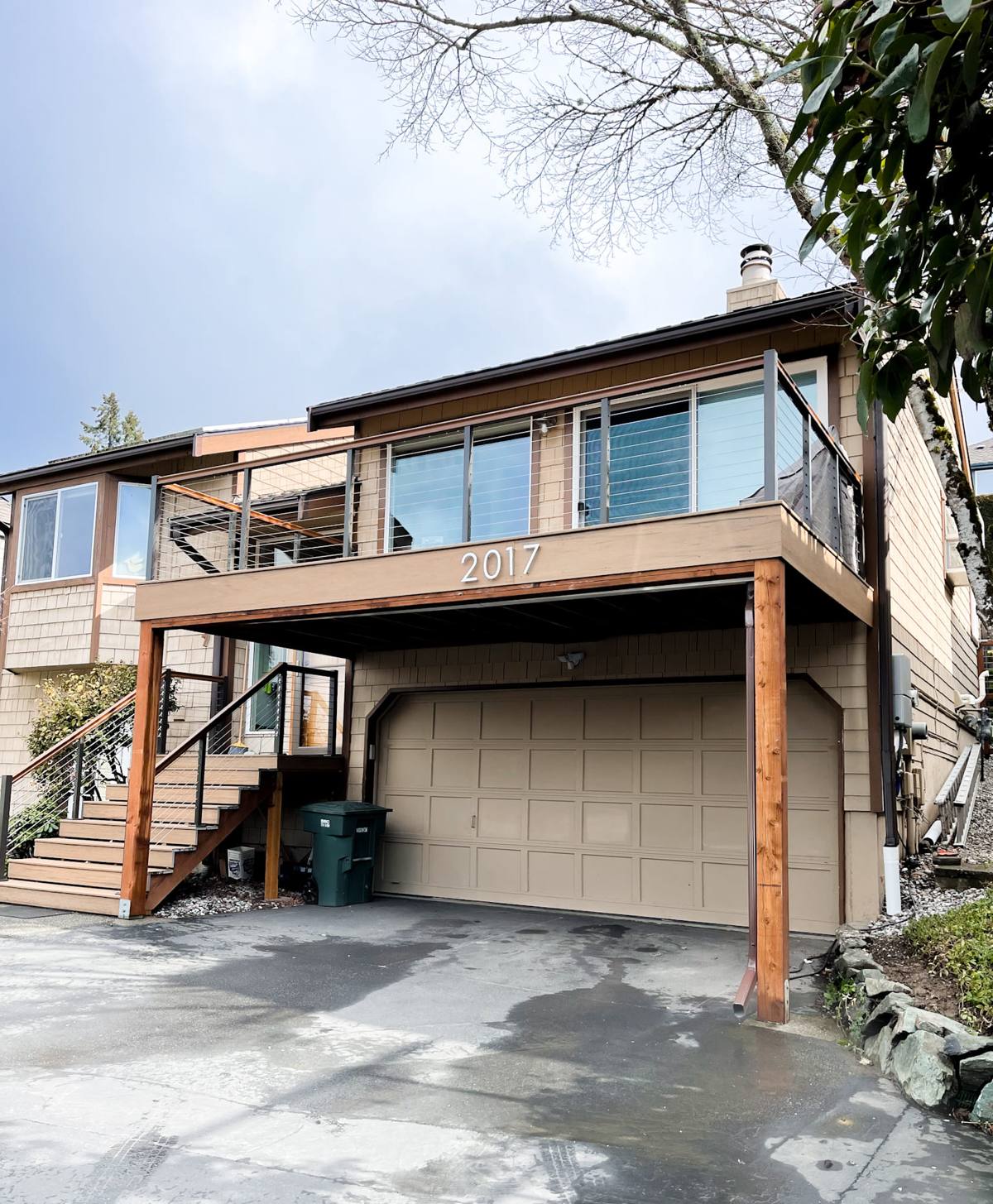
What Whatcom County's Climate Does to a Deck Over Time
Salt Air and Metal Fatigue
Coastal moisture accelerates corrosion on nails, screws, joist hangers, and post bases. Once a fastener starts to rust, it loses grip strength gradually, and a deck can look structurally fine while its connections are quietly failing underneath.
Driving Rain and Hidden Moisture
Wind-driven rain doesn't just fall on a deck, it gets pushed sideways into gaps, under flashing, and behind ledger boards. That's why some of the worst rot we find isn't on the visible decking at all, it's on the framing members behind and beneath it.
Moss Season and Trapped Dampness
A long moss and algae season keeps wood surfaces damp for extended stretches, even between rain events. Damp wood that never fully dries is exactly the environment rot fungus needs. Moss also holds moisture against fasteners and connectors, compounding the corrosion problem.
Warning Signs Worth Calling About
Most deck problems are easier and cheaper to fix early. Here's what we tell Burlington homeowners to keep an eye on between seasons:
- Boards that feel soft, spongy, or spring back slowly when you step on them
- A railing or post that flexes more than it used to, especially at the base
- Rust streaks running down from screws, nails, or metal connectors
- Gaps opening up where the deck meets the house, or at the ledger board
- Persistent moss or dark staining that won't scrub off and keeps coming back
- Stair stringers that feel uneven or bounce underfoot
- A musty smell coming from underneath the deck or around support posts
Any one of these on its own might be minor. A few together usually means it's time for a real inspection, not just a pressure wash.
Where Repairs Are Actually Needed Most
Not every part of a deck fails at the same rate. In our experience working on homes in this area, the trouble spots usually fall into a few categories:
The Ledger Board Connection
This is where the deck attaches to the house, and it's the single most important structural connection on the whole deck. It's also the part most exposed to water running down the siding and pooling where the two structures meet. A compromised ledger board isn't a cosmetic problem, it's a safety one.
Support Posts and Footings
Posts that sit close to grade or in poorly draining soil take on moisture from below as well as above. We check for rot at the base, movement at the footing, and hardware corrosion at the post-to-beam connection.
Joists and Beams
Framing members underneath the decking are out of sight, which means damage can progress for years before it's noticed. Top-down rot, where water sits on the upper edge of a joist under the decking boards, is one of the most common issues we find on older decks in this region.
Decking Boards and Railings
The most visible wear, and usually the easiest to address, is cupping, splitting, or graying decking boards and railings that have loosened over time. This is often what prompts the call, even when the real problem is underneath.
Repair or Replace? How We Help You Decide
Not every deck problem calls for a full rebuild, and not every deck can be saved with a patch. The honest answer depends on how much of the structure is affected versus the surface.
| Factor | Points Toward Repair | Points Toward Replacement |
|---|---|---|
| Framing condition | Joists and beams are sound, damage is isolated | Rot is widespread across multiple structural members |
| Ledger board | Connection is solid, flashing intact | Ledger is soft, poorly flashed, or improperly attached |
| Age of deck | Under 15-20 years, built to a reasonable standard | Older deck nearing the end of its structural lifespan |
| Extent of damage | Limited to a few boards, a post, or a rail section | Damage recurring in the same areas after prior repairs |
| Code and safety | Meets current railing and attachment standards | Undersized framing or outdated, unsafe railing design |
We'll always tell you plainly which side of that line your deck falls on, including when a full section replacement is a better long-term value than patching around rot that's going to keep spreading.
How Our Repair Process Works
- Inspection first. We check the structure from underneath, not just the walking surface, including the ledger connection, posts, footings, and fastener condition.
- Honest scope. We tell you exactly what's failing, what's still sound, and why. If it's a simple board swap, we say so. If it's more, we explain what's driving the recommendation.
- Remove and expose. Damaged boards, framing, or connectors come out so we can see the true extent of rot or corrosion underneath, not just guess from the surface.
- Rebuild to hold up here. Replacement framing, fasteners, and connectors are matched to coastal conditions, not generic hardware store minimums.
- Flashing and moisture management. Ledger flashing, joist tape, and proper drainage gaps get addressed as part of the repair, not skipped to save time.
- Final check. We walk the deck with you, point out what was done, and flag anything worth watching going forward.
Materials: What We Use and Why
Material choice matters more here than in a dry climate, because the wrong hardware or lumber grade can undo a good repair within a few seasons.
- Fasteners: We use hot-dip galvanized or stainless connectors and screws rated for ground contact and coastal exposure, not standard interior-grade hardware that corrodes quickly in salt air.
- Framing lumber: Pressure-treated lumber rated for the application, matched correctly to ground contact versus above-grade use.
- Decking: Both quality wood and composite decking have a place, and we'll walk through the real trade-offs, wood costs less up front but needs regular maintenance, composite costs more up front but handles moisture and moss growth with less upkeep over time.
- Flashing: Proper ledger flashing and self-adhering membrane at critical joints, since this is one of the most common points of failure we find on repair calls.
Why a Crew That Already Works Burlington Matters
A deck repair isn't just a lumber question, it's a local-conditions question. A crew that works decks and siding throughout the Chuckanut and Burlington area day in and day out already knows which framing details hold up against driving rain, which fastener grades actually last against salt air, and which spots on a typical local deck tend to rot first. That's knowledge you don't get from a one-size-fits-all repair checklist, it comes from seeing the same failure patterns repeat across homes in this specific climate.
It also means less guesswork for you. We're not learning the region on your project, we're applying what we already know works here.
What a Correct Repair Actually Involves
A lot of deck "repairs" are really just surface fixes, a board swapped here, a screw added there, without addressing why the damage happened in the first place. A correct repair means:
- Identifying the moisture source, not just the symptom
- Checking connections and framing, not only the boards you can see
- Using hardware and lumber suited to coastal, high-rain conditions
- Restoring proper drainage and flashing so water sheds instead of collecting
- Meeting current safety standards for railings and structural attachment
Skipping any of these steps usually just delays the same problem, and often makes it more expensive to fix correctly the second time around.
Get a Straight Answer About Your Deck
If your deck has a soft spot, a loose rail, or you just haven't had it looked at in a while, we're happy to come take a look. We'll give you a clear, no-pressure assessment of what's actually going on and what it would take to fix it right, whether that's a targeted repair or something bigger. Reach out below for a free estimate.