 Chuckanut
 Composite Decking Built for Columbia's Conditions
Columbia sits close enough to the water that salt air is part of daily life, and close enough to the trees that shade and moisture linger on outdoor surfaces long after a storm has passed. That combination is hard on any deck, but it's especially hard on decks that weren't built with drainage, ventilation, and fastener corrosion in mind from the start. Composite decking, installed correctly, holds up well against all three of those pressures — salt, rain, and moss — but "installed correctly" is doing a lot of work in that sentence, and it's the part that separates a deck that looks good for two seasons from one that still looks good in ten.
This page is about composite decking specifically for homes in and around Columbia, within our Chuckanut service area. We're not going to give you a generic rundown of composite decking in the abstract — we're going to walk through what this material needs to do differently here than it would in a dry inland climate, what a correct installation actually involves, and why a crew that already works this neighborhood tends to catch problems a first-timer to the area won't.
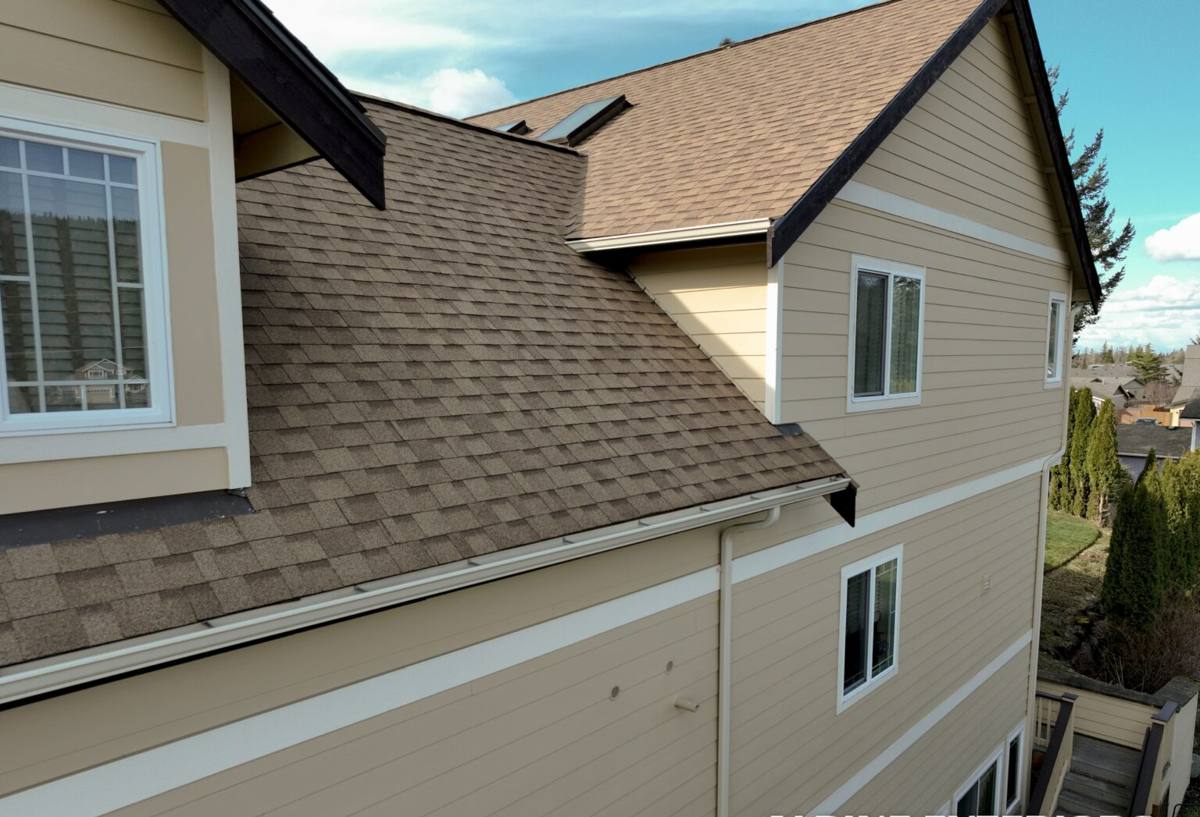
What Salt Air, Driving Rain, and Moss Actually Do to a Deck
Each of these three factors attacks a deck in a different way, and understanding the mechanism matters because it changes what you should ask a contractor to do about it.
Salt Air
Salt-laden air accelerates corrosion on any exposed metal — fasteners, brackets, flashing, railing hardware. On a wood deck this shows up as rust streaks and weakened connections over time. On a composite deck, the boards themselves don't corrode, but every screw, hidden-fastener clip, and joist bracket underneath still can if it's not rated for coastal exposure. This is one of the most common corners cut on decks in our area — standard hardware instead of stainless steel or coated fasteners rated for marine or coastal-adjacent environments.
Driving Rain
Wind-driven rain doesn't just fall on a deck, it gets pushed sideways into ledger connections, under railing posts, and into any gap where flashing wasn't lapped correctly. Over years, that's how you get soft framing under a deck that looks fine on top. The framing and flashing details underneath a composite deck matter just as much as the boards on top — arguably more, since they're the part nobody inspects casually.
Moss and Algae
Shaded, moisture-retentive spots in Whatcom County grow moss on almost any horizontal surface that doesn't drain and dry properly — roofs, walkways, and decks included. Composite boards resist rot, but moss and algae can still colonize the surface texture of a board that stays damp too long, particularly in board grooves, tight-spaced joints, or areas that never see direct sun. Board spacing, gap width, and airflow underneath the deck all affect how fast — or whether — that happens.
What a Correctly Built Composite Deck Involves
A composite deck is only as good as the structure and detailing underneath it. Here's what we consider non-negotiable on a coastal Whatcom County install:
- Ledger flashing — proper step or Z-flashing where the deck ties into the house, lapped so water sheds outward, not into the wall assembly
- Joist tape — a waterproof membrane over every joist top before decking goes down, so fastener penetrations don't become entry points for moisture into the wood framing
- Corrosion-rated fasteners and hardware — stainless or coated hardware throughout, not just at the ledger
- Correct board spacing — gaps sized for the specific composite product's expansion behavior and for drainage, not just eyeballed
- Airflow underneath — enough clearance and skirting ventilation that the underside of the deck can actually dry out between rain events
- Hidden fastener systems — where the product supports it, hidden clips reduce surface penetrations and give a cleaner, more consistent board-to-board gap for drainage
None of this is visible once the deck is finished, which is exactly why it's worth asking a contractor to walk you through it before work starts, not after.
Composite vs. Wood vs. PVC — What We Tell Columbia Homeowners
We install what fits the site and the budget, but here's the honest comparison for a salt-air, high-rain, shaded-lot climate like ours:
| Material | Moisture Behavior | Maintenance | Typical Lifespan Here |
|---|---|---|---|
| Pressure-treated wood | Absorbs and releases moisture; prone to cupping, splintering, and mold in shaded spots | Annual sealing/staining recommended | 10–15 years before major repair or replacement |
| Composite (capped) | Doesn't absorb moisture into the core; surface can still hold surface moss if airflow is poor | Periodic washing; no sealing or staining | 25+ years with correct installation |
| PVC | Fully moisture-resistant, lightest material | Low; can look more "plastic" and shows scratches differently than composite | 25+ years, higher upfront cost |
We install capped composite for most Columbia projects because it strikes the right balance of moisture resistance, appearance, and cost for this climate. We don't push customers toward uncapped composite boards — the exposed core on those products absorbs moisture at cut edges and fastener holes, which is a real liability in a climate this wet, and it's not a trade-off we think is worth the savings.
Our Process for a Composite Deck in Columbia
We keep this straightforward, and we don't start cutting boards until the structure underneath is right:
- Site visit and assessment — we look at existing framing (if replacing a deck), ledger condition, drainage slope, sun exposure, and shading, since all of that affects both structural needs and which board color/texture will actually perform well in that spot
- Structural check and repair — any soft framing, undersized joists, or missing flashing gets addressed before decking goes down, not covered over
- Framing and waterproofing — joist tape, corrosion-rated hardware, and correct ledger flashing installed to code
- Composite installation — boards installed with correct spacing and fastening method for the specific product
- Railing, stairs, and finish details — matched hardware, proper post attachment, and a final walk-through with you
- Cleanup — site cleared of debris and offcuts before we consider the job done
Cost Factors for a Composite Deck
Composite decking costs more up front than pressure-treated wood, but the honest math includes the maintenance you're not paying for later. Rough factors that move the price on a Columbia project:
| Factor | Why It Matters |
|---|---|
| Deck size and shape | More linear footage of board and framing; complex shapes add cutting and waste |
| Height off grade | Taller decks need more substructure, railing, and sometimes stairs |
| Existing structure condition | Replacing rotten framing or a failed ledger connection adds cost but isn't optional if it's found |
| Board tier and color | Composite lines vary in price by capping technology, color depth, and streaking pattern |
| Railing style | Composite, aluminum, and cable railing all price differently and affect maintenance |
We give a firm, itemized estimate after the site visit — we don't quote composite decking projects sight unseen, because the framing condition alone can shift the number significantly.
Maintaining a Composite Deck Through a Whatcom County Winter
Composite decking is low-maintenance, not no-maintenance, especially with a moss season this long. A simple seasonal routine keeps a deck looking like new:
- Sweep leaves and debris off regularly — trapped organic matter holds moisture and feeds moss growth
- Rinse with a garden hose or wash with a soft-bristle brush and mild soap a couple of times a year, more often in heavily shaded spots
- Avoid pressure washing at close range or high PSI — it can etch or fray the board's capped surface
- Check that gutters and downspouts near the deck aren't dumping extra water onto it
- Keep skirting vents and underside airflow paths clear of stored items and debris
- Inspect railing post connections and stair stringers once a year for movement
Why a Crew That Already Works Columbia Matters
A lot of what makes a composite deck last here isn't in the product spec sheet — it's in decisions made on-site: how much slope to build into the framing given a particular lot's drainage, which fastener spec actually holds up this close to the water, where moss is likely to become a problem based on how a yard sits relative to tree cover and sun. A crew that's worked other decks in Columbia and the wider Chuckanut area has already seen how these variables play out on real homes here, not just in a manufacturer's install guide written for a different climate. That local pattern recognition is what keeps small decisions — flashing laps, fastener grade, board gap — from turning into problems five years down the road.
If you're thinking about a new composite deck or replacing an aging wood one, we're happy to come take a look and walk you through what your specific lot needs. The estimate is free, there's no pressure, and you'll get a straight answer about what the job actually involves — just fill out the form below to get started.