 Chuckanut
 Deck Replacement in Columbia, Washington
If you own a home in the Columbia area of Chuckanut, you already know what a deck goes through here. It isn't just sun exposure and foot traffic — it's salt-laden air off the water, driving rain that comes in sideways for days at a stretch, and a moss season that can run from early fall clear through spring. Decks in this part of Whatcom County age differently than decks inland, and a replacement done without that in mind tends to fail the same way the old one did, just a few years faster.
This page covers what a deck replacement actually involves for a Columbia property, what tends to go wrong with decks in this specific setting, and how we approach the job so the new structure holds up to the conditions instead of fighting them.
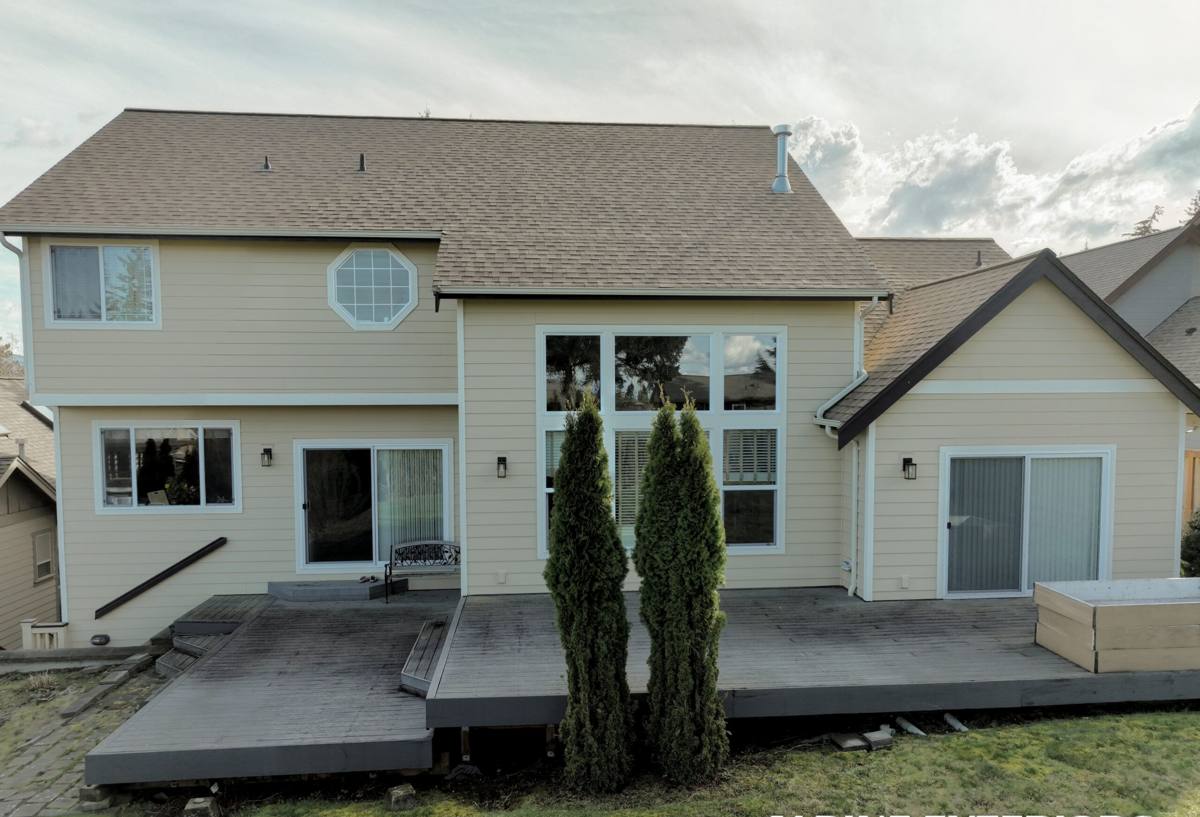
Why Decks Wear Out Faster Here
Salt air and fasteners
Homes closer to the water deal with a slow, steady corrosion problem that inland decks never see. Salt-laden air accelerates rust on fasteners, brackets, and any hardware that isn't rated for it. A deck can look structurally fine on the surface while the ledger bolts or joist hangers underneath are quietly corroding. This is one of the most common reasons we get called out to a deck that's "only" 12-15 years old and already needs full replacement rather than repair.
Driving rain and end-grain exposure
Rain here doesn't fall straight down — wind-driven rain gets under rail caps, into fastener holes, and along the cut ends of boards where sealant has worn thin. Wood (and even some composite substrates) absorbs the most moisture through end grain and any spot where the factory coating has been cut or drilled through. Over time this shows up as soft spots near stair stringers, swelling at board ends, and rot starting from the inside out — often before the surface looks bad.
Moss, algae, and the shade problem
A long moss season means anything shaded — under trees, on the north side of a house, near fences — stays damp far longer after a rain than a similar deck in full sun. Moss and algae hold moisture against the deck surface, and on wood decking that moisture cycle is what actually causes rot; the moss itself is more of a symptom than the cause. Decking material, board spacing, and airflow underneath the deck all affect how quickly a surface dries out between storms.
Signs a Deck Needs Replacement, Not Repair
- Soft or spongy spots in the decking, especially near the house or at stair landings
- Visible rust staining running down from fasteners or hardware
- Railing posts that wiggle at the base — often a sign the post-to-frame connection has rotted
- Persistent moss or dark staining that comes back within weeks of cleaning
- A ledger board (where the deck attaches to the house) that shows gaps, staining, or soft wood
- Boards cupping, splitting, or pulling away from fasteners
- A deck older than 20 years that has never had the substructure inspected
Surface staining or a few loose boards can often be repaired. Structural issues at the ledger, posts, or joists usually mean the substructure has been compromised long enough that a full rebuild is the more honest recommendation — patching those spots just moves the failure point somewhere else.
What a Correct Deck Replacement Involves
Tear-off and inspection
We remove the old decking, railing, and — where needed — the substructure, and inspect what's underneath: the ledger connection, the posts, footings, and joists. This is often where we find the real story behind why the old deck failed, whether that's undersized framing, missing flashing at the ledger, or hardware that was never rated for exterior or coastal exposure.
Ledger flashing done properly
The ledger-to-house connection is the single most common failure point on any deck in a wet climate, because it's the one spot where the deck penetrates the building envelope. Proper flashing here — installed so water sheds away from the house rather than behind the ledger — matters more to long-term durability than almost any other decision on the project.
Fasteners and hardware rated for the exposure
Given the salt air common to homes in and around Chuckanut, we use fasteners and structural hardware rated for coastal or high-corrosion exposure, not standard interior-grade hardware. It costs a little more up front and it's the difference between hardware that lasts the life of the deck and hardware that's rusting through in under a decade.
Decking material selection
Wood, composite, and PVC decking each respond differently to this climate. We'll walk through the honest trade-offs for your specific site — sun exposure, shade, proximity to salt air — rather than defaulting to one product for every job.
Decking Material Comparison for Coastal, Wet Climates
| Material | Moisture Behavior | Maintenance | Typical Lifespan |
|---|---|---|---|
| Pressure-treated wood | Absorbs moisture at cuts and fastener holes; needs sealing to manage it | Annual cleaning, periodic re-staining/sealing | 10-15 years before major work |
| Cedar | Naturally moisture-resistant but still needs maintenance in constant damp/shade | Regular cleaning and refinishing | 15-20 years with upkeep |
| Composite decking | Doesn't rot, but can hold surface moisture/algae if airflow is poor | Periodic cleaning, no sealing or staining | 25-30 years, varies by product |
| PVC decking | Fully moisture-resistant surface; least sensitive to shade and rain exposure | Lowest maintenance of the group | 25+ years |
These are general trade-offs, not a recommendation for every home — the right choice depends on your budget, how shaded the deck is, and how much upkeep you want to do.
Our Process for a Columbia Deck Replacement
- On-site assessment — we look at the existing deck, the ledger connection, framing condition, drainage, and sun/shade exposure specific to your lot.
- Honest scope and estimate — we tell you plainly whether you need a full replacement or whether targeted repair is realistic, and what's driving that recommendation.
- Material walkthrough — we go over decking, railing, and hardware options with the actual trade-offs for your site, not a one-size answer.
- Tear-off and substructure rebuild — old materials removed, framing and ledger flashing corrected as needed, corrosion-rated hardware installed throughout.
- Decking and railing installation — installed to manufacturer spacing and fastening specs, with attention to drainage and airflow underneath.
- Final walkthrough — we go over the finished deck with you and flag any maintenance you should keep an eye on given your specific exposure.
Cost Factors for a Deck Replacement
| Factor | Why It Affects Cost |
|---|---|
| Deck size and shape | More square footage and multi-level or angled designs mean more material and labor |
| Substructure condition | Rotted framing, posts, or footings add rebuild work beyond the visible decking |
| Decking material chosen | Wood, composite, and PVC carry different material costs and installation labor |
| Railing style and code requirements | Height, baluster spacing, and material all affect both cost and permitting |
| Site access and height | Elevated decks or difficult access add labor time |
| Ledger and flashing work | Correcting a poorly flashed ledger connection is worth the added cost to protect the house |
We don't quote decks over the phone with a flat number, because the substructure condition is usually the biggest variable — and you won't know that until someone's actually pulled up the old boards.
Why Hire a Crew That Already Works in Chuckanut
A deck replacement here isn't the same job as a deck replacement in a dry inland climate, and it isn't the same job on every Chuckanut property either — a shaded, tree-covered lot in Columbia behaves differently than an open, wind-exposed one. A crew that regularly works this area already knows to spec corrosion-rated hardware without being asked, knows what a properly flashed ledger needs to look like given the rain patterns here, and has seen firsthand how fast an under-built deck fails in this climate. That's not something you get from a crew that mostly works decks somewhere drier.
We're straightforward about what we find during tear-off, what it'll take to fix it right, and what your material options actually mean for maintenance down the road — no upsells on things your deck doesn't need, and no cutting corners on the parts that matter, like ledger flashing and fastener grade.
Get a Free Estimate
If your deck in the Columbia area is showing soft spots, rust staining, or a railing that's gone loose at the base, it's worth having it looked at before it gets worse. We offer free, no-pressure estimates — walk us through what you're seeing and we'll give you an honest read on whether it's a repair or a full replacement, along with what that would involve for your specific property. Use the form below to get started.