 Chuckanut
 Why Lake Samish Homes Need Windows Built for This Climate
Homes around Lake Samish sit in a different microclimate than a house a few miles away in town. Tall conifer cover shades roofs and walls for much of the day, lake humidity lingers in the air longer than it does on open ground, and many lots slope steeply enough that water runs fast and finds every gap it can. Add in the driving rain that comes through Whatcom County in the fall and winter, plus the salt-tinged air that drifts up from the nearby bay on a west wind, and you have a set of conditions that is genuinely harder on a window than what most manufacturers test for.
A lot of the homes out here started as cabins or seasonal places and have since been upgraded into full-time residences. That means the original windows were often chosen for a weekend retreat, not for year-round comfort or a real heating bill. When we get called out to Lake Samish, the most common request isn't cosmetic — it's homeowners who are done fighting drafts, condensation, and a furnace that never seems to catch up.
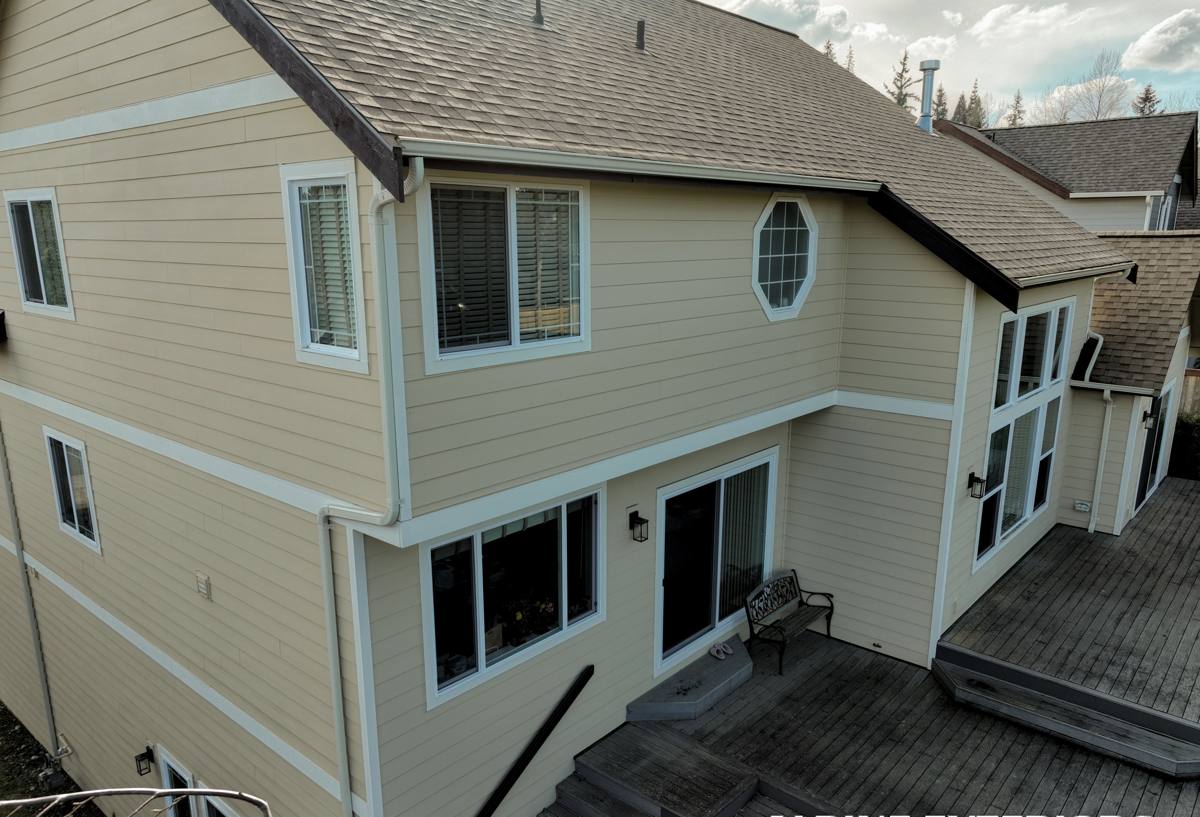
What Moss Season, Driving Rain, and Damp Air Do to Windows Here
Whatcom County's long wet season is hard enough on siding and roofing — it's just as hard on window components that aren't built or installed to handle sustained moisture. Around Lake Samish specifically, the tree canopy means many windows never get a full afternoon of direct sun to dry out after a storm. Moisture sits in wood sills and frame corners longer, moss and algae get a foothold on horizontal surfaces, and any small gap in the original flashing or caulking becomes a slow, ongoing intrusion point rather than a one-time leak.
Older aluminum-frame windows conduct cold straight through the frame and fog up with condensation on humid mornings. Older wood windows that haven't been maintained can have soft spots at the bottom corners where water collects. Even reasonably modern vinyl windows can fail early if the low-E coating or gas fill was never a good match for a shaded, damp lot in the first place.
Warning Signs Worth Taking Seriously
- Fogging or a milky haze between the panes of a double-pane window — the seal has failed and the insulating gas is gone
- Cold air you can feel near the frame even with the window fully latched
- Soft, spongy, or discolored wood at the sill or bottom corners
- Moss or dark staining building up on the sill or exterior trim year after year
- Difficulty opening, closing, or latching a window that used to operate smoothly
- A noticeable jump in heating costs with no other explanation
What "Energy-Efficient" Really Means for This Climate
Energy-efficient windows aren't just double-pane glass — the numbers behind them matter, and they matter differently depending on how much sun and moisture a house actually gets. For a shaded, damp lot like most around Lake Samish, we're usually weighing insulation value more heavily than solar control, since these homes aren't fighting summer heat gain the way a south-facing valley home might be.
| Spec | What It Tells You | What to Look For Here |
|---|---|---|
| U-Factor | How well the window resists heat loss | Lower is better — prioritize this given our long heating season |
| SHGC (Solar Heat Gain Coefficient) | How much solar heat passes through the glass | Less critical on shaded lots; more relevant on lake-facing, sun-exposed walls |
| Low-E Coating | Microscopic coating that reflects heat back into the room | Worth having on every window, shaded or not |
| Gas Fill (argon/krypton) | Inert gas between panes that slows heat transfer | Standard on quality double- and triple-pane units |
| Frame Insulation | How much the frame material itself conducts cold | Matters more here than in drier climates, since cold frames also condense moisture |
The other piece that doesn't show up on a spec sheet is how well the window was installed. A high-performance window installed with a poor moisture barrier will still leak air and water — the rating on the box only holds up if the installation detail behind it is done right.
Frame Materials: What Holds Up on a Lake Samish Lot
We get asked a lot whether vinyl, fiberglass, or wood-clad is the "right" choice. Honestly, all three can perform well here — the right pick depends on your home's exposure, your maintenance appetite, and your budget. Here's how we walk homeowners through it.
| Frame Type | Moisture Resistance | Maintenance | Best Fit |
|---|---|---|---|
| Vinyl | Very good — won't rot, doesn't need painting | Low — occasional cleaning | Most homes prioritizing value and low upkeep |
| Fiberglass | Excellent — very stable in wet/dry cycling | Low | Shaded, high-moisture lots or homes with larger window openings |
| Wood-Clad | Good on the exterior clad face; interior wood needs care | Moderate — interior finish upkeep over time | Homes prioritizing a traditional wood interior look |
| Aluminum | Poor thermal performance; prone to interior condensation in our climate | Low, but condensation issues are a maintenance headache of their own | Generally not our recommendation for full-time Lake Samish homes |
We steer most homeowners here away from bare aluminum frames — not because the metal itself is bad, but because uninsulated aluminum conducts cold straight through, which means condensation on the frame almost every damp morning. In a shaded, humid spot like this, that condensation has nowhere good to go and just adds another moisture problem to manage.
How We Handle a Window Replacement Here
Every home is a little different, but our process on Lake Samish jobs generally follows the same order, because skipping steps is exactly how call-backs happen two winters later.
- Walk the exterior with you and check each opening for existing rot, soft framing, or past water intrusion before quoting anything
- Measure and confirm frame sizes, sightlines, and any structural framing repairs needed
- Remove the old window carefully and inspect the rough opening for hidden moisture damage
- Repair or replace any compromised framing before the new window ever goes in
- Install a proper sill pan and flashing sequence so water is directed out and down, never trapped behind the new window
- Set the window level, plumb, and square, then seal and insulate around the frame correctly — not just caulked from the outside
- Finish exterior trim and touch up siding tie-ins so the whole assembly sheds water the way it's supposed to
- Walk the finished work with you and confirm every window operates and locks properly
Why the Flashing Detail Gets Extra Attention Here
Driving rain doesn't fall straight down — wind pushes it sideways into wall assemblies, especially on exposed or lake-facing sides of a house. That's why our flashing and sill pan work gets extra attention on Lake Samish jobs specifically: a window that's fine in a sheltered, sunny spot can still leak here if the water-shedding details aren't done to account for wind-driven rain and the extra time everything stays damp under the trees.
Why the Installation Matters More Than the Brand Name
We won't tell you one window brand is bad and another is good — most reputable manufacturers make a solid product when it's installed correctly. What actually determines whether a window performs for twenty years or fails in five is almost always the installation: the flashing sequence, the quality of the seal around the frame, whether the rough opening was properly prepared, and whether the person doing the work understood how water moves through a wall assembly in this specific climate. A premium window installed poorly will underperform a mid-range window installed correctly, every time.
Why Local Experience on Lake Samish Matters
Working around the lake comes with practical realities that a crew unfamiliar with the area won't anticipate. Many properties have narrow or steep gravel access, limited staging space, and septic or well systems that need to be worked around rather than driven over. Older cabins converted to full-time homes sometimes have framing that doesn't match modern standard sizes, which affects window ordering and lead times. And because much of the area falls under Whatcom County's building requirements rather than a city process, permitting and inspection expectations can differ from a job just a few miles away in Bellingham.
A crew that's done this work around Lake Samish before knows to check for these things upfront instead of discovering them mid-installation — which keeps your project on schedule and avoids surprise costs.
Keeping New Windows Performing Season After Season
Energy-efficient windows are a long-term investment, and a little seasonal attention keeps them performing the way they're supposed to.
- Clear moss and debris from sills and tracks before it holds moisture against the frame
- Check exterior caulking and trim seals each fall before the wet season sets in
- Keep gutters and downspouts clear so runoff isn't sheeting down across window heads
- Trim back branches or vegetation that keeps a window shaded and damp longer than necessary
- Operate each window a few times through the year so hardware and weatherstripping don't seize up
What Affects the Cost of a Window Replacement Here
| Factor | Why It Matters |
|---|---|
| Number and size of openings | More or larger windows means more material and labor |
| Frame material chosen | Vinyl, fiberglass, and wood-clad carry different material costs |
| Condition of existing framing | Hidden rot or water damage adds repair work before installation |
| Access and site conditions | Steep or limited-access lots can affect staging and labor time |
| Performance package | Triple-pane, upgraded gas fill, or specialty coatings add cost but improve efficiency |
We give honest, itemized pricing rather than a flat per-window number, because the factors above genuinely change the cost from one Lake Samish home to the next — and we'd rather you understand what you're paying for than guess.
Ready for Windows That Actually Handle This Climate?
If your windows are fogging, drafting, or just costing you more to heat than they should, it's worth having a straightforward look before another wet season sets in. We offer free, no-pressure estimates for Lake Samish homeowners — use the form below to get a time on the calendar.