 Chuckanut
 Silver Beach is one of the shoreline communities in the broader Chuckanut area, and like the rest of this stretch of Whatcom County coastline, it takes a steady beating from salt-tinged marine air, storms that drive rain sideways into exterior walls, and a moss season that can stretch across most of the year on shaded sides of a house. Siding here isn't just a finish layer — it's the first and, in a lot of weather, the only thing standing between that climate and the framing underneath. This page is specifically about fiber cement siding for Silver Beach homes: what the local climate actually asks of the material, what a correctly installed job looks like, how we run the work, and why a crew that already works this shoreline handles it differently than one seeing it for the first time.
What Silver Beach's Climate Actually Demands From Siding
A lot of siding failures aren't really material failures — they're mismatches between a product's design and the specific conditions it's asked to survive. Silver Beach's conditions are specific enough that they're worth naming individually.
Salt Air Off the Water
Air moving across the bay and into the Chuckanut area carries a mild but persistent salt content, and that salt doesn't stay near the shoreline — it settles onto siding, trim, and fasteners across the whole neighborhood, not just the homes closest to the water. Over time, salt exposure accelerates the breakdown of paint films and lower-grade finishes and speeds corrosion at any fastener or flashing point that isn't rated for it. A finish that looks fine after year one can be visibly chalking or fading by year four if it wasn't built for this kind of air.
Driving, Wind-Driven Rain
Storms rolling in off the water don't drop straight down the way a calm rain does — wind pushes them sideways into whichever wall faces the weather, forcing water into seams, laps, and joints that a well-designed siding system is supposed to shed rather than absorb. On a home with an exposed, water-facing elevation, that wall takes meaningfully more punishment than the sheltered side of the same house, which is why flashing and lap details matter more here than they would on a calm inland lot.
A Long Moss and Mildew Season
Between marine humidity, regular Pacific Northwest rainfall, and the tree cover common on Chuckanut-area lots, north-facing and shaded walls in Silver Beach often don't get a long enough dry stretch to fully reset between storms for much of the year. That's the exact condition moss and mildew need to establish themselves. Siding materials that hold moisture at the surface rather than shedding it stay damp longer, giving organic growth more time to take hold before the next dry spell shows up.
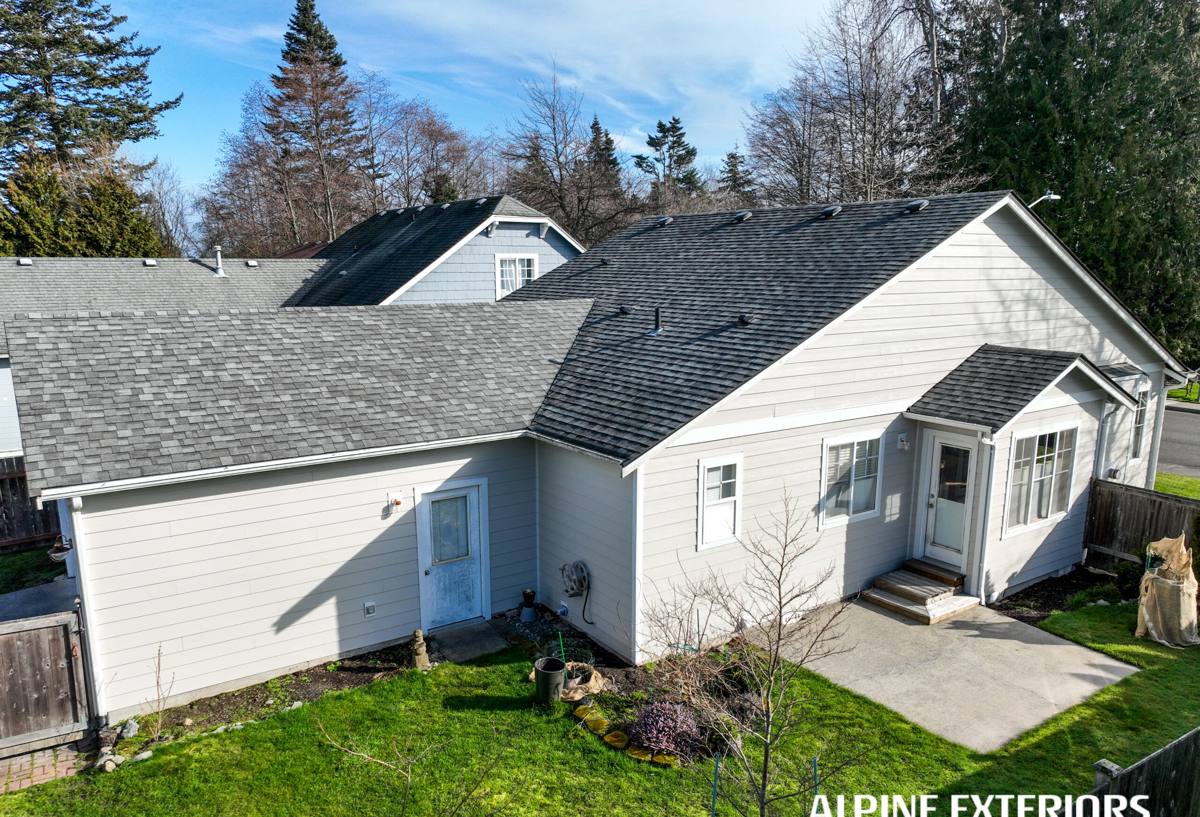
Why We Install James Hardie Fiber Cement Here — Nothing Else
We install James Hardie fiber cement siding exclusively. We don't install LP SmartSide, vinyl, Cemplank, Allura, primed spruce, or cedar. That's not a sales preference — it's a standard we settled on after weighing what each of those products actually asks of a homeowner in a climate like this one, and deciding we're only willing to put our name behind the system that holds up without leaning on a homeowner's maintenance discipline to get there.
Climate-Engineered HZ Product Lines
Hardie's HZ5 formulation is engineered specifically for regions with heavy moisture exposure and freeze-thaw cycling, which is a close match for a marine-influenced, high-rainfall setting like Silver Beach. It's not a generic siding board — the formulation itself is built around this kind of exposure.
Factory-Applied ColorPlus Finish
Instead of a field-applied paint job that starts weathering the day it goes on, Hardie's ColorPlus finish is baked on in a controlled factory process. That finish holds color and resists the fading, chalking, and moisture intrusion that salt air accelerates in site-applied coatings, and it's backed by its own finish warranty separate from the substrate warranty.
A Non-Combustible, Dimensionally Stable Core
Fiber cement's cement, sand, and cellulose fiber composition doesn't feed a fire the way wood-based siding can, and it doesn't swell, cup, or warp with repeated wetting the way engineered wood products can near sustained marine moisture. It moves through wet-dry cycles without the dimensional changes that stress joints and fasteners over time.
A Warranty Worth Having
Hardie backs correctly installed siding with one of the stronger transferable warranty structures in the industry — but that warranty is only as good as the installation behind it, which is why installation quality gets its own section below.
What a Correct Fiber Cement Installation Actually Involves
Fiber cement only performs the way it's engineered to when it's installed to Hardie's published specifications. The material itself isn't the variable that determines whether a job holds up in this climate — the installation is. On a Silver Beach property, we treat these as non-negotiable, not upgrade options:
- Correct fastener type, length, and spacing per Hardie's specification for the substrate and exposure
- Proper clearance from grade, roofline, and any horizontal surface like a deck or patio
- Drainage or rain-screen detailing appropriate to the wall assembly, especially on water-facing elevations
- Correctly lapped and sealed joints at every butt seam, corner, and trim intersection
- Flashing integrated properly at every window, door, and roof-to-wall transition — the single most common place moisture actually gets into a wall
- Factory-cut or properly field-sealed cut edges, since an unsealed cut edge is a weak point regardless of how good the rest of the installation is
A quality board installed loosely will still develop moisture problems on a wind-exposed Silver Beach wall. The material and the installation have to both be right — one doesn't compensate for the other.
How We Run a Fiber Cement Project in Silver Beach
The sequence itself isn't unusual, but where we put extra attention shifts based on what this specific climate asks for.
- Assessment and exposure mapping: We walk the property and identify which elevations take direct wind-driven rain and salt exposure versus which stay more sheltered, since that changes flashing and drainage priorities wall by wall.
- Tear-off and substrate check: Existing siding comes off and we inspect the sheathing and framing underneath for any moisture damage that needs to be addressed before new siding goes up — covering a compromised substrate just traps the problem.
- Weather-resistive barrier and flashing: House wrap or building paper goes on correctly lapped, and flashing gets installed at every penetration, window, door, and transition before a single piece of siding is hung.
- Siding installation to spec: Boards go up with correct fastener spacing, clearance, and lap detailing, with extra attention on water-facing walls identified in the assessment step.
- Trim, caulking, and final seal: Joints, corners, and trim intersections get sealed correctly, since these are the details that determine whether wind-driven rain stays out over the long run.
- Final walkthrough: We go over the finished work with the homeowner and explain what maintenance, if any, the specific product and color require going forward.
Comparing Siding Materials in a Salt Air, High-Rain Climate
| Material | Moisture Behavior | Maintenance Near the Water | Typical Longevity Here |
|---|---|---|---|
| James Hardie fiber cement | Dimensionally stable; sheds moisture rather than absorbing it | Low; factory finish resists salt-driven fading and chalking | 30+ years with correct installation |
| Vinyl siding | Can trap moisture behind panels in poorly ventilated wall assemblies | Low upfront cost, but seams and edges stay damp longer near the shoreline | Variable; shorter on directly water-facing elevations |
| LP SmartSide / engineered wood | Wood-based core is moisture-sensitive at cut edges and joints | Moderate to high; edge sealing is critical in sustained dampness | Depends heavily on installation quality and upkeep |
| Cedar / primed wood | Absorbs and releases moisture readily | High; needs recurring refinishing, especially on exposed walls | Shorter without a disciplined maintenance schedule |
What Drives Cost on a Silver Beach Fiber Cement Job
Every property is different, so we're not going to quote a number here that doesn't mean anything without seeing the house. What we can tell you is what actually moves the price on a job like this:
| Factor | Why It Matters |
|---|---|
| House size and wall complexity | More square footage, corners, and trim details mean more material and labor |
| Existing siding removal | Tear-off and disposal of old material adds time versus a bare-sheathing install |
| Substrate condition | Water-damaged sheathing found during tear-off needs repair before new siding goes up |
| Exposure and access | Water-facing walls, steep grades, or limited access can add labor time |
| Product line and profile | Lap width, texture, and trim style affect material cost |
| Color | Standard ColorPlus colors versus custom or premium finish options |
The only way to get a real number is a walk-through of the specific property, which is what we offer below.
Why a Crew That Already Works Silver Beach Matters
Two homes a short distance apart in Silver Beach can have genuinely different exposure profiles — one with a wide-open wall facing the water and taking full wind-driven rain, another set back and shaded enough to deal more with moss than with storm exposure. A crew that regularly works this shoreline already recognizes that difference on sight and adjusts drainage detailing, flashing laps, and fastener choices wall by wall, instead of applying one generic spec to the whole house and hoping it holds. That's the difference between a siding job that looks good for a season and one that's still doing its job decades in.
A Few Questions Worth Asking Before You Hire
- What siding product do they install, and are they willing to explain why they chose it over the alternatives?
- Are they Hardie-certified, and does that certification back the warranty they're quoting?
- Do they talk specifically about flashing, clearance, and drainage detailing, or just about the product name?
- Have they worked on water-facing or salt-exposed properties in this area before?
- Will they put the warranty terms in writing before work starts?
Local experience isn't a marketing line — it's the difference between a crew that has already seen how this specific stretch of coastline treats a wall and one that's guessing.
If you're weighing siding options for a home in Silver Beach or elsewhere in the Chuckanut area, we're glad to walk the property, point out which elevations are taking the most weather, and give you a straight read on what fiber cement siding would actually involve for your house. Reach out for a free, no-pressure estimate.