 Chuckanut
 Metal Roofing Built for Bellingham's Climate
Bellingham homeowners looking at metal roofing are usually weighing the same thing: a roof that outlasts two or three shingle replacements, sheds the region's constant rain without holding onto moss, and doesn't need much attention once it's on. That's a fair read of what metal roofing can do. What it glosses over is that metal roofing performs that well only when it's installed with real attention to the specific conditions it has to survive here — salt-tinged marine air off Bellingham Bay, rain that gets driven sideways into seams and laps instead of just falling straight down, and a moss season on shaded roof planes that can run most of the year. A metal roof installed to a generic national spec, without those local stresses in mind, will not perform the way the material is capable of performing.
This page focuses specifically on metal roofing for homes in the Bellingham area — what the material needs to do here, what a correct installation actually involves, and what separates a metal roof that runs 40-plus years without a callback from one that starts leaking at the fasteners inside a decade.
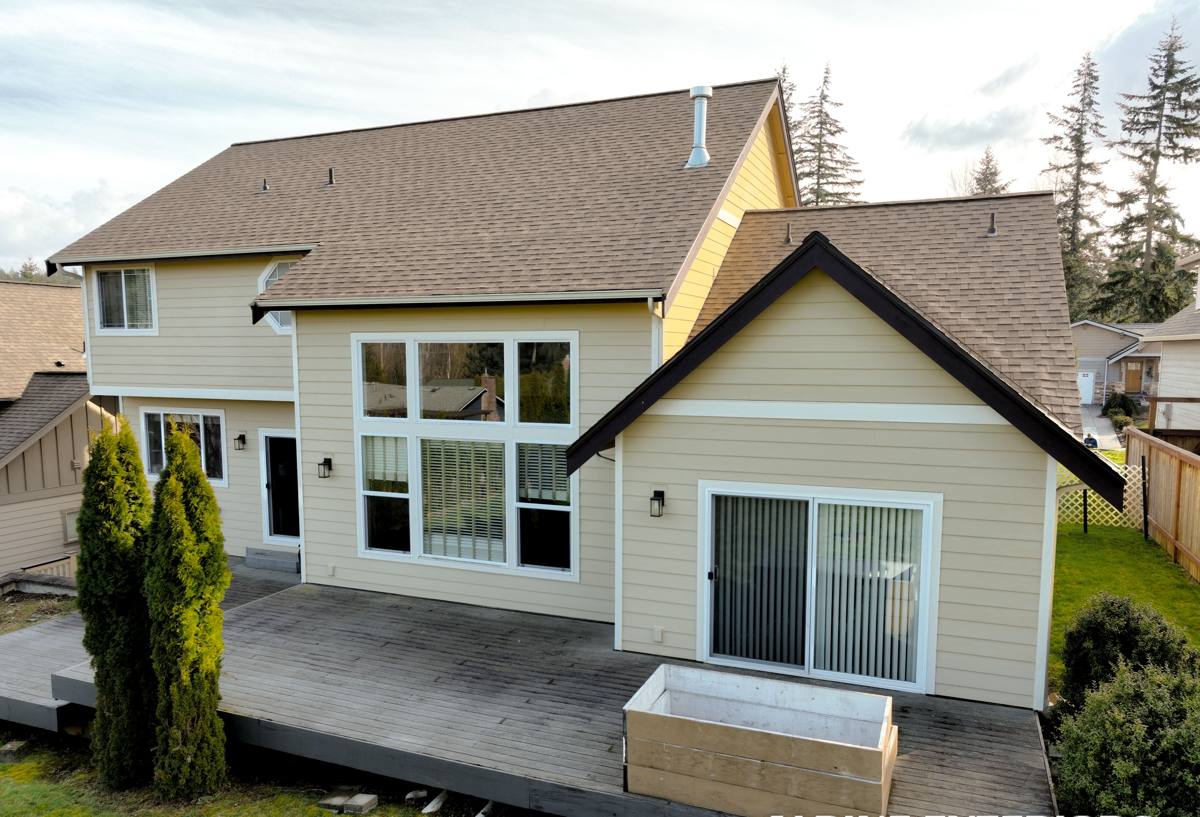
Why Metal Roofing Fits This Corner of Whatcom County
Metal roofing has a real, practical case for homes in a wet, salt-exposed, moss-prone climate like this one, beyond just its reputation for lasting a long time.
- Steep, fast water shedding: A metal panel's smooth, continuous surface sheds rain quickly instead of holding it against a porous texture, which matters directly in a place where storms can stack up for days at a time.
- Poor growth surface for moss and algae: Moss and algae need a rough, moisture-retentive surface to establish on. Metal doesn't offer either one the way shingles or wood shakes do, so shaded, north-facing planes stay noticeably cleaner over time.
- Non-combustible: Metal roofing carries a Class A fire rating, which matters to insurers and to homeowners regardless of how close a property sits to wildland vegetation.
- Long service life: A correctly installed metal roof commonly runs 40 to 60 years, well beyond the 20 to 30 years typical of a good asphalt shingle roof, which changes the math on a homeowner's long-term cost per year of coverage.
- Minimal ongoing maintenance: Once installed correctly, a metal roof asks very little of a homeowner beyond periodic gutter and debris checks, a real advantage in a climate that punishes anything requiring a recurring maintenance schedule.
None of that makes metal roofing the automatic right answer for every home or every budget. It does mean the material's strengths line up unusually well with what Bellingham's weather actually does to a roof year after year.
What a Correct Metal Roof Install Involves
Metal roofing is unforgiving of shortcuts in a way asphalt shingles sometimes aren't. A shingle roof with a slightly imperfect detail can often limp along for years before it fails. A metal roof with the same kind of imperfect detail — a poorly lapped seam, an under-spec fastener, a flashing detail sealed with caulk instead of built into the system — tends to show the problem sooner, because the whole system is designed around precision rather than mass and redundancy.
Deck Condition and Underlayment
Metal panels get installed over a solid deck and a high-temperature synthetic or self-adhered underlayment, not the lighter felt sometimes used under shingles. That underlayment is the roof's real waterproof layer in a lot of respects, since it's what stands between the house and any water that works its way past a seam or fastener during the sideways, wind-driven rain events that are routine here. Ice-and-water shield membrane at eaves, valleys, and around every penetration adds a second line of defense at the spots where water pressure is highest.
Panel Fastening: Concealed Clips vs. Exposed Screws
How a panel is attached to the roof deck has more to do with long-term performance than almost any other single decision. Standing seam panels are held down with concealed clips hidden under the seam, which lets the metal expand and contract with temperature changes without stressing the fastener. Exposed-fastener panels are screwed directly through the face of the panel, which is faster and less expensive to install but leaves every screw penetration, and the rubber washer sealing it, exposed to years of UV, salt air, and freeze-thaw cycling. Either system can perform well, but they age differently, and a homeowner should know which one they're getting and why.
Flashing at Valleys, Ridges, and Penetrations
As with any roofing material, most real-world leaks on a metal roof start at a transition, not in the open panel field. Valleys, ridge caps, chimney and vent penetrations, and wall-to-roof transitions all need flashing that's formed and integrated into the panel system, with closures and sealant used correctly at each joint rather than as a substitute for a proper mechanical fit.
Ventilation
Balanced intake and exhaust ventilation keeps the underside of the roof deck dry and helps control condensation, which matters more on a metal roof than people often expect — metal is an excellent conductor, and without adequate airflow and underlayment, temperature swings between a cold night and a warmer day can produce condensation on the underside of the panels themselves.
Standing Seam vs. Exposed-Fastener Panels
| Factor | Standing Seam | Exposed-Fastener Panel |
|---|---|---|
| Fastening method | Concealed clips under the seam | Screws driven directly through the panel face |
| Expansion and contraction | Panel floats on clips, handles temperature swings cleanly | Fasteners are fixed points, working against panel movement over time |
| Weak points over time | Seam integrity and clip spacing | Screw penetrations and washer seals, which harden and crack with UV and age |
| Typical service life | 50 years or more with correct installation | 25-40 years, often shorter if washers aren't checked and re-sealed periodically |
| Upfront cost | Higher | Lower |
| Best fit | Homeowners prioritizing longest service life and lowest maintenance | Homeowners balancing budget against a still-solid, long-lasting roof |
Both systems have a legitimate place on Bellingham roofs. Where we steer a homeowner depends on budget, roof complexity, and how long they plan to own the home — a straightforward gable roof on a home the owner plans to keep for decades makes a strong case for standing seam, while a more complex roofline or a tighter budget can still get real value out of a well-installed exposed-fastener system.
Coatings, Fasteners, and Corrosion Protection
Salt air off the bay is a slow, steady corrosive force, and it doesn't announce itself the way a storm does. It works quietly on unprotected metal, lower-grade fasteners, and thin coatings for years before a problem becomes visible. A few details determine how well a metal roof resists that process.
| Detail | Why It Matters Here |
|---|---|
| Panel coating (Kynar 500/PVDF vs. basic polyester) | A premium PVDF finish resists fading, chalking, and coating breakdown far longer under sustained UV and salt exposure than a basic painted finish |
| Steel or aluminum substrate quality | Heavier-gauge, properly galvanized or aluminum-zinc coated steel resists corrosion at cut edges and fastener points better than thin, minimally coated material |
| Fastener material matching | Mixing dissimilar metals between fasteners and panels sets up galvanic corrosion, where one metal accelerates the breakdown of the other at every contact point |
| Cut-edge treatment | Field-cut panel edges expose bare steel unless they're properly treated or positioned away from direct water flow |
This is one of the more common places we see corners cut on metal roofs that fail early: a contractor uses whatever fastener is on the truck instead of one matched to the panel metal, or installs a budget coating without explaining the trade-off to the homeowner. Neither shows up as a problem on installation day. Both show up as a problem five to ten years later, in a climate that gives corrosion every advantage it needs.
Cost Factors Worth Understanding
Metal roofing bids vary more than shingle bids do, because the material, panel style, and finish all carry real price differences on top of labor. Understanding what drives the number makes it much easier to compare estimates that look nothing alike on paper.
| Factor | What It Affects |
|---|---|
| Panel style | Standing seam costs more upfront than exposed-fastener panel but generally lasts longer with less maintenance |
| Coating grade | PVDF/Kynar finishes cost more than basic polyester coatings but resist fading and breakdown far longer |
| Steel gauge and substrate | Heavier-gauge material resists denting and corrodes more slowly at edges and fasteners |
| Roof complexity | Valleys, dormers, and penetrations all add flashing labor and material that a simple gable roof doesn't require |
| Underlayment grade | Self-adhered, high-temperature underlayment costs more than basic synthetic but performs better under wind-driven rain |
| Tear-off vs. re-roof over existing material | Whether hidden deck damage gets found and repaired before new panels go down |
A written estimate that breaks these components out line by line tells you far more than a single total. If two bids for the same roof come in noticeably apart, the gap is almost always in one of these categories, not in one contractor simply padding the number.
How Our Process Works
A metal roof is a long-term investment, and we run the process so you know exactly what you're getting at each stage, not just at the final walkthrough.
- In-person inspection: We walk the roof and attic ourselves, checking deck condition, ventilation, and existing flashing details before quoting anything.
- Written estimate: You get an itemized bid covering panel style, coating grade, underlayment, flashing, and ventilation, not a single lump-sum figure.
- Material selection: We walk through the standing seam versus exposed-fastener trade-off, coating options, and color, based on your budget and how long you plan to stay in the home.
- Scheduling around weather: We build reasonable flexibility into the timeline, since wet-season delays are a normal part of working in this region.
- Tear-off and deck repair: Old roofing comes off completely, and any deck damage found gets repaired before underlayment and panels go on.
- Underlayment, flashing, and panel installation: Each layer goes on to manufacturer specification, with particular attention at valleys, penetrations, and wall transitions.
- Final walkthrough: We review the finished roof with you in person before considering the job complete.
Why Hiring a Crew That Already Works in Bellingham Matters
Metal roofing rewards experience in a way that's easy to underestimate. A crew that's worked roofs throughout the Bellingham area has already seen how salt air corrodes mismatched fasteners over a handful of winters, which panel details actually shed wind-driven rain during a real Whatcom County storm, and which roof orientations hold onto moss long enough to matter. That's the kind of practical knowledge that shows up in dozens of small decisions across a job, decisions a crew unfamiliar with this specific stretch of coastline has no reason to think twice about.
It also matters after installation. A workmanship warranty on a roof meant to last 40 to 60 years is only worth something if the company behind it is still reachable decades from now, not a name that installed a handful of roofs in the region and moved on.
A Practical Checklist Before You Choose a Metal Roofing Contractor
- Do they specify panel type, gauge, and coating by name, not just "metal roofing"?
- Is fastener material explicitly matched to the panel metal to avoid galvanic corrosion?
- Does the estimate call out underlayment grade separately from the panel itself?
- Is flashing work at valleys, penetrations, and wall transitions written into the bid, not left vague?
- Do they carry current WA contractor licensing, liability insurance, and workers' compensation?
- Can they point to metal roofing work they've actually completed in or near Bellingham?
- Does the bid separate the manufacturer's material warranty from the contractor's own workmanship warranty?
Signs Your Bellingham Roof May Be a Good Fit for Metal, or Due for Attention
Some situations point clearly toward metal roofing as worth serious consideration, and if you already have one, a few signs are worth having checked before they become a bigger repair.
- You're on your second or third asphalt shingle roof on the same house and want to stop the replacement cycle
- Heavy, shaded tree cover means persistent moss on any shingle roof you've had
- You're planning to stay in the home long enough for a longer-lived material to pay off
- An existing metal roof shows rust streaking at fastener heads or cut edges
- Panel seams or ridge caps show visible gaps, lifting, or loose fasteners
- You notice condensation or staining on the underside of the roof deck in the attic
If any of that sounds familiar, whether you're weighing a first metal roof or looking at an existing one that's showing its age, it's worth having someone take a real look rather than guessing from the ground.
If you'd like an honest, no-pressure look at your Bellingham roof and a written estimate you can compare against anything else you've received, we're glad to come take a look. Use the form below to request a free estimate.