 Chuckanut
 Building Decks for Samish's Coastal Climate
Samish sits close enough to the water that salt-laden air, wind-driven rain, and a moss season that can run eight months or more are just part of owning a home here. A deck built the way it would be built inland — standard fasteners, no ledger flashing, boards laid tight with no drainage plan — will look fine for a year or two and then start showing problems: black streaks, soft spots at the ledger, rust bleeding from screw heads, moss creeping into every north-facing board gap. In Whatcom County's marine climate, a deck isn't just outdoor furniture bolted to the house. It's a structure that has to shed water fast, resist corrosion, and keep breathing air underneath it, or it starts failing from the inside before it ever looks bad from the top.
This page is about what that means specifically for a custom deck built in Samish — the material choices, the framing details, the hardware, and the maintenance reality that comes with living this close to Chuckanut Bay's weather.
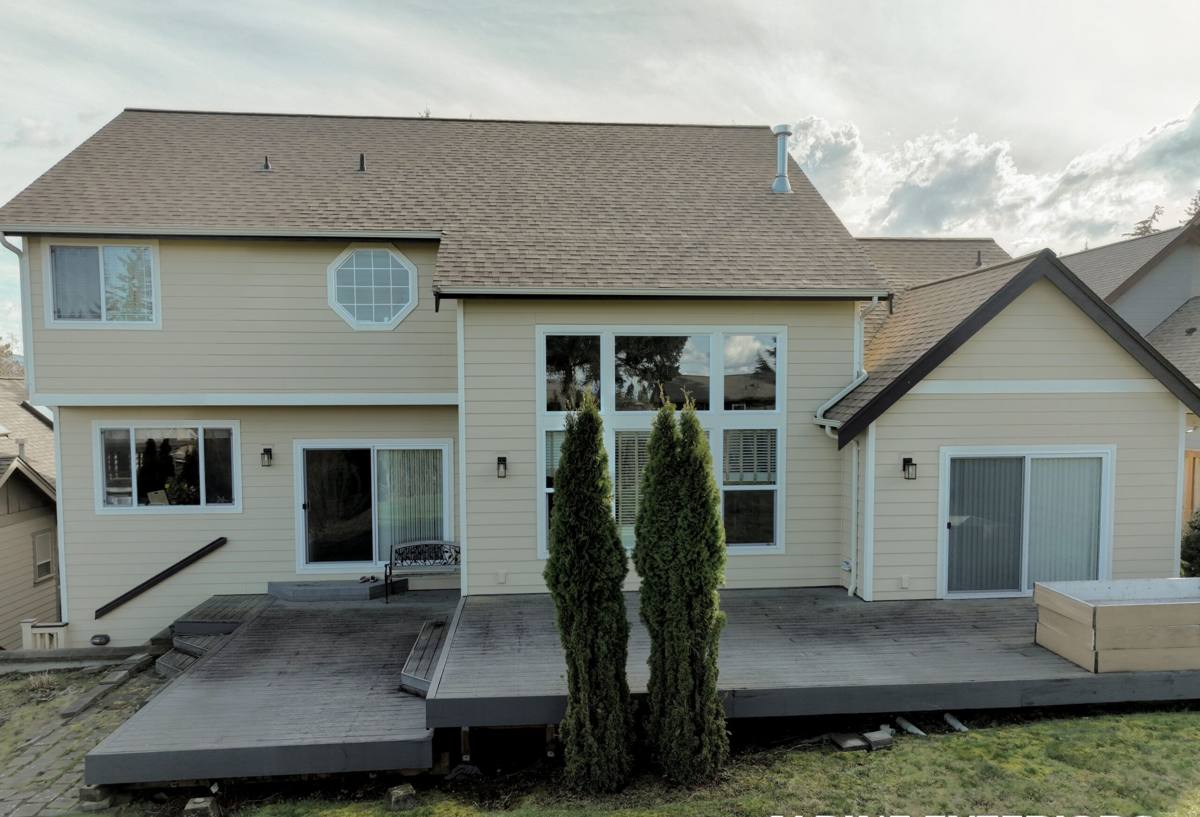
What Samish Properties Typically Need From a Deck
Every deck we build is different because every lot is different, but Samish properties tend to share a few conditions worth planning around:
- Wind-driven rain hitting the house at an angle, which means water gets forced under boards and behind ledger boards more than it would on a calmer site.
- Salt air corrosion that accelerates the breakdown of standard zinc-coated screws, nails, and hardware — even a mile or two inland from open water.
- Shaded, tree-covered lots common in this part of Chuckanut, which slow drying time after rain and create ideal conditions for moss and algae growth on decking surfaces.
- Sloped or uneven terrain, which is typical in this part of Whatcom County and affects footing depth, post height, and whether you need a multi-level design instead of a single flat plane.
None of these are exotic problems — they're just the normal cost of building outdoors on the Salish Sea. The fix isn't a different kind of deck, it's building the same deck with the right details in the right places.
Choosing the Right Decking Material
There's no single "best" decking material — there's a best material for your budget, your sun exposure, and how much upkeep you actually want to do. Here's how the common options hold up specifically in a coastal, moss-prone climate like Samish's:
| Material | Upfront Cost | Maintenance | How It Handles Salt Air & Moss |
|---|---|---|---|
| Pressure-treated fir/hem-fir | Lowest | Annual cleaning, re-staining every 2-3 years | Prone to moss buildup in shade; needs consistent sealing to prevent checking and rot at fastener points |
| Cedar | Moderate | Cleaning and oiling every 1-2 years to hold color | Naturally rot- and insect-resistant, but still needs regular cleaning to keep moss from taking hold in shaded areas |
| Composite (Trex, TimberTech, etc.) | Higher | Periodic washing, no staining or sealing | Resists rot and doesn't absorb moisture like wood, but can still grow surface algae in deep shade and needs the same drainage planning underneath |
| PVC decking | Highest | Lowest — occasional washing | Best moisture resistance of the group; performs well in wet, shaded coastal conditions but costs the most upfront |
We'll walk you through this trade-off honestly during your estimate — including where composite or PVC earns back its higher cost over time versus where a well-built wood deck is genuinely the smarter choice for your budget.
Why We're Selective About Certain Product Lines
Not every composite or capstock product on the market performs the same in a wet, shaded coastal climate. Some lower-tier composites are more prone to moisture absorption at cut edges or fastener penetrations if they aren't sealed and installed exactly to spec. Our standard is to only install product lines with manufacturer-backed moisture and fade warranties that hold up in Pacific Northwest conditions, and to follow the manufacturer's installation spec to the letter — proper gapping, hidden fastener systems where specified, and sealed end cuts. That's a maintenance and warranty decision, not a brand opinion.
Framing and Substructure — Where Decks Actually Fail
Almost every deck failure we get called out to repair started underneath the decking, not on top of it. The visible boards are the last thing to fail; the framing is the first. In a climate like Samish's, three details matter more than anywhere drier:
Ledger Flashing
The ledger board — where the deck attaches to the house — is the single most common point of rot on any deck in this region. Without proper flashing (and ideally a water-resistant membrane behind it), driving rain works its way behind the ledger and into the house's rim joist over time. This is invisible from the outside until it's a serious repair.
Joist Protection
Untreated or unprotected joist tops trap moisture under the decking where it never fully dries between rain events. We use joist tape or a comparable moisture barrier on framing members so water sheds off instead of soaking into end grain and screw holes.
Footings and Post Bases
Footings need to be sized and set below the frost line and clear of standing water, with post bases that keep the post end grain off the concrete entirely. On sloped Samish lots this sometimes means deeper or stepped footings rather than a uniform grid — worth planning for before pouring, not after.
Fasteners and Hardware for Salt Air Exposure
This is the detail most decks get wrong, and it's cheap to get right. Standard electro-galvanized screws and nails corrode faster in salt-influenced air, and once a fastener starts rusting, it weakens the connection and stains the surrounding wood or composite. For Samish jobs we specify stainless steel or high-grade coated fasteners rated for coastal/ACQ-treated lumber compatibility, along with corrosion-resistant joist hangers, post bases, and railing hardware. It costs more per fastener. It costs far less than replacing a rail post that's rusted through in six years.
Moss, Algae, and Drainage — The Long-Term Reality
Whatcom County's moss season is long, and a deck in a shaded Samish yard will grow some moss and surface algae eventually, no matter what it's built from. What determines whether that's a cosmetic nuisance or a structural problem is drainage and airflow:
- Proper board spacing so water passes through instead of pooling on the surface
- Adequate clearance and ventilation underneath the deck so the substructure can dry out between storms
- Grading and drainage at ground level so water doesn't collect under low decks near grade
- A realistic cleaning schedule — an annual wash with a deck-safe cleaner keeps moss from establishing a foothold in the first place
We design for this up front rather than leaving it as a maintenance surprise. A deck built with the right spacing and clearance is dramatically easier to keep clean than one that traps water against the boards.
Our Deck-Building Process
Every custom deck we build in Samish follows the same sequence, regardless of size or material:
- On-site evaluation — we assess slope, drainage, sun/shade exposure, and how the deck ties into the existing structure.
- Design and material selection — sized to your budget, with an honest walkthrough of material trade-offs for your specific site conditions.
- Permitting — we handle the paperwork with the local jurisdiction so the structure is inspected and code-compliant.
- Footings and framing — built to the depth and spacing your soil and slope require, with moisture protection at every joint.
- Ledger flashing and waterproofing — done before a single deck board goes down.
- Decking, railing, and stairs installed — with corrosion-resistant fasteners throughout.
- Final walkthrough — we go over care and cleaning specific to the material you chose.
Permits and Local Considerations
Most decks attached to a house, and any deck above a certain height off grade, require a building permit in Whatcom County. Requirements can vary depending on your specific parcel and whether the property falls under shoreline or critical-area regulations common in areas near the water, which is worth checking early since it affects setbacks and footing placement. We handle the permit process as part of the job so you're not the one tracking down inspection requirements.
Why Hire a Crew That Already Works in Samish
A contractor who mostly builds decks in drier inland climates isn't necessarily going to default to stainless fasteners, ledger membrane, or moss-conscious board spacing — because they don't need to where they usually work. Building decks regularly in Whatcom County's coastal conditions means these details aren't upgrades we sell you, they're just how we build every deck, because we've seen what happens when they're skipped. That familiarity with the local climate, the local permitting process, and the way Samish lots typically slope and drain is what separates a deck that looks good for a season from one that holds up for decades.
If you're planning a new deck or replacing one that's showing its age, we're happy to come take a look and give you a straightforward, no-pressure estimate — just fill out the form below.