 Chuckanut
 Building Decks That Actually Hold Up in Sedro-Woolley
A deck in Sedro-Woolley lives a harder life than the glossy composite-decking ads suggest. Between the driving rain that rolls through the Skagit Valley much of the year, the salt-tinged air that carries in off the Sound and surrounding waterways, and a moss season that can stretch from late fall well into spring, an outdoor structure here is under near-constant attack from moisture. That's not a reason to avoid building one — it's a reason to build it correctly the first time, with materials and details chosen for this specific climate rather than a national average.
We build and repair custom decks for homeowners in the Sedro-Woolley area, and most of the repair calls we get trace back to the same handful of shortcuts: undersized footings, missing flashing where the deck meets the house, fasteners that weren't rated for exposed coastal-influenced air, or boards laid tight against each other with no room to shed water. None of that is complicated to avoid — it just has to be done right from the start.
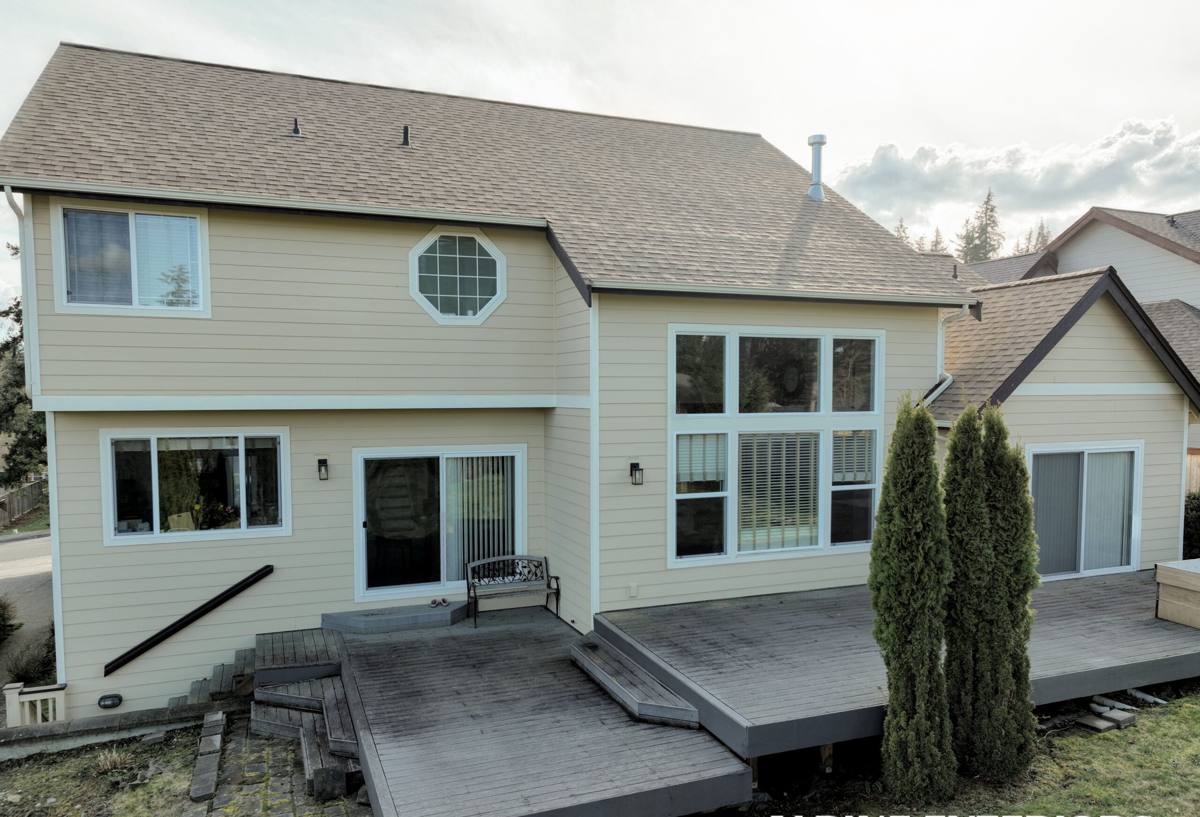
What This Climate Does to an Unprotected Deck
Western Washington weather is hard on wood and hardware in ways that aren't always obvious until a few years in. Understanding the mechanism helps explain why we build the way we do.
Driving Rain and Standing Moisture
Rain here doesn't just fall straight down — wind-driven rain gets pushed sideways into ledger boards, under railing posts, and into any gap that isn't properly flashed or sealed. Combined with our long wet season, that means wood and even composite substructures spend a lot of the year at or near saturation if the deck wasn't built to drain and dry.
Moss and Algae
Shaded decks, north-facing decks, and decks under mature trees — common in this area — grow moss and algae readily once organic debris and moisture sit on the surface for weeks at a time. Beyond looking bad, moss holds water against the board surface, which accelerates rot in real wood and can stain or etch some composite surfaces if left unaddressed.
Salt Air and Corrosion
Proximity to the water means airborne salt finds its way onto exposed metal — fasteners, joist hangers, railing hardware, post bases. Standard zinc-coated hardware can start showing rust and pitting well before its rated lifespan in a coastal-influenced environment, which is a structural concern, not just a cosmetic one.
Choosing Decking Material for a Sedro-Woolley Property
There's no single "best" decking material — there's a best material for your budget, your home's style, and how much upkeep you actually want to do. Here's how the common options compare for this climate specifically.
| Material | How It Handles Our Climate | Maintenance | Typical Lifespan |
|---|---|---|---|
| Pressure-treated wood | Good if properly sealed and maintained; absorbs moisture readily if coating lapses | Annual cleaning, re-sealing every 1-2 years | 15-20 years with upkeep |
| Cedar | Naturally rot- and insect-resistant, handles wet cycles well, softens over time without finish | Periodic cleaning, optional staining every 2-3 years | 15-25 years |
| Capped composite | Cap layer resists moss staining, moisture absorption, and salt exposure well | Occasional washing, no sealing or staining | 25-30+ years |
| Uncapped/early-generation composite | More prone to moisture wicking at cut edges and surface staining over time | Moderate cleaning; harder to fully restore once stained | 15-20 years |
We're honest with clients about the trade-offs here rather than pushing whatever has the best margin. Real wood, especially cedar, still makes sense for homeowners who want a traditional look and don't mind maintenance. Capped composite tends to be the better long-term investment for anyone who's tired of the sanding-and-sealing cycle, specifically because that cap layer is what stands up to moss, driving rain, and salt air without needing yearly attention.
What's Underneath Matters More Than What's On Top
Homeowners naturally focus on the decking boards — the part they'll see and walk on — but the structure underneath is what determines whether a deck lasts ten years or thirty.
Footings and Frost Depth
Footings need to be sized and set below frost depth per local code, not eyeballed. Undersized or shallow footings are one of the most common failure points we find on decks that were built without a permit or inspection.
Ledger Board Flashing
Where a deck attaches to the house is the single most common source of hidden rot. Proper flashing — installed correctly, in the right order relative to the house's existing water barrier — keeps rain from tracking behind the ledger and into the rim joist or wall framing. This detail alone is worth asking any contractor about directly.
Joist Protection
Joist tape or an equivalent moisture barrier on top of each joist prevents water from sitting in fastener holes and wicking into the wood over time, which is a major factor in how long a treated-wood substructure actually lasts in a wet climate like ours.
Fasteners and Hardware for a Coastal-Influenced Climate
Given the salt air factor around Sedro-Woolley, hardware selection is not a place to cut corners. We use stainless steel or heavy hot-dip galvanized fasteners and connectors rated for exposed, coastal-influenced environments — not the minimum-code hardware that's fine in a drier inland climate but starts corroding here within a few seasons. The same goes for joist hangers, post bases, and any structural connector: matching the coating rating to the fastener material also matters, since mismatched metals can accelerate corrosion through galvanic reaction.
Railings, Stairs, and Code Requirements
Railings and stairs are where code compliance and everyday safety overlap most directly, and they're also high-wear areas in wet weather.
- Guardrails are required at a minimum height once a deck surface is a certain distance above grade — we confirm the exact trigger height and required baluster spacing against current local code before we build, not from memory.
- Stair stringers need adequate bearing and, ideally, protection from standing water at the base to prevent premature rot.
- Handrail graspability and consistent stair riser heights are both inspected items and real trip-hazard concerns, especially on wet, mossy steps.
- Post-to-frame connections for railings need to be engineered for lateral load, not just toe-nailed — this is a common weak point on older or DIY-built decks we're asked to repair.
Drainage, Moss, and Keeping a Deck Looking Good Year-Round
Even a well-built deck needs some help managing this climate long-term. Board spacing, gap width, and surface slope are all decisions made during construction that determine how well a deck sheds water and resists moss buildup afterward. We plan for slight drainage slope away from the house and consistent board gapping so water doesn't pool, which cuts down significantly on the moss and algae growth that's otherwise close to inevitable on a shaded or low-sun deck in this part of Washington.
Once it's built, a simple seasonal maintenance routine keeps most decks looking good with minimal effort:
- Sweep debris and organic matter off the surface regularly, especially in fall
- Rinse or gently wash the surface a couple of times a year to prevent moss and algae from taking hold
- Check railing connections and stair fasteners annually for looseness or corrosion
- Re-seal or re-stain real wood on the schedule appropriate to the product used
- Clear gutters and downspouts near the deck so roof runoff isn't dumping extra water onto it
Our Process, From First Call to Final Walkthrough
We keep the process straightforward because homeowners deserve to know what's happening and why at every step.
1. On-Site Consultation
We come look at the actual site — grade, sun exposure, proximity to trees, how the house's siding and roofline will interact with the new structure — rather than quoting off photos alone.
2. Design and Material Selection
We walk through material options honestly, including the maintenance and lifespan trade-offs above, and design the layout, railing style, and stair placement around how the space will actually be used.
3. Permitting
Most attached decks and many freestanding ones require a permit through the local building department. We handle that paperwork and coordinate inspections as part of the job rather than leaving it to the homeowner to sort out.
4. Construction
Footings, framing, flashing, and joist protection go in first and get inspected before decking goes down — the parts nobody sees are the parts that determine whether the deck is still solid in fifteen years.
5. Final Walkthrough
We walk the finished deck with the homeowner, cover basic care for whatever material was installed, and make sure every question is answered before we consider the job done.
Cost Factors Homeowners Should Know Going In
Every deck is different, so we won't put a fake number on a project we haven't scoped, but these are the factors that actually move the price:
| Factor | Why It Matters |
|---|---|
| Decking material chosen | Wood, cedar, and composite carry different upfront material costs and different long-term maintenance costs |
| Deck height and grade | Taller decks need deeper footings, more framing, and code-required guardrails, all of which add labor and material |
| Substructure condition | Rebuilds on existing footprints sometimes uncover rot or undersized framing that needs to be corrected, not just covered up |
| Railing and stair complexity | Custom railing styles, multiple stair sets, or multi-level designs add both material and labor time |
| Permit and inspection requirements | Scope and site conditions determine what's required locally, which affects timeline and cost |
Why Hiring a Crew That Already Works in Sedro-Woolley Matters
A deck built by a crew unfamiliar with this climate is a deck built on assumptions that don't hold up here. We already know how local footing depths and code requirements are typically applied, what hardware actually survives the salt air and rain cycle this area sees, and how much drainage and gapping a deck needs to fight off moss instead of growing it. That local familiarity shows up in fewer callbacks, fewer surprises during inspection, and a deck that's still solid well after the novelty of a new composite finish has worn off.
If you're planning a new deck or need an honest look at an existing one, we're happy to come take a look and put together a free, no-pressure estimate. There's a form below — tell us a little about your project and we'll go from there.