 Chuckanut
 Why Sedro-Woolley Siding Wears Out Faster Than Homeowners Expect
Sedro-Woolley sits in the Skagit River valley, tucked between the foothills of the Cascades and the marine weather systems that roll in off the Salish Sea. That combination is tougher on exterior siding than it looks from the street. Moisture-laden air pushes up the valley through the wet season, driving rain hits west- and south-facing walls at an angle for days at a time, and the tree cover and valley humidity that make the area beautiful also keep siding damp longer than it would stay in a drier climate. The result is a long moss and algae season that runs from fall through spring on almost every home with any shade or north exposure.
None of that is dramatic on its own. It's the accumulation that causes problems. Siding that stays damp for weeks at a stretch, season after season, is siding that's constantly being tested — for paint adhesion, for seam integrity, for how well the material underneath handles repeated wetting and drying. Some products handle that cycle well for decades. Others start showing it in year eight or ten. A big part of doing this job right in Sedro-Woolley is choosing a material and installation method that's built for exactly this kind of weather, not just weather in general.
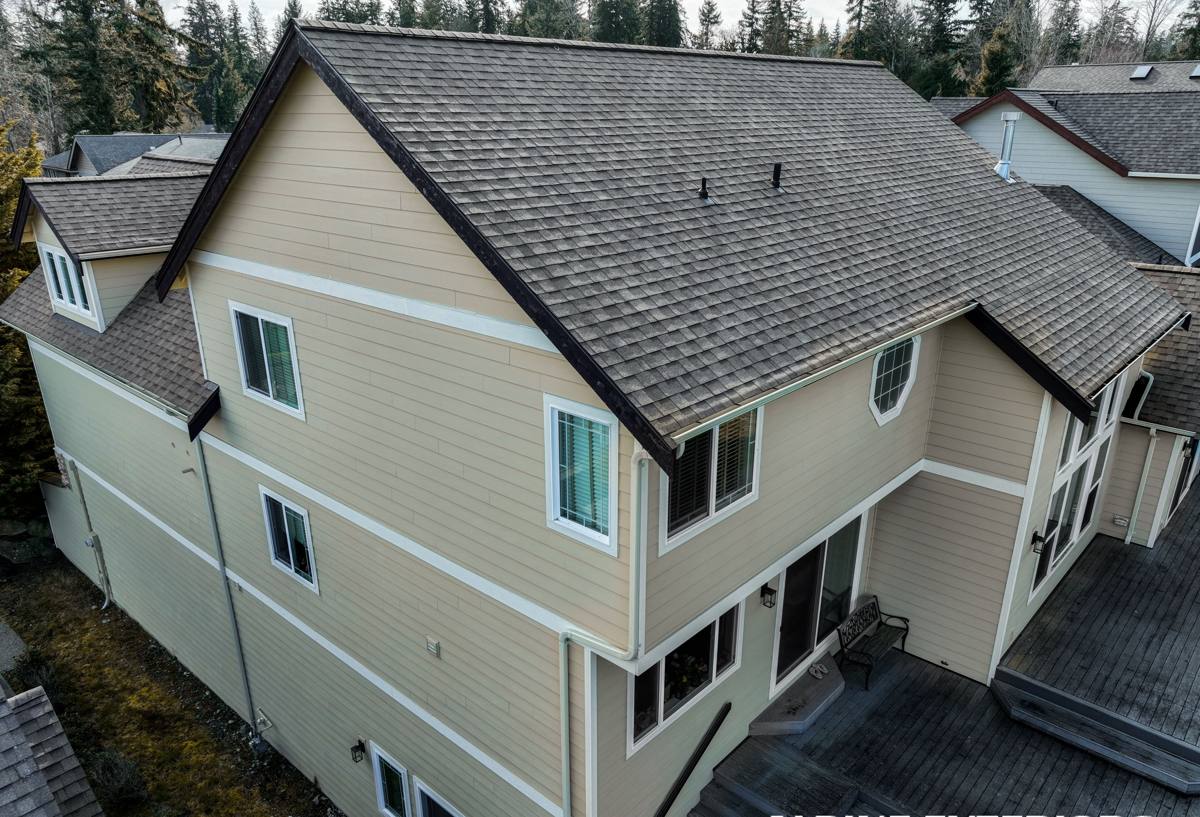
Signs Your Siding Needs Replacement, Not Another Patch
Homeowners often ask us to look at "one bad spot," and that's a reasonable place to start — but a single trouble spot is frequently a symptom of a bigger issue underneath. Here's what tells us a full replacement is the honest answer rather than a repair:
- Soft, spongy, or crumbling siding when you press on it, especially near the bottom courses and around windows
- Paint that keeps failing in the same spots within a year or two of repainting
- Persistent moss or algae growth that comes back within weeks of cleaning
- Visible warping, cupping, or separation at the seams between siding panels or planks
- Staining or discoloration on interior walls near exterior corners, which often points to moisture already past the siding
- Siding that's more than 20-25 years old and was never rated for this climate to begin with
If you're only seeing one or two of these and the siding is otherwise sound, a targeted repair might genuinely be enough. If you're seeing several at once, patching becomes a short-term fix on a problem that's already spread.
What a Correct Siding Replacement Actually Involves
It Starts Underneath, Not With the New Siding
The siding you see is the last layer, not the only one that matters. A proper replacement starts with removing the old material and actually inspecting the sheathing and framing underneath — not assuming it's fine because the house "looks okay" from outside. In a climate that pushes this much moisture at exterior walls, it's common to find soft sheathing, degraded old building paper, or rot around window and door openings that was completely invisible until the siding came off. Any of that gets addressed before a single new panel goes up. Installing new siding over compromised sheathing just hides the problem for a few more years.
The Weather-Resistive Barrier and Flashing
Behind every well-installed siding job is a weather-resistive barrier — a water- and air-management layer that's supposed to shed the moisture that inevitably gets past the siding itself over time. In a valley climate with a long wet season, the details matter more than the material: correct overlaps, properly flashed windows and doors, and drip caps and kick-out flashing at rooflines that actually direct water away from the wall assembly instead of behind it. Most siding failures we investigate aren't failures of the siding material at all — they're failures of flashing and water management that let moisture in behind an otherwise fine product.
Installation to Manufacturer Spec
Correct fastener spacing, correct clearances above grade, roofing, and decks, correct gaps at butt joints for expansion, and correct caulking (or intentional lack of it, where the manufacturer specifies none) all affect how long siding lasts. This is where installation quality separates a job that looks fine at closing from one that still looks fine in year twenty.
Why We Install Only James Hardie Fiber Cement
We don't install vinyl, LP SmartSide, Cemplank, Allura, primed spruce, or cedar siding. That's not a marketing position — it's a standard we set because of what we've seen these products do over time in exactly this kind of climate, and we'd rather explain it honestly than install something we don't fully stand behind.
Vinyl is inexpensive and low-maintenance in mild climates, but it's a thin, flexible plastic that can warp in heat, crack in cold, and fade faster in direct sun. It also doesn't hold paint, so color options are fixed and limited. Engineered wood products like LP SmartSide are wood-based, which means their long-term performance depends heavily on keeping every cut edge, seam, and fastener point sealed correctly for the life of the product — a hard standard to guarantee in a climate with this much sustained moisture. Cedar and primed spruce are natural wood: beautiful, but they require ongoing maintenance (repainting, sealing, moss and mildew treatment) to hold up, and they're the most vulnerable of the group to rot if that maintenance schedule slips even one season.
James Hardie fiber cement is non-combustible, dimensionally stable, and engineered specifically for wet, humid climates through its HZ5 product line, which is built for exactly the conditions the Pacific Northwest sees — regions with regular hard freezes, heavy rain, and extended damp seasons. It doesn't feed moss and algae growth the way wood-based products can, it holds its factory-applied ColorPlus finish for years longer than field-applied paint on other materials, and it comes with a strong transferable warranty when installed to spec. It costs more upfront than vinyl and is heavier and more particular to install correctly than most alternatives — installation quality matters more with fiber cement, not less. That's a real trade-off, and we tell homeowners that plainly. But for a house that has to stand up to a Skagit Valley wet season year after year, it's the material we're willing to put our name behind.
Comparing the Options Honestly
| Factor | James Hardie Fiber Cement | Vinyl | Wood / Engineered Wood |
|---|---|---|---|
| Moisture resistance | Excellent when installed to spec; won't rot | Good, but seams and gaps can trap moisture | Requires ongoing maintenance to prevent rot |
| Moss/algae resistance | Strong, doesn't feed organic growth | Moderate; growth still occurs on damp surfaces | Weakest; wood-based surfaces are more hospitable to growth |
| Finish longevity | Factory ColorPlus finish, years of color retention | Color is baked in but can fade/chalk over time | Field-applied paint or sealant, needs recoating |
| Fire resistance | Non-combustible | Can melt or deform under heat | Combustible |
| Upfront cost | Higher | Lowest | Moderate to high |
| Maintenance over time | Low | Low, but limited repair options if damaged | High — regular painting/sealing needed |
Our Process, Start to Finish
- On-site assessment — we walk the exterior, check current siding condition, look for existing moisture damage, and talk through what you're seeing and what concerns you.
- Written estimate — a clear scope covering tear-off, sheathing repair allowances, weather barrier, flashing details, siding and trim, and finish.
- Tear-off and inspection — old siding comes off and we inspect sheathing and framing before anything new goes up, flagging any repairs needed with photos.
- Weather barrier and flashing — correct overlaps, window and door flashing, and drainage details installed before siding.
- Hardie installation — installed to manufacturer spec for fastening, clearances, and joints.
- Trim, caulking, and touch-up — finish details completed and job site cleaned up.
- Final walkthrough — we go over the finished work with you before calling the job done.
What Drives Cost on a Sedro-Woolley Siding Job
| Cost Factor | Why It Matters Here |
|---|---|
| Sheathing/framing condition | Hidden moisture damage found during tear-off, more common on older, long-shaded walls, adds repair scope |
| House size and wall complexity | More corners, gables, and trim details mean more labor and material |
| Siding profile and accessories | Lap, shingle, or panel style, plus trim boards and soffit work, change material cost |
| Access and site conditions | Slopes, tree cover, and tight lot lines common in the valley can affect setup and staging time |
| Existing paint/material removal | Some older materials require extra care or disposal handling during tear-off |
We don't quote a number without seeing the house first — anyone who does is guessing, and a guess isn't useful to you when you're budgeting a project this size.
Why a Crew That Already Works in Sedro-Woolley Matters
A siding job isn't just a material choice — it's dozens of small decisions made on site: how to flash a particular window detail, how much clearance to leave above a deck ledger, which direction the prevailing wind-driven rain hits a given wall. A crew that's worked houses throughout Sedro-Woolley and the surrounding Skagit Valley has already seen how this specific climate treats siding over years, not just on install day. That's different from general siding experience picked up in a drier region. It also means we're a known, reachable local business if a question comes up five or ten years after the job — not a crew that worked the area once and moved on.
If your Sedro-Woolley home is due for new siding, we're glad to take a look and give you a straight, no-pressure assessment of what it actually needs. Use the form below to request a free estimate.