 Chuckanut
 Blanchard Sits in a Tough Spot for Siding
Homes along the Chuckanut Drive corridor near Blanchard take a different kind of beating than houses just a few miles inland. You've got salt-laden air drifting up off the water, driving rain that comes in sideways during winter storms, heavy tree cover that keeps everything shaded and damp, and a moss season that can stretch for the better part of the year. Individually, none of those are unusual for Whatcom County. Together, on a specific stretch of hillside or waterfront lot, they add up to siding that ages faster than the manufacturer's brochure implies.
That's the backdrop for every siding repair call we take in this area. We're not troubleshooting a one-off problem — we're dealing with a predictable set of conditions that show up on house after house, and knowing that pattern is what makes a repair actually hold instead of failing again in two years.
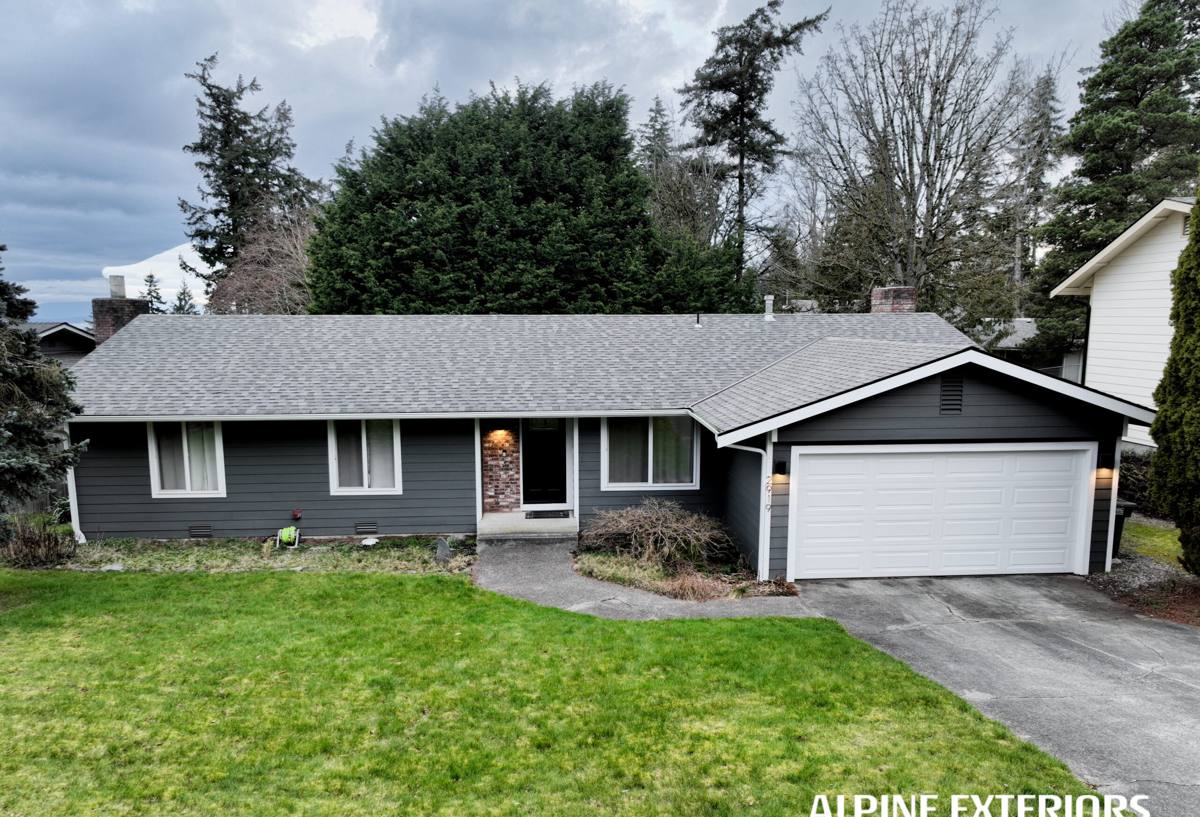
What "Siding Repair" Actually Covers
Siding repair is a broad term, and homeowners are often surprised by the range of things it can mean. In Blanchard, the calls we get generally fall into a handful of categories:
Moisture and Rot Damage
Driving rain doesn't just hit siding straight-on — it gets pushed up and under laps, into seams, and behind poorly sealed trim. On wood-based or engineered wood products, that moisture intrusion leads to soft spots, swelling, and eventually rot at the bottom edges of boards, around window trim, and near ground-level transitions.
Impact and Wind Damage
Branches, storm debris, and the occasional ladder mishap crack or dent siding panels. On brittle or aging material, a small impact can spread into a larger crack over a season or two of temperature swings.
Failed Caulking and Flashing
Caulk joints and flashing details are the first line of defense against wind-driven rain. Once they fail — and salt air accelerates that failure — water finds its way behind the siding even if the siding itself looks fine from the ground.
Moss, Algae, and Staining
Constant shade and moisture make this a prime area for moss and algae growth on siding. That's sometimes a cosmetic issue and sometimes a sign that a surface is staying wet longer than it should, which is worth checking rather than assuming.
Signs Your Siding Needs Repair, Not Just a Wash
A pressure wash or a coat of paint can hide a lot of problems temporarily. Here's what actually signals a repair is needed:
- Soft or spongy spots when you press on the siding, especially near the bottom edges or under windows
- Visible cracking, chipping, or crumbling at panel edges or corners
- Bubbling, peeling, or discolored paint that keeps coming back in the same spot after repainting
- Gaps opening up around trim, window frames, or where siding meets the foundation
- Moss or dark staining that returns quickly after cleaning, especially in shaded north- or west-facing sections
- Warping or buckling panels that no longer sit flat against the wall
- Musty smell or visible staining on interior walls that back up to exterior siding
Repair vs. Replace: How We Make the Call
Not every damaged section needs a full re-side, but not every problem can be patched either. The right call depends on how much of the wall is affected, what's underneath the siding, and what the siding is made of.
| Scope of Work | Typical Trigger | What's Involved | When It Makes Sense |
|---|---|---|---|
| Spot Repair | Isolated impact damage, one or two failed boards | Remove and replace the affected pieces, re-flash, re-caulk, color-match | Damage is limited and the surrounding wall and sheathing are dry and sound |
| Section Replacement | Rot concentrated in one wall or area (common near ground level, under windows) | Strip a full section, inspect and repair sheathing/house wrap, re-side the section | Damage is contained but the underlying water intrusion has spread |
| Full Re-Side | Widespread failure, siding material at end of life, repeated repairs not holding | Remove all existing siding, address any sheathing or moisture barrier issues, install new siding system | The siding is old, repairs keep resurfacing, or damage is spread across multiple walls |
We'll always tell you honestly which category your home falls into. A spot repair on a wall that's otherwise sound is a fraction of the cost of a re-side, and there's no reason to push a bigger job than the house needs.
What a Correct Repair Actually Involves
A repair that just covers the visible damage without addressing what caused it tends to fail again — often in the same spot. Here's what we check and do on every siding repair:
- Inspect beyond the damaged panel itself — check the sheathing, house wrap, and flashing behind and around it for hidden moisture damage
- Identify the actual water path, not just where the damage shows up (water often travels before it pools)
- Remove only what needs to come off, keeping disruption to surrounding, sound material to a minimum
- Repair or replace any compromised sheathing or moisture barrier before new siding goes back on
- Re-flash any window, door, or trim transitions in the repair area to current best practice, not just to match what was there before
- Install replacement siding with proper fastening and clearances — including ground clearance, which matters a lot in a wet climate
- Seal and caulk with materials rated for the exposure the wall actually sees
- Match color and finish as closely as the product allows
Skipping the "why did this happen" step is the single biggest reason siding repairs don't last in a climate like this one. A patch over a leak that's still leaking just buys you a year or two before the same call comes back.
Why We Only Repair and Replace With James Hardie Fiber Cement
We get asked fairly often why we don't do repair work on vinyl, LP SmartSide, or other engineered wood siding. It's a fair question, and the honest answer is about long-term outcomes, not brand loyalty.
Vinyl and engineered wood products each have real strengths, but they also have failure modes that make repair work frustrating in this climate specifically. Vinyl becomes brittle over time in sun and temperature swings, and matching an older panel's color and profile gets harder every year as it fades and formulations change. Engineered wood products are more moisture-sensitive at cut edges and fastener points — exactly the conditions created by driving rain and long damp seasons — and once moisture gets into the substrate, a surface patch doesn't stop the underlying breakdown.
James Hardie fiber cement doesn't have those weak points. It's non-combustible, dimensionally stable, and doesn't swell or rot when it gets wet the way wood-based products can. The factory-applied ColorPlus finish also means a well-matched repair section blends in far better over time than field-painted patches on other materials. When we do repair or replace a section, we can tie it into the surrounding Hardie siding with a result that actually looks intentional, not patched.
Our Process for Blanchard Homeowners
Inspection and Honest Assessment
We start by looking at the whole exterior, not just the spot you called about. Damage from salt air and driving rain rarely stays confined to one panel, so we check adjacent areas, trim, and anywhere water tends to collect on your specific home's orientation.
Clear Scope Before Any Work Starts
You'll know whether you're looking at a spot repair, a section replacement, or something bigger before we touch anything — along with why, based on what we actually found.
Repair Work
We handle the removal, any sheathing or moisture barrier repair, re-flashing, and installation with the same attention to detail as new construction work, because a repair is only as good as what's happening behind the visible siding.
Cleanup and Walkthrough
We walk the finished work with you so you can see exactly what was done and why, not just take our word for it.
Why Local Experience Matters for This Kind of Work
A crew that already works the Chuckanut Drive and Blanchard area has seen the specific patterns this stretch of Whatcom County produces — which wall orientations take the worst of the driving rain, where moss builds up fastest under heavy tree cover, and how salt air accelerates wear on fasteners, trim, and caulk compared to more sheltered inland neighborhoods. That's not something you learn from a general siding manual; it's something you learn from doing repair after repair on homes exposed to the same weather patterns year after year.
It also means we're not guessing at what "normal wear" looks like here versus what's an actual red flag. A moss-streaked wall that would raise alarms in a drier climate might be routine in Blanchard, while a small stain in the wrong spot might be worth investigating further. Knowing the difference saves homeowners from paying for work they don't need — or from underestimating a problem that does need attention.
Get a Straight Answer About Your Siding
If you're seeing soft spots, cracking, staining that won't go away, or you're just not sure whether what you're looking at is cosmetic or something more, we're happy to take a look. We'll give you a clear, honest read on what's going on and what it would take to fix it right — with a free, no-pressure estimate and no upsell to a bigger job than your home actually needs.