 Chuckanut
 Larrabee sits along the Chuckanut Drive corridor, where wooded bluffs drop down toward Samish Bay, and that setting shapes almost every window job we do out here. The housing stock is a mix — older cabins and cottages built long before modern window standards existed, sitting alongside newer homes designed to take advantage of the water and forest views. Both categories bring their own installation issues, but they share the same exposure: salt air off the water, rain that rarely falls straight down, and a tree canopy heavy enough to keep walls shaded and damp well after a storm has cleared.
We treat window installation in this neighborhood as its own category of work, not a generic swap-and-go job. The flashing sequence, the frame material, and the scheduling all get adjusted for what this specific stretch of Chuckanut throws at a house. This page covers what that actually looks like — what local homes need, what a correct installation involves, and why hiring a crew that already works this area matters.
Why Larrabee's Setting Is Harder on Windows Than It Looks
A window that performs fine a few miles inland can struggle here for reasons that have nothing to do with the window itself. Salt-laden air off the bay speeds up corrosion on hardware, fasteners, and lower-grade frame components faster than a drier setting would. Storms coming off the water push rain sideways into wall assemblies and window flashing instead of letting gravity carry it straight down, which means water finds gaps that would never get tested somewhere calmer. And the shade from heavy tree cover keeps a lot of walls damp longer after a storm, which is exactly the environment moss and mildew need to take hold — a season that can run most of the year on north-facing walls and trim around here.
None of that means windows can't perform well in Larrabee. It means the installation has to account for that exposure instead of following a generic, average-climate installation sheet.
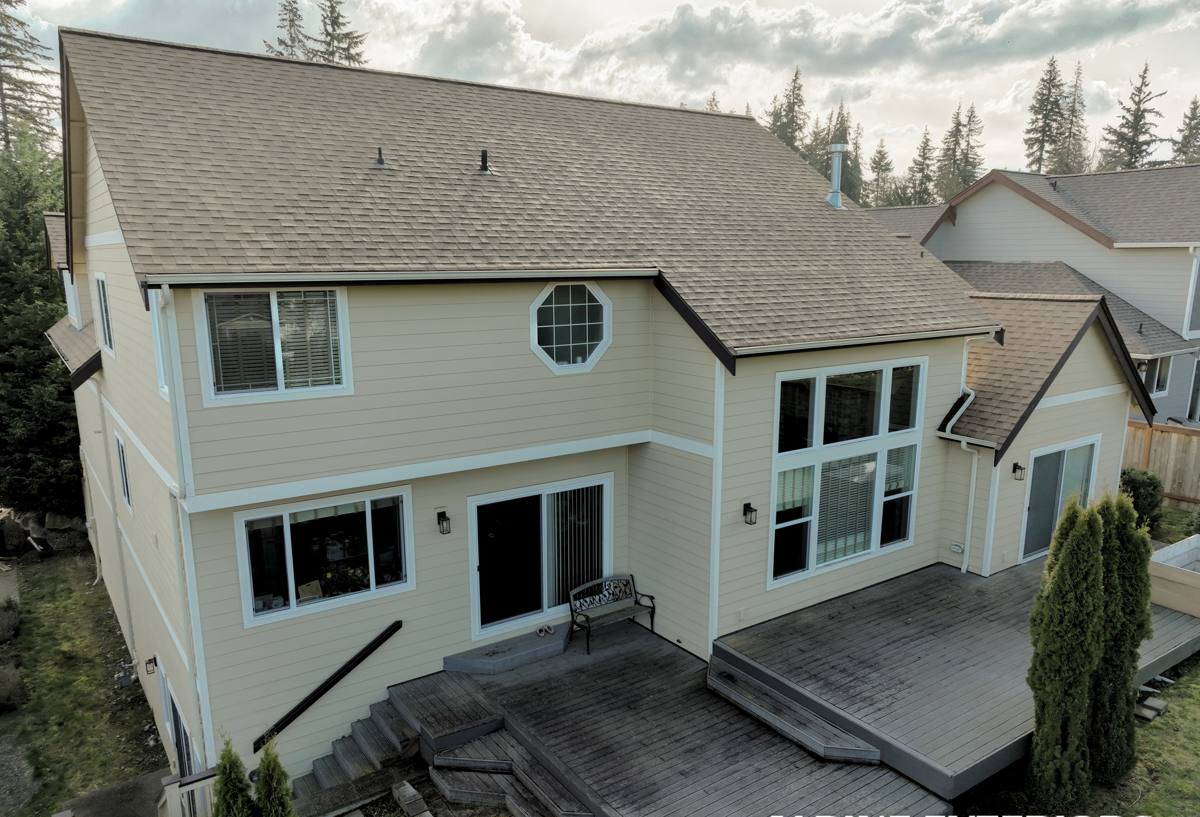
Common Window Problems We See Around Larrabee
A handful of issues show up repeatedly on homes in this area, and most of them trace back to the same root causes — age, moisture, and installation shortcuts that didn't matter until the elements found them.
- Fogged or failed seals — older double-pane units where the seal between panes has broken down, letting moisture in and killing the insulating gas fill
- Soft or rotting sills and casings — wood components near grade or under a roofline drip edge that stay wet longer than the rest of the wall
- Moss and mildew staining — dark growth around trim and sills on shaded, north-facing walls, a near year-round issue under heavy tree cover
- Flashing gaps from older installation methods — homes built or last re-windowed before modern weather-resistive barrier and flashing practices became standard
- Drafts and condensation — often a sign of a failed seal, poor original installation, or both, rather than the glass itself being the problem
Any one of these can look cosmetic at first — a little fogging in the corner of a pane, a slightly soft spot on a sill — and stay that way for a while before it turns into a real repair. That's part of why we'd rather look at a window in person than guess from a description over the phone.
What a Correct Window Installation Involves
Removal and Opening Inspection
Pulling the old unit is also when we find out what's actually going on behind it. On older Larrabee homes especially, this is where hidden rot, failed prior flashing, or framing issues that have been quietly developing for years usually surface. We'd rather find that during removal than have it turn into a surprise mid-installation.
Flashing and Weatherproofing Sequence
This is the step that matters most given the exposure here. Flashing has to be layered correctly — housewrap, flashing tape, sill pan, and head flashing all need to overlap in the right order so that any water that does get past the window sheds outward and down, never inward. Skipping or reversing that sequence is one of the most common causes of a leak that doesn't show up for a year or two, long after the crew that did the work has moved on.
Insulation and Air Sealing
The gap between the window frame and the rough opening needs to be filled with the right material and sealed correctly — not stuffed, not left open. Done right, this cuts drafts and keeps condensation from forming inside the wall cavity where you can't see it happening.
Trim and Finish
The exterior trim and finish work has to hold up to the same conditions as the window itself — salt air, sun exposure, and sustained damp periods under tree cover. We integrate the finish so it matches the surrounding siding and sheds water the way the rest of the wall does, rather than treating trim as an afterthought once the window's in.
Frame Materials for This Climate
Frame material is one of the bigger decisions on a Larrabee window job, since the material sits directly in the path of salt air and sustained moisture. We'll walk through the honest trade-offs for your specific project rather than defaulting to whatever's fastest to install.
| Frame Material | Performance in Salt Air & Moisture | Maintenance | Best Fit |
|---|---|---|---|
| Vinyl | Handles moisture well; won't rot or corrode | Low — occasional cleaning | Budget-conscious replacements, most standard openings |
| Fiberglass | Excellent moisture and salt-air resistance; very stable | Low | Larger units, water-facing walls, long-term durability priorities |
| All-wood exterior | Vulnerable without diligent, ongoing finish maintenance | High — regular refinishing needed | Historic-style homes where the look is the priority |
| Wood-clad (wood interior, clad exterior) | Exterior cladding protects the wood from direct exposure | Moderate | Homes wanting a wood interior look without exterior upkeep |
In general, vinyl and fiberglass hold up to sustained salt air and moisture with less ongoing upkeep than an all-wood exterior finish, which is why we lead with them on weather-facing installs in this area. A wood-clad option can still make sense when the interior look matters and the exterior cladding is doing its job — it's a trade-off worth discussing against your specific home, not a one-size answer.
Our Process, Start to Finish
- On-site assessment — we look at the existing windows, the wall assembly, and any signs of moisture or prior repair before recommending anything
- Honest recommendation — repair, replace, or reframe, and which frame material fits your exposure and budget, explained with the reasoning behind it
- Measuring and ordering — precise field measurements, since older Larrabee homes often have openings that are slightly out of square or don't match modern standard sizes
- Removal and opening prep — the old unit comes out carefully, and any hidden rot or flashing issues get addressed before the new window goes in
- Installation and flashing — the new unit is set, shimmed, and flashed in a sequence built for this climate's exposure
- Trim, finish, and cleanup — exterior trim integrated to match the surrounding siding, site cleaned up before we call the job done
What Affects the Cost of a Window Installation
We won't quote a number without seeing the actual openings, but a handful of factors consistently move the price on jobs like this.
| Factor | Tends to Lower Cost | Tends to Raise Cost |
|---|---|---|
| Number of windows | Larger batch, same visit | Single window, separate trip |
| Opening condition | Original opening square and sound | Rot or framing repair needed first |
| Frame material | Vinyl | Fiberglass or wood-clad |
| Window size and type | Standard sizes, simple double-hung or slider | Large, custom, or specialty shapes |
| Access | Ground-level, easy access | Upper stories, difficult site access |
Broadly, most straightforward, standard-size replacement jobs land in a moderate per-window range, with cost climbing from there based on the factors above — especially any hidden rot or framing repair found once the old unit comes out. We'll flag that possibility during the initial assessment rather than let it become a surprise mid-project.
Practical Checklist Before You Hire
- Confirm whether your project needs an insert (pocket) replacement or a full-frame installation
- Ask what the flashing sequence looks like for your specific opening
- Get a written scope of work and a realistic timeline before committing
- Ask what's covered under warranty — the window unit and the installation labor are often separate
- Confirm current Washington contractor licensing and insurance
- Ask how they'll handle weather protection if rain moves in mid-installation
Why a Crew That Already Works Larrabee Matters
Manufacturer installation guidance is written for average conditions in a moderate climate. Larrabee doesn't offer average conditions — salt air, wind-driven rain, and a moss season that runs most of the year stack the deck against a rushed or generic installation more than they would somewhere drier and calmer. A crew that has actually flashed windows on this stretch of Chuckanut Drive knows which parts of standard guidance are non-negotiable here, and which details are worth the extra time even when they aren't strictly required elsewhere.
That experience shows up in decisions that don't come up in a sales pitch — how much lap a flashing course needs on a wall that takes wind-driven rain head-on, when a sill needs a sloped detail instead of relying on caulk alone, how to sequence an install around a stretch of dry weather instead of forcing it into a rainy week. Those are the details that decide whether a window is still performing cleanly in fifteen years or showing drafts and soft trim in five.
If you're dealing with fogged glass, a soft sill, drafts, or you're simply ready to replace aging windows on a Larrabee-area home, it's worth having someone look at the actual openings before you start pricing units. We offer free, no-pressure estimates for window installation in Larrabee and the surrounding Chuckanut area — use the form below to get a time on the schedule.