 Chuckanut
 A deck in Bow doesn't fail the way a deck fails in a drier, more sheltered part of the country. Here, the damage usually starts underneath — at the ledger board, the framing connections, and the fasteners holding it all together — long before the surface boards look bad enough to worry anyone. Salt-laden air off Samish Bay, driving rain that comes in sideways instead of straight down, and a moss season that stretches across a good chunk of the year all work on a deck at the same time, and they work on the parts you can't see from the yard. Repairing a deck correctly in Bow means understanding that pattern, not just replacing whatever boards look worn.
Why Decks Age Differently in Bow
Bow sits close enough to open water that salt-influenced air reaches decks that are nowhere near the shoreline, and it accelerates corrosion on fasteners, joist hangers, and any exposed metal hardware. Combine that with wind-driven rain — the kind that gets pushed under railings and into end-grain cuts instead of running off — and a deck here takes on more sustained moisture per year than a comparable deck somewhere calmer and drier. Add the long moss season that much of western Whatcom County deals with, and you get a surface that holds moisture against the wood or decking material for longer stretches, which slows drying time between rain events even further.
Where the Damage Actually Shows Up First
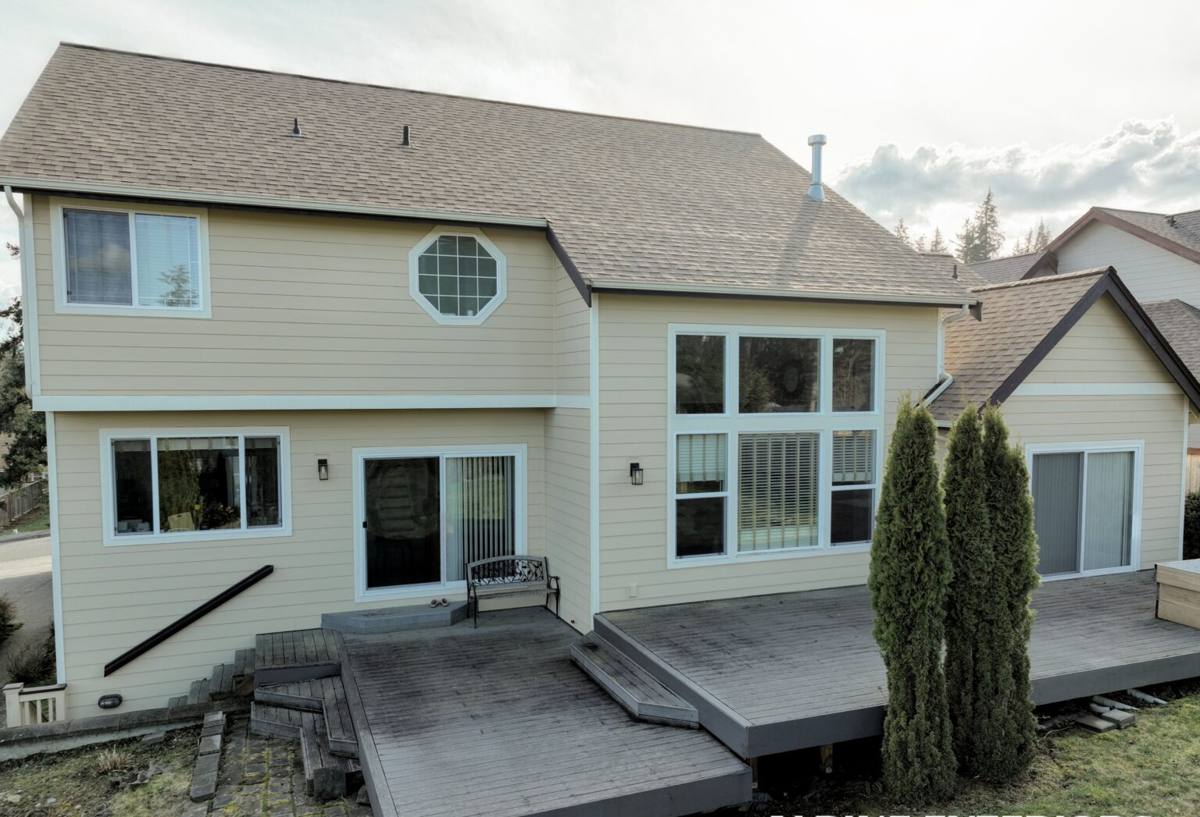
Because of that moisture pattern, the earliest failures on a Bow deck are almost never in the middle of the decking surface. They show up at the ledger board where the deck attaches to the house, at fastener heads where corrosion starts, at the base of posts where water pools and doesn't dry, and underneath railings where moss and debris trap dampness against the framing. A deck can look perfectly serviceable from a few feet away while one of these connection points is quietly failing underneath.
Signs a Bow Deck Needs Repair
Most deck problems in this climate give some warning before they become a safety issue, but the warning signs are often subtle. Knowing what to look for — and checking in the right spots — makes the difference between a straightforward repair and a full rebuild.
- Soft or spongy decking when you walk across it, especially near the house or along railings
- Visible gaps, rust streaking, or corrosion around fasteners and joist hardware
- Any movement or flex where the deck meets the house at the ledger board
- Persistent moss or dark staining that keeps returning to the same boards after cleaning
- Cracked, split, or checked boards concentrated on one side of the deck facing prevailing weather
- Railing posts that wobble or feel less rigid than they used to
- Standing water that doesn't drain within a reasonable time after rain stops
None of these on their own necessarily means a full teardown. But any of them is worth a real inspection rather than a guess, because the underlying cause is often at the framing or fastener level, not just the visible board.
What a Correct Deck Repair Actually Involves
A deck repair that only replaces surface boards without checking what's underneath is addressing the symptom, not the cause. In a climate like Bow's, that approach tends to mean redoing the same repair again within a few years, because the moisture and corrosion problem that damaged the original boards is usually still there.
Ledger Board and Flashing
The ledger board — the piece that attaches the deck to the house — is one of the most common failure points on any deck, and it's a particular concern here because wind-driven rain finds its way behind poorly flashed ledger connections more readily than rain falling straight down. Correct repair work means checking that flashing at this connection actually sheds water away from the house, not just patching visible rot and moving on. A ledger board that's been quietly absorbing moisture for years can compromise the whole structural connection even if the rest of the deck looks fine.
Framing and Structural Connections
Joists, beams, and post connections all take on more sustained dampness in Bow than they would inland, which means hardware corrosion and wood softening at these connections happen sooner. A proper repair checks joist hangers, post bases, and beam connections for corrosion or movement, not just the boards resting on top of them. Replacing decking over a compromised frame doesn't actually fix the problem — it just hides it under new boards for a while.
Fasteners and Hardware
Standard-grade fasteners corrode faster in salt-influenced coastal air, and once a fastener starts rusting it loses grip strength well before it visibly fails. We use corrosion-resistant fasteners and hardware rated for coastal or marine-adjacent exposure on repair work here, because standard hardware is a false economy on a deck that's going to sit through another decade of Bow winters.
Repair vs. Replacement: Making the Right Call
Not every deck problem in Bow requires a full rebuild, and not every deck can be saved with targeted repair. The right call depends on how much of the structure — not just the surface — is actually compromised.
| Factor | Favors Repair | Favors Replacement |
|---|---|---|
| Framing condition | Joists and beams are sound; damage is localized | Widespread rot or corrosion across multiple structural members |
| Ledger board | Intact with only minor flashing issues | Significant rot or compromised attachment to the house |
| Decking surface | Isolated boards affected | Most boards showing wear, splitting, or moss staining |
| Age of original build | Relatively recent, built to current code | Older deck, outdated framing or fastening methods |
| Overall cost outlook | Lower upfront cost, addresses specific issues | Higher upfront cost, but resets the service life of the whole structure |
A straight, honest inspection is the only way to know which side of this table your deck actually falls on. We'd rather tell a homeowner their deck just needs a ledger repair and new hardware than talk them into a rebuild they don't need — and we'd rather be upfront if the framing really is too far gone for a patch to hold.
Decking Surface Repairs and Material Considerations
Once the structure underneath is sound, decisions about the visible surface come down to how the material handles Bow's moisture and moss exposure over time. Wood decking can be repaired board by board and can look great, but it needs a real, ongoing maintenance commitment — sealing, staining, and moss treatment on a schedule that gets tighter, not looser, in this climate. Composite decking resists moisture absorption without ongoing sealing and is less hospitable to moss and mildew growth, though it isn't immune to surface buildup and still needs periodic cleaning. Neither option is wrong; the right one depends on how much maintenance time a homeowner actually wants to commit to versus a higher upfront material cost.
When we're repairing an existing wood deck, we match new boards as closely as practical and treat them consistently with the rest of the structure so the repair doesn't age at a different rate than the surrounding decking. When a deck has enough wood-decking damage that partial replacement doesn't make sense anymore, that's usually the point where switching to composite for the new surface becomes worth discussing.
How We Handle a Deck Repair in Bow
- Walk the deck and check the framing, ledger connection, posts, and fasteners — not just the visible surface — to find where the actual problem starts
- Give a straight assessment of what's structurally sound, what's failing, and what repair versus replacement actually looks like for that specific deck
- Address the ledger board and flashing first if that's where moisture is getting in, since surface repairs won't hold if this connection is still failing
- Replace compromised framing members and corroded hardware with corrosion-resistant materials suited to coastal exposure
- Repair or replace decking boards as needed, matching material and finish to the rest of the deck where practical
- Walk the finished repair with the homeowner and explain what was done and why, including any maintenance the material choice requires going forward
Why a Crew That Works Bow Regularly Matters
Bow isn't a uniform subdivision — it's a mix of waterfront properties, farmhouses, and homes tucked against the tree line, each sitting differently relative to wind, sun, and water exposure. A crew that repairs decks in this specific stretch of Whatcom County regularly develops a feel for which connections fail first, how much corrosion is normal wear versus a sign of a deeper problem, and which repair shortcuts don't actually hold up here even if they'd be fine somewhere drier. That judgment comes from doing this work on homes like these on a regular basis, not from a general contractor passing through once.
What to Check Before Hiring for Deck Repair in This Area
- Ask whether the inspection includes the framing, ledger board, and fasteners, or just the visible decking surface
- Confirm any replacement hardware and fasteners are rated for coastal or marine-adjacent exposure
- Get a clear, specific explanation of what's being repaired and why, not just a quote for "new boards"
- Ask how the ledger-to-house flashing connection will be handled if it's part of the problem
- Verify the contractor is licensed, bonded, and insured to perform this kind of structural work in Washington State
- Get a clear answer on the workmanship warranty for the repair, separate from any material warranty
What This Means for Your Deck
Every deck in Bow ages a little differently depending on its orientation, age, and how it was originally built, so the right repair scope depends on the specific structure in front of us — not a standard package. We're not going to recommend tearing out a deck that just needs its ledger board and hardware addressed, and we're not going to patch surface boards over framing we don't trust. If you're not sure whether your deck needs a repair or something more, we're happy to take an honest look and tell you straight.
If you'd like a free, no-pressure estimate on your deck, reach out and we'll walk the structure with you, explain what we find, and lay out your options — no pressure either way.