 Chuckanut
 Why Happy Valley Siding Wears Out Faster Than the National Average
Homes in Happy Valley sit in one of the more demanding siding environments in Whatcom County. The combination of salt-laden air moving in off the water, long stretches of driving rain, and a moss season that can stretch from fall through spring puts a specific kind of stress on exterior walls that homes in drier parts of the country simply don't deal with. Siding here isn't just decorative — it's the first and most-tested line of defense against moisture intrusion, and it's working overtime almost year-round.
Salt air is corrosive to exposed metal fasteners and trim, and it accelerates the breakdown of lower-grade coatings and caulks faster than manufacturers' lab tests in drier climates would suggest. Driving rain — rain that comes in sideways during a windstorm instead of falling straight down — finds every gap in flashing, every under-caulked seam, and every place where siding wasn't held off the wall assembly correctly. And the shaded, tree-covered lots common in this part of Whatcom County keep siding damp longer after every storm, which is exactly the condition moss, algae, and mildew need to take hold.
None of this means siding is doomed here. It means the material choice and the installation quality matter more in Happy Valley than they would in a lot of other places, and cutting corners on either one shows up faster than it would somewhere with a milder, drier climate.
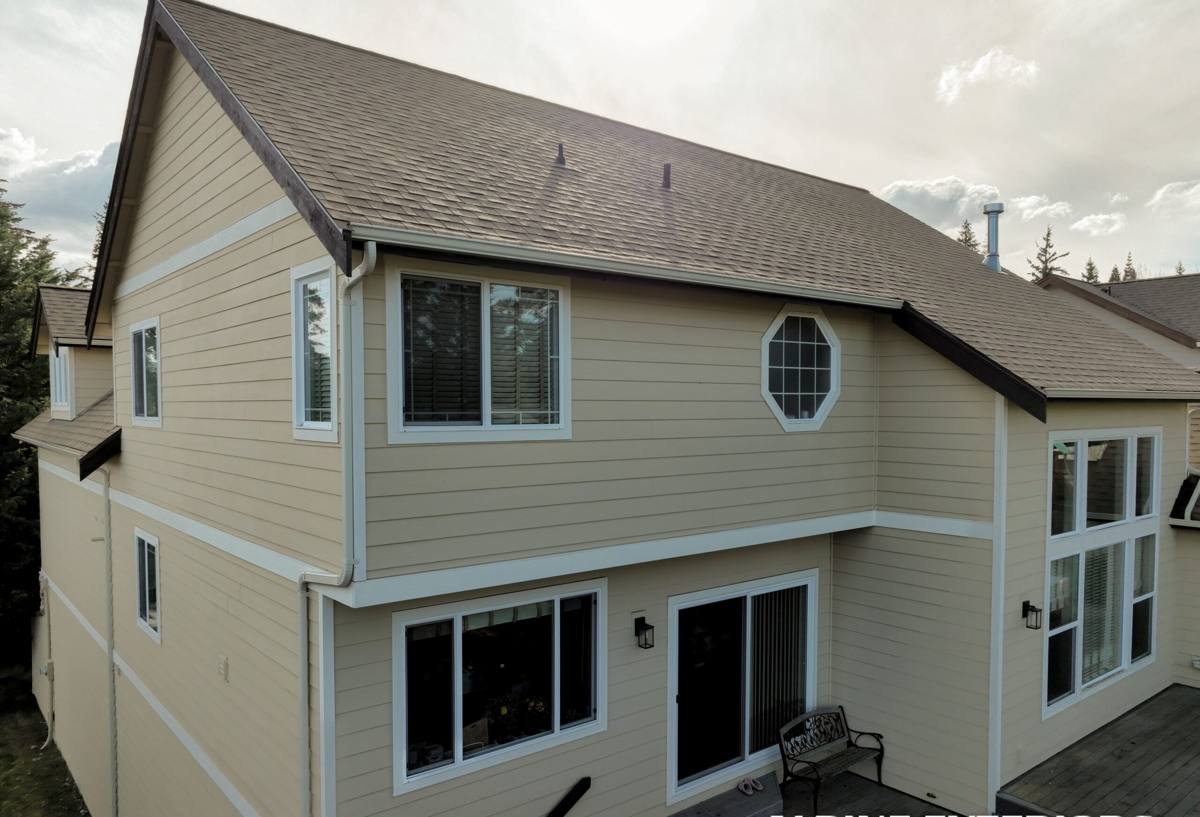
Signs Your Happy Valley Home's Siding Has Reached the End of Its Service Life
Because moisture damage develops behind the siding before it's visible on the surface, a lot of homeowners wait longer than they should before calling for an inspection. These are the signs worth acting on:
- Soft or spongy spots when you press on the siding, especially near the bottom courses and around window and door trim
- Paint that's bubbling, peeling, or needing repainting more often than every 6-8 years
- Visible warping, buckling, or panels that have separated slightly from the wall
- Persistent moss or algae staining that comes back within a season or two of cleaning
- Cracking or chalking on the siding surface, particularly on north- and west-facing walls that get the most weather exposure
- Rising energy bills that aren't explained by anything else, which can point to a compromised weather barrier
- Visible gaps or separation at seams, corners, and butt joints
- Interior signs — musty smell, discoloration on interior walls near exterior corners, or trim that's swelling
Any one of these on its own might be minor. Two or three together, especially on a home more than 20-25 years old, usually means it's time for a real assessment rather than another round of caulk and paint.
What a Correct Siding Replacement Involves — Not Just the Siding Itself
What's Underneath Matters as Much as What's On Top
The siding panel itself gets all the attention, but in a climate like this, the assembly behind it does most of the actual work. A correct replacement in Happy Valley includes:
- Sheathing inspection and repair — any rot or soft wood found during tear-off gets replaced before new siding goes on, not covered up
- A continuous weather-resistive barrier installed and lapped correctly, shingle-style, so water is always directed outward and down
- Properly flashed windows, doors, and penetrations — this is the single most common failure point we find on older homes in this area
- Correct fastener type and placement for the specific siding product, driven to the manufacturer's spec rather than overdriven or underdriven
- Proper clearance between the bottom of the siding and grade, decks, and roof lines, so water has somewhere to go instead of wicking upward
Skip any of these steps and it doesn't matter how good the siding product is — the wall assembly will fail from the inside out, often years before the siding itself would have worn out on its own.
Why This Matters More Here Than in a Drier Climate
A flashing detail that's slightly off in a dry climate might go unnoticed for a decade. In Whatcom County's rain volume, wind exposure, and shade-driven dampness, the same shortcut can show up as a soft spot within a few wet seasons. That's the honest reason replacement quality varies so much between contractors here — the mistakes are the same everywhere, but the consequences show up faster in Happy Valley.
Material Comparison: What We See Actually Hold Up in This Climate
We get asked regularly why we standardized on James Hardie fiber cement and don't install vinyl, LP SmartSide, or cedar. Here's an honest side-by-side of how these materials perform against the specific conditions Happy Valley homes face:
| Factor | James Hardie Fiber Cement | Vinyl | LP SmartSide (engineered wood) | Cedar |
|---|---|---|---|---|
| Moisture behavior | Non-combustible, dimensionally stable, engineered for wet climates in its HZ product lines | Doesn't absorb water itself, but can trap moisture behind it and warps in heat | Wood-based core is vulnerable if any edge or cut is left unsealed | Absorbs moisture, requires diligent maintenance to prevent rot |
| Salt air exposure | Coating and substrate hold up well; factory finish resists fading | Can become brittle and discolored over time near coastal air | Coating can degrade faster with added moisture and salt exposure | Weathers and grays quickly; needs frequent refinishing |
| Moss and algae resistance | Factory-cured surface resists staining better than raw wood; still needs periodic washing | Can trap moisture behind panels where moss and mildew thrive unseen | Susceptible where finish wears thin | Prone to moss growth, especially on shaded walls |
| Maintenance burden | Low — occasional wash, repaint on a much longer cycle with ColorPlus finish | Low upkeep but limited repair options if damaged, and color can't be refreshed by painting easily | Moderate — caulking and paint need regular attention | High — regular staining/sealing required |
| Fire resistance | Non-combustible | Melts and can contribute to fire spread | Combustible (wood-based) | Combustible |
| Typical lifespan when installed correctly | 30-50 years | 20-30 years | 20-30 years | 15-25 years with upkeep |
Every product on this list can be installed well or poorly, and every one has homeowners who like it. Our position isn't that the alternatives are junk — it's that after years of doing exterior work in this climate, fiber cement's moisture stability, non-combustibility, and factory finish consistently outperform the alternatives on the specific things that fail first here: moisture, salt exposure, and prolonged dampness under shade.
Why We Install Only James Hardie
James Hardie fiber cement is engineered specifically for regional climate demands through its HZ5 product line, which is built for the kind of freeze-thaw cycling, wind-driven rain, and moisture exposure that's normal for the Pacific Northwest. A few specifics that matter for a Happy Valley install:
- ColorPlus factory finish — baked-on color that resists fading and chipping far better than field-applied paint, which matters when your walls are getting hit with salt air and UV together
- Non-combustible core — fiber cement doesn't feed a fire the way wood-based products can
- Dimensional stability — it doesn't expand, contract, warp, or buckle with moisture swings the way wood-based sidings can
- Transferable warranty — backed by the manufacturer, not just the installer, and it stays with the home if you sell
We didn't arrive at a single-product standard casually. It's the result of seeing what actually holds up on homes in this exact climate over years, not what looks good on a spec sheet in a showroom somewhere drier.
Our Replacement Process
Every home is a little different, but a full siding replacement in Happy Valley generally follows the same sequence:
- On-site assessment — we walk the exterior, check for soft spots, inspect flashing and trim, and identify any areas of concern before quoting
- Tear-off — old siding comes off down to the sheathing so we can actually see what's underneath instead of guessing
- Sheathing repair — any rot, soft wood, or damaged sections get replaced; this is where hidden moisture problems usually surface
- Weather-resistive barrier installation — installed and lapped correctly around the whole envelope
- Flashing at all windows, doors, and penetrations — done before the new siding goes on, not patched around afterward
- Siding installation — panels, fasteners, and clearances installed to manufacturer spec
- Trim, caulking, and finish detail work
- Final walkthrough — we go over the completed work with you before calling the job done
The steps that take the most time — and matter most in this climate — are usually the ones you can't see once the job is finished: the barrier, the flashing, and the sheathing condition underneath.
What Affects the Cost of a Replacement
Every quote is specific to the home, but these are the factors that typically move the price up or down:
| Cost Factor | Why It Matters |
|---|---|
| Square footage of exterior wall | The base driver of material and labor cost |
| Condition of sheathing underneath | Hidden rot or moisture damage found during tear-off adds repair scope |
| Story height and access | Second and third stories, steep grades, and limited access increase labor time |
| Trim, fascia, and detail complexity | Homes with more corners, dormers, or trim detail take longer to finish correctly |
| Siding profile and finish choice | Lap width, texture, and ColorPlus color options carry different material costs |
| Removal and disposal of old siding | Older materials sometimes require specific handling |
We'd rather walk your home and give you a real number than throw out a broad range that doesn't mean much once we're actually looking at your walls.
Why Local Experience in This Area Actually Matters
A lot of the wall assembly mistakes that cause premature siding failure aren't visible until years later — which means a contractor who hasn't worked enough homes in this specific climate may not even know they're making them. A crew that regularly works Happy Valley and the surrounding Chuckanut and Whatcom County area has already seen where flashing details fail under sustained wind-driven rain, which wall orientations take the worst of the salt air, and which shaded lots need extra attention to moss and moisture management. That's not something you get from a general contractor who does siding occasionally alongside a dozen other trades — it's something you get from doing this specific work, in this specific climate, repeatedly.
If your Happy Valley home is showing any of the warning signs above, or you're just planning ahead, we're happy to walk the exterior with you and give you a straight, no-pressure assessment of what your siding actually needs. Use the form below to request a free estimate.