 Chuckanut
 Siding on Lake Samish Has to Answer to the Lake, Not Just the Weather
Lake Samish sits in a forested basin south of Bellingham, ringed by Chuckanut Mountain and Lookout Mountain, and that setting changes what siding has to deal with compared to a house out in the open. Tree cover means shade most of the day on a lot of lots, shade means slow-drying wood and fiber cement surfaces, and slow-drying surfaces are exactly what moss and algae need to take hold. Add in the marine air that moves through the Whatcom County lowlands from Samish Bay and Chuckanut Bay, and you've got a climate that's damp for most of the year and rarely gets the kind of dry, sunny stretch that lets a wall assembly fully reset.
None of that means siding fails here. It means siding has to be chosen and installed with those conditions in mind rather than installed the same way you'd do it on a dry, south-facing lot in eastern Washington. This page covers what fiber cement siding specifically needs to hold up around Lake Samish, what a correct installation looks like, and why we install James Hardie products exclusively rather than the wider range of siding materials on the market.
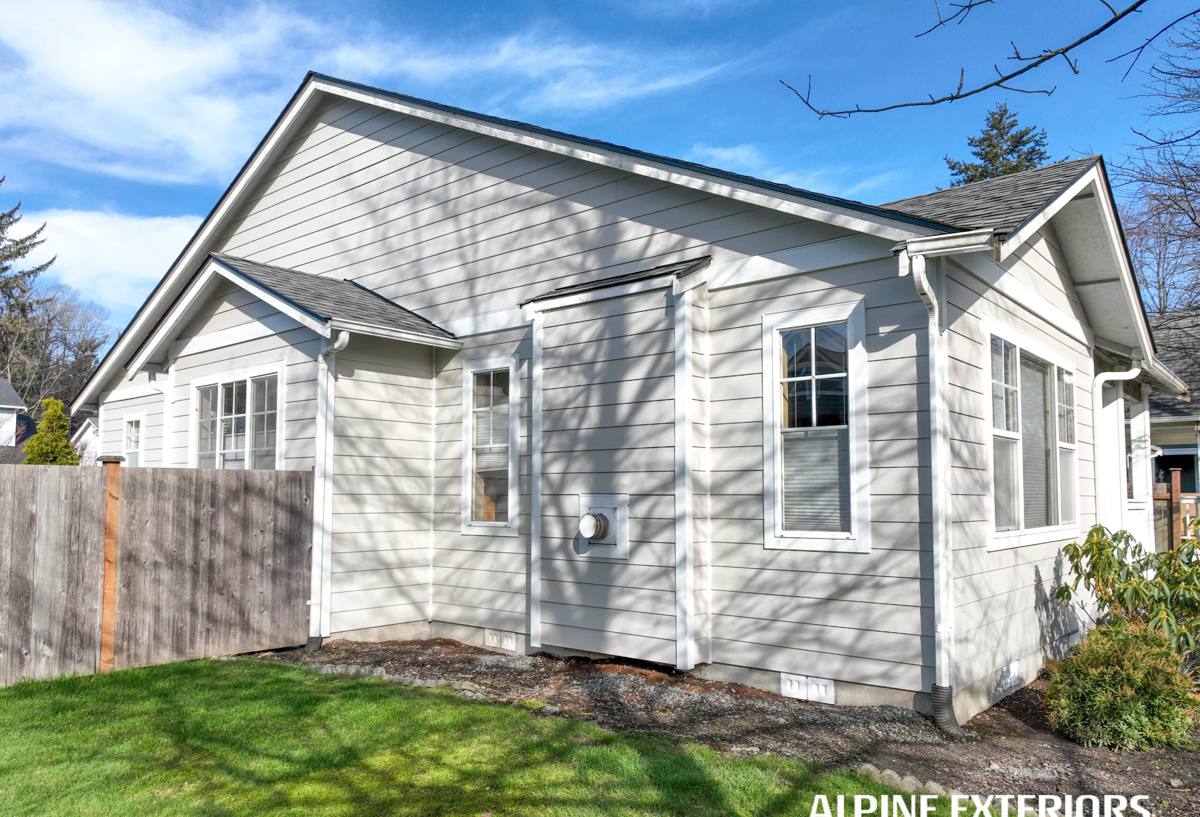
What Driving Rain, Salt Air, and Moss Actually Do to a Wall
Moisture that doesn't leave
Driving rain off the water and through tree gaps hits siding at an angle, not straight down, which means it works its way behind trim, into laps, and around penetrations more than a light vertical rain would. On a shaded lakefront lot, that moisture doesn't evaporate quickly. Siding that isn't back-ventilated or properly flashed holds water against the sheathing, and over years that's how rot starts — not from one storm, but from hundreds of storms where the wall never fully dried out between them.
Marine air and fastener corrosion
The air moving through this part of Whatcom County carries enough salt content to matter for metal. Uncoated or poorly rated fasteners, flashing, and trim hardware corrode faster here than they would inland. It's a slow problem — you won't see it in year one — but it shows up as rust staining and eventually as failed fastening points several years down the road if the wrong hardware went in.
Moss, algae, and the "long green season"
Around Lake Samish, shaded north- and east-facing walls can stay damp enough to grow moss and algae for most of the year, not just the classic Pacific Northwest winter months. That growth holds moisture against the siding surface and, on products that aren't dimensionally stable or properly sealed at the edges, it accelerates swelling, cracking, and paint failure.
Why We Install James Hardie and Nothing Else
We standardized on James Hardie fiber cement for every siding job we take on, including around Lake Samish, and we don't install LP SmartSide, vinyl, Cemplank, Allura, primed spruce, or cedar. That's not a marketing position — it's a decision based on what holds up in exactly the conditions described above.
- Non-combustible core: fiber cement doesn't feed a fire the way wood-based products can, which matters more every year as wildfire smoke seasons stretch into the Pacific Northwest.
- Dimensionally stable in damp conditions: Hardie's fiber cement doesn't swell and shrink with moisture the way engineered wood products do, which matters directly on shaded, damp lots where the material rarely gets to fully dry.
- ColorPlus factory finish: a baked-on finish applied under controlled conditions holds up better against long damp seasons and moss growth than field-applied paint, and it carries its own finish warranty.
- Climate-engineered HZ product lines: Hardie makes HZ5 product specifically engineered for wetter, colder climate zones like ours, rather than a single one-size-fits-all formulation.
- Transferable warranty: a warranty that survives a home sale matters on lake properties, which tend to turn over as second homes or rentals more often than typical neighborhood housing.
We're not saying every alternative product is worthless everywhere — we're saying that for the specific combination of shade, standing moisture, salt air, and long moss seasons found around Lake Samish, fiber cement with a factory finish is the product we're willing to put our name behind and warranty.
How Fiber Cement Siding Compares in This Climate
| Material | Moisture behavior | Moss/algae resistance | Salt air durability | Long-term maintenance |
|---|---|---|---|---|
| James Hardie fiber cement | Dimensionally stable when installed with proper clearance and flashing | Factory finish resists growth better than field-painted surfaces | Cement core doesn't corrode; fastener/trim hardware still needs proper rating | Occasional wash-down; repaint cycle is long due to ColorPlus finish |
| Vinyl siding | Doesn't absorb water but can trap moisture behind it if house wrap fails | Growth sits on the surface and needs manual cleaning | Can become brittle over time; color fades in UV | Low maintenance, but damage means panel replacement, not repair |
| LP SmartSide / engineered wood | Wood-based core is more moisture-sensitive at cut edges and joints | Prone to growth in shaded, damp spots if finish wears | Fasteners and edge sealing are critical; gaps invite rot | Needs consistent recaulking and repainting on the manufacturer's schedule |
| Cedar siding | Absorbs and releases moisture naturally; needs airflow to dry out | Susceptible to moss and mildew without regular treatment | Natural material holds up reasonably but needs finish upkeep | Highest maintenance — refinishing, sealing, and spot repairs over time |
What a Correct Installation Involves Around Lake Samish
Fiber cement siding is only as good as the wall assembly behind it. On damp, shaded lots, the details matter more than the material choice itself.
Drainage and clearance
Siding needs a drainage plane behind it — either a rainscreen gap or a code-compliant weather-resistive barrier — so any water that gets past the surface has somewhere to go besides the sheathing. Bottom clearance from grade, decks, and roof lines has to be correct, because on a lake lot with landscaping and irrigation nearby, that clearance is often the first thing that gets ignored during a quick re-side.
Flashing at every transition
Windows, doors, roof-to-wall intersections, and deck ledgers all need step flashing or head flashing installed before the siding goes on, not caulk applied after the fact as a substitute. Caulk is a maintenance item; flashing is the actual water management system.
Fastening and hardware
Fasteners and trim hardware need to be rated for the corrosive marine air this area sees, not the cheapest fastener that happens to fit the nail gun. This is a detail that's invisible on installation day and very visible five or ten years later if it was skipped.
Joint treatment and caulking
Hardie panel and lap joints need to be treated according to the manufacturer's specifications — the right sealant, the right gap, and the right factory-cut or field-cut edge treatment — so moisture doesn't wick into the cut ends of the board.
Our Process for a Lake Samish Siding Project
- On-site assessment: we look at sun exposure, tree cover, drainage patterns, and existing moisture damage specific to your lot before quoting anything.
- Tear-off and sheathing check: once old siding comes off, we inspect the sheathing and framing underneath for rot or moisture damage that needs to be addressed before new siding goes on — this is where problems that caused the original failure get found.
- Weather barrier and flashing: a correct drainage plane and flashing package goes in at every window, door, and transition before a single piece of Hardie board is installed.
- Hardie installation to spec: panels and lap siding installed with proper clearance, fastening, and joint treatment, following James Hardie's published installation guidelines rather than shortcuts.
- Trim, caulking, and touch-up: finish details get the same attention as the field siding, since trim failures are one of the most common ways water gets behind a wall.
- Final walkthrough: we go over the finished work with you before calling the job done.
What Drives the Cost of a Project Like This
| Factor | Why it matters around Lake Samish |
|---|---|
| Access and site conditions | Sloped, wooded, or lakefront lots can limit staging area and equipment access, which affects labor time |
| Existing damage found at tear-off | Long-shaded walls with a history of moisture exposure sometimes need sheathing or framing repair before re-siding |
| Product line and finish | Hardie panel, lap, and shingle profiles carry different material costs, and ColorPlus vs. field-painted finish affects both cost and long-term upkeep |
| Trim and flashing scope | Homes with more windows, dormers, and roof transitions need more flashing work, which is labor-intensive but critical here |
| Home size and complexity | Straightforward single-story elevations cost less per square foot than multi-story homes with varied rooflines |
We give straightforward, honest estimates based on what we actually find on your property — not a generic per-square-foot number that ignores the site conditions specific to a lake lot.
Living With Fiber Cement Siding in a Damp, Mossy Climate
Even the right product needs some basic upkeep to perform the way it's supposed to, especially on shaded lake properties. A little attention goes a long way toward protecting the investment.
- Rinse siding surfaces, especially shaded north and east walls, once or twice a year to keep moss and algae from establishing.
- Keep gutters clear so overflow doesn't run down the siding face repeatedly during heavy rain.
- Trim back tree branches and shrubs that keep siding sections in constant shade and slow drying.
- Check caulking at trim, window, and door joints periodically — caulk is a wear item even on a well-flashed wall.
- Address any staining or discoloration early rather than waiting, since it's usually easier to trace the cause when it first appears.
Why Hiring a Crew That Already Works Lake Samish Matters
A siding crew that mainly works dry, open lots in other parts of the county doesn't necessarily think about back-ventilation, fastener corrosion resistance, or shaded-wall moss the same way a crew that regularly works lake and forested properties does. Local experience means fewer surprises during tear-off, better judgment about where flashing needs extra attention, and a realistic sense of how a specific lot's sun exposure and tree cover will treat the siding over the next twenty years — not just how it looks on installation day.
It also means knowing the practical side of working around Lake Samish: property access on narrow or sloped driveways, protecting landscaping and shoreline areas during tear-off and disposal, and scheduling around the wetter stretches of the year so the wall assembly isn't left exposed longer than it needs to be.
Get a Straightforward Estimate for Your Lake Samish Home
If your siding is showing moss staining, soft spots, or you're just planning ahead for a home in this climate, we're happy to take a look and give you a clear, no-pressure estimate for James Hardie fiber cement siding built for your specific lot. Use the form below to get started.