 Chuckanut
 Larrabee sits along Chuckanut Drive, where the wooded slopes of Chuckanut Mountain drop down to meet Samish Bay. It's one of the more distinctive stretches of Whatcom County to side a house in — homes here deal with open-water exposure, steep and heavily forested lots, or often both at once. That combination asks more of a siding system than a typical inland subdivision does, and it's not a place where a generic installation approach holds up for long. We install James Hardie fiber cement siding exclusively, and this page covers what Larrabee's specific conditions demand from a siding job, what correct installation actually involves, and how our process works for homeowners in this area.
What Larrabee's Coastal Climate Asks of Siding
A house in Larrabee isn't dealing with generic Pacific Northwest weather. It's dealing with a specific set of conditions created by open saltwater on one side and steep, tree-covered terrain on the other, and both work against siding in different ways.
Salt Air Off Samish Bay
Homes positioned close to the water along this stretch see a steady drift of salt-laden marine air, not just during storms but as a near-constant background condition. That kind of exposure is slow and unglamorous in how it does damage — it accelerates corrosion at fastener heads and flashing, and it wears down lower-grade finishes faster than the same product would age forty miles inland. It rarely announces itself as a single dramatic failure. It shows up gradually, as rust bleed, chalking, or a finish that looks tired years ahead of when it should.
Wind-Driven Rain Along Chuckanut Drive
Where the mountain meets open water, wind doesn't move in a straight, predictable line. Storms off the water get pushed and funneled by the terrain, and the result is rain that arrives sideways as often as it falls straight down, especially against south- and west-facing walls that face the bay directly. That matters because wind-driven rain doesn't test a wall the way a calm, straight-down rain does — it finds lap joints, trim seams, and any gap around a window or door that a finish coat is supposed to be keeping closed.
A Long Moss Season Under Forest Canopy
The same mountainside that gives Larrabee its scenery also keeps a lot of walls shaded for a large part of the day, and shaded walls dry out slowly after a storm. Mild temperatures and sustained dampness under heavy tree cover add up to a moss and mildew season that can run most of the year on north-facing or heavily shaded siding. A porous or moisture-retentive material gives that growth something to hold onto; a dense, inorganic material doesn't.
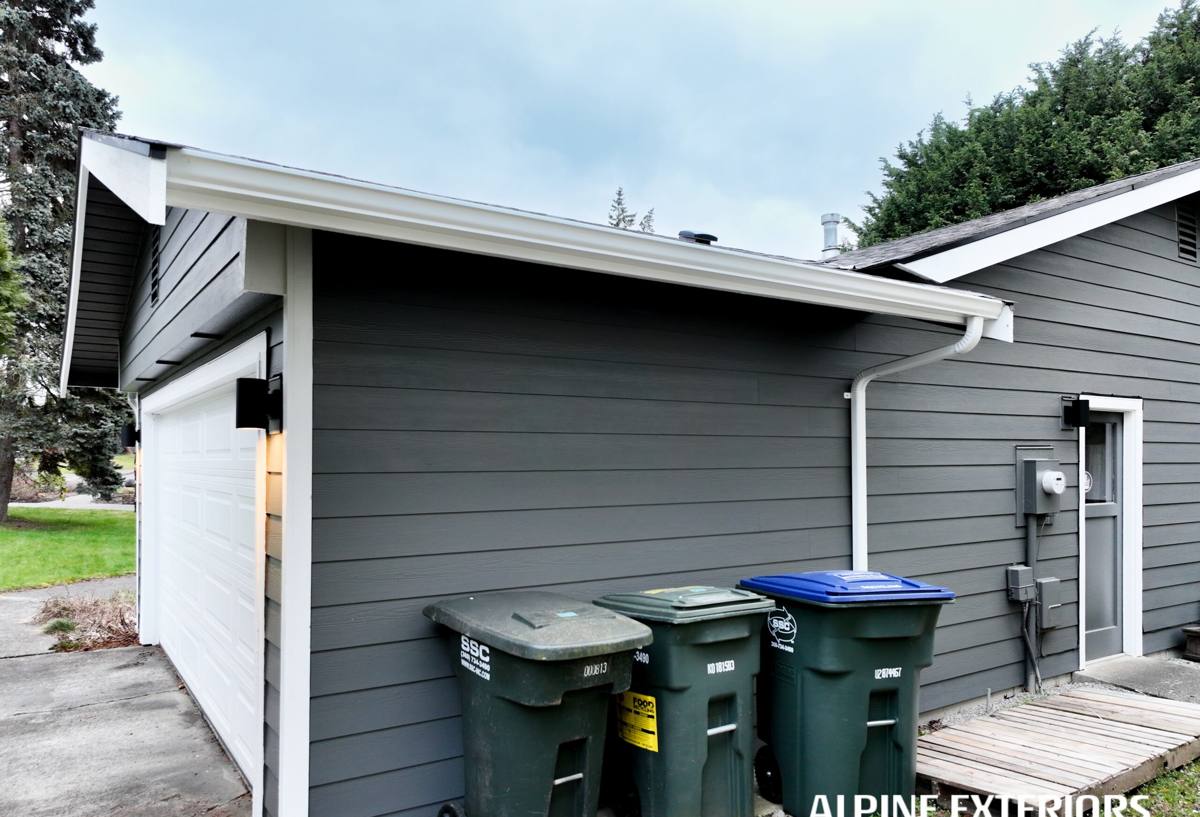
Why James Hardie Is What We Install in Larrabee
We don't offer a menu of siding brands and let price make the decision. We install James Hardie fiber cement, and only James Hardie, because of how consistently it holds up against exactly the conditions Larrabee produces.
HZ5: Engineered for This Kind of Weather
Hardie doesn't sell one generic board everywhere in the country. Its HZ product lines are formulated for different regional exposure profiles, and for the Pacific Northwest that means the HZ5 formulation, engineered for sustained moisture and freeze-thaw cycling rather than a drier or more moderate climate. That's a meaningful distinction for a property sitting this close to open saltwater under this much tree cover.
ColorPlus Factory Finish
Most Hardie siding we install carries a ColorPlus finish, a color coat that's applied and cured at the factory under controlled conditions rather than brushed or sprayed on-site after the boards go up. That process gives it real resistance to fading, chalking, and cracking compared to field-applied paint, which matters in a spot where salt air and long gray stretches both work against a finish year-round. It also carries its own finish warranty, separate from the warranty on the board itself.
A Non-Combustible, Dimensionally Stable Core
Fiber cement's core is cement, sand, and cellulose fiber, with no organic wood content to feed a fire or to swell, cup, and warp the way engineered wood products can after repeated wet-season moisture cycles. Combined with a strong transferable warranty when the installation follows Hardie's spec, that's the combination we've decided to stand behind on every property we side, Larrabee included.
What a Correct Hardie Installation Involves in Larrabee
The product is only half of the equation. A Hardie installation that actually performs the way it's engineered to depends on installation details that are easy to skip and hard to spot once the wall is closed up. On a Larrabee property, we pay particular attention to:
- Proper clearance between the bottom of the siding and grade, decks, roof lines, and any retaining wall or slope
- Correct flashing at every window, door, and roof-to-wall intersection, sized for wind-driven rain rather than straight-down rain
- House wrap and flashing installed as one continuous water-management system, not as separate steps done in isolation
- Fasteners rated for marine exposure, placed to Hardie's spacing specification rather than "close enough"
- Lap joints and butt joints sealed and detailed to shed wind-driven water rather than just resist it
- Extra attention to shaded, north-facing wall sections where moss and slow drying are most likely to become an issue
Skip or rush any one of these on a bay-facing or heavily shaded lot, and the weak point usually doesn't show itself for a year or two — long after the crew that cut the corner has moved on.
Our Process for a Larrabee Siding Project
Every property along this stretch is a little different depending on how close it sits to the water, how much tree cover it has, and how exposed it is to wind off the bay, so we walk the actual lot before we quote or install anything.
- On-site assessment: We look at wall orientation relative to the bay, existing tree cover and shade patterns, drainage and slope, and the condition of the current siding and substrate underneath it.
- Product and color selection: We help you choose the right Hardie profile and ColorPlus color for your home, factoring in sun exposure, shade, and how a given finish holds up against salt air.
- Prep and tear-off: Removing the old siding is also when hidden moisture damage to sheathing or framing gets found and addressed, rather than covered over.
- Installation to spec: Flashing, house wrap, fastening, and joint detailing are done to Hardie's requirements, with extra care at the wall sections that take the most wind and moisture.
- Final walkthrough and warranty registration: We walk the finished job with you and make sure your Hardie warranty is properly registered and documented.
Signs a Larrabee Home's Siding Needs Attention
- Moss or dark staining that comes right back after cleaning, especially on shaded or north-facing walls
- Soft, spongy, or discolored siding near the base of the wall or around window and door trim
- Peeling, bubbling, or chalking paint on siding boards or trim
- Cracked or missing siding sections after a windstorm off the bay
- Rust staining at fasteners or flashing, an early sign of marine air exposure
- Visible gaps at seams, corners, or trim joints where wind-driven rain can track in
Cost Factors for a Hardie Siding Project in Larrabee
| Factor | What It Affects | Why It Matters Here |
|---|---|---|
| Proximity to the bay | Fastener and flashing detail | Homes closer to open water take more direct salt air and wind-driven rain than lots set back under the trees |
| Tree cover and slope | Site access and drying time between coats | Larrabee's mountainside lots often mean scaffolding, staging, and a slower-drying job site |
| Tear-off vs. overlay | Labor scope and substrate access | Tear-off exposes any hidden moisture damage common under older siding this close to the water |
| Substrate condition | Repair costs before new siding goes on | Trapped moisture behind failing siding can damage sheathing before it's ever visible from outside |
| Color and finish selection | Material cost and long-term appearance | ColorPlus factory finish holds up against salt air and UV far longer than field-applied paint |
These are the variables that actually move a number up or down on a given property. We walk the site and give you a real figure rather than a square-footage estimate that ignores exposure and terrain.
Why a Crew That Already Works in Larrabee Matters
Wind, salt exposure, and shade don't behave uniformly across Whatcom County, and they don't even behave uniformly across Larrabee itself — a lot facing the open bay and a lot tucked under the mountainside a few hundred feet away can need noticeably different flashing and fastener decisions. A crew that has actually sided homes along this stretch knows which wall orientations take the worst of a winter storm, which shaded sections need extra attention against moss, and where the terrain tends to complicate drainage and access. That local pattern recognition doesn't come from a spec sheet. It comes from having done the work here before, on real houses, through real wet seasons.
If your Larrabee home needs new siding, a repair, or just an honest assessment of what's actually happening behind an aging wall, we're glad to take a look. Reach out using the form below to schedule a free, no-pressure estimate.