 Chuckanut
 Why Mount Vernon Roofs Take a Different Kind of Beating
Mount Vernon sits in the Skagit Valley, close enough to Puget Sound and the Salish Sea that homes here deal with a mix most inland Washington towns never see: salt-laced air moving in off the water, long stretches of driving rain through fall and winter, and a moss season that can run nine months out of the year in shaded, north-facing roof sections. None of these show up as a single dramatic event most of the time. They show up as slow, cumulative damage that a homeowner doesn't notice until a storm finds the weak spot and turns it into a leak.
That's the pattern we see over and over on Mount Vernon roofs: a windstorm lifts a run of shingles that had already been softened by months of trapped moisture under moss growth, or driving rain gets pushed sideways under flashing that was fine in a light drizzle but not in a 40 mph gust off the valley. Storm damage repair here isn't just about patching what broke last night — it's about understanding what made that spot vulnerable in the first place, because if you don't fix that, the next storm finds the same weak point again.
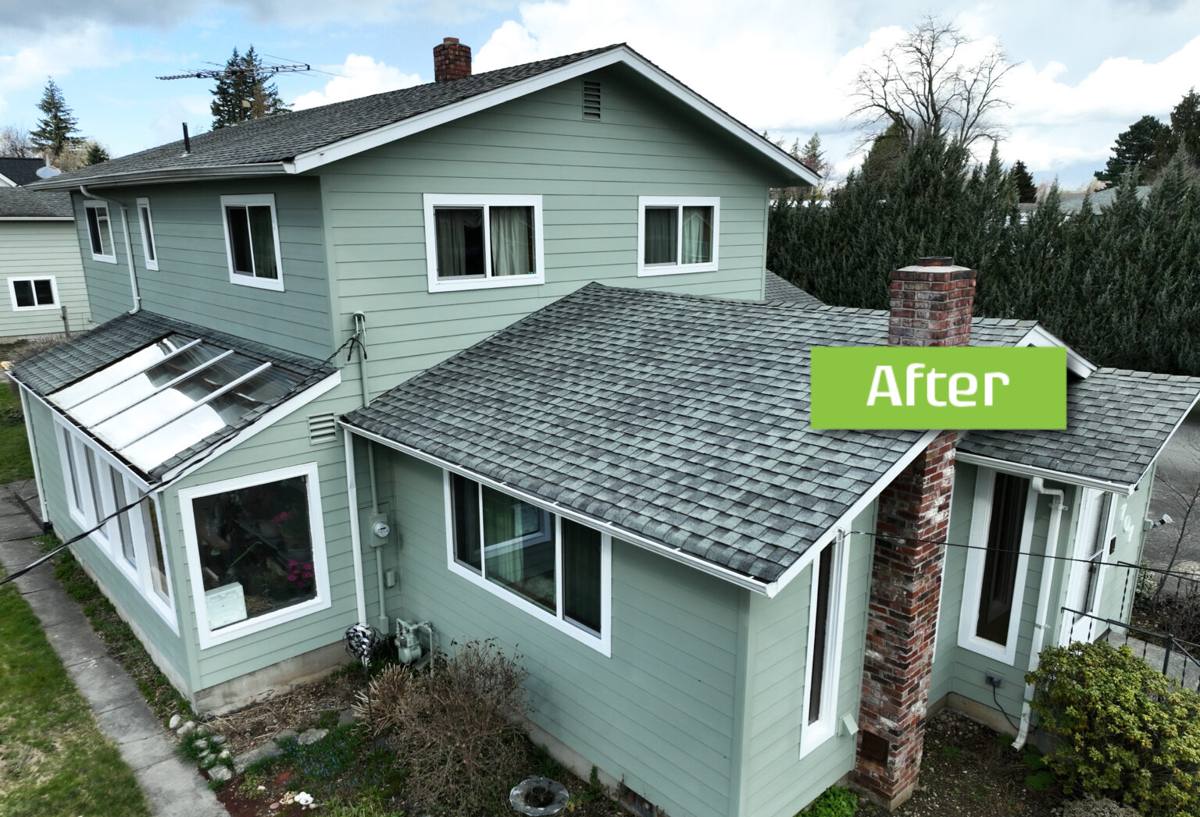
What "Storm Damage" Actually Looks Like on a Skagit County Roof
Homeowners often expect storm damage to be obvious — a missing shingle, a visible hole. Sometimes it is. Just as often, it's subtler, and the subtler kind is what causes the expensive problems if it sits unaddressed through another wet season.
Wind Damage
Wind rarely just rips a shingle clean off. More often it lifts an edge, breaks the seal, and leaves the shingle looking mostly intact from the ground while water has a clear path underneath it. Repeated wind events loosen fasteners and creep flashing out of position a little at a time.
Wind-Driven Rain Intrusion
This is the one that catches people off guard. Rain that comes in at an angle — which is the norm during a Puget Sound storm system — can push past roof penetrations, chimney flashing, and valley metal that would shed water fine in a straight-down rain. Interior stains around skylights or chimneys after a storm are almost always a wind-driven rain signature, not a simple leak.
Moss and Trapped Moisture Damage
Moss itself doesn't "cause" a storm to do damage, but it sets the stage. Moss mats hold water against the shingle surface, degrade the granule layer that protects against UV and wear, and lift shingle edges as it grows. A roof with heavy moss going into a windstorm is a roof with dozens of pre-loosened edges for the wind to grab.
Debris Impact
Branch strikes and wind-thrown debris are common in the Skagit Valley's wooded and semi-rural lots. Impact damage can crack shingles or dent metal without ever creating a visible hole, which is why a physical inspection after a bad storm matters more than a look from the driveway.
Our Process for Storm Damage Repair in Mount Vernon
We keep this straightforward and honest, because storm repair is one of the areas where homeowners get taken advantage of most — rushed sales pitches, vague scopes, and repairs that only address what's easy to see.
- Ground-level and roof-surface inspection. We look at the whole roof, not just the area the homeowner points to, because storm damage often has more than one point of entry.
- Attic and interior check. Where accessible, we check the attic for water staining, wet insulation, or daylight coming through — this tells us how far moisture has already traveled.
- Written scope with photos. You get a clear description of what's damaged, what's just worn, and what's still sound, so you're not paying to replace things that don't need it.
- Repair or targeted replacement. Most storm damage in Mount Vernon is fixable without a full roof replacement — matching shingles, resealing flashing, and correcting the underlying moisture problem so it doesn't recur.
- Insurance documentation, if needed. If the damage is significant enough to involve your homeowner's insurance, we provide documentation that supports your claim — we don't inflate scope to chase a bigger payout.
Getting the Diagnosis Right the First Time
A lot of "repeat leaks" homeowners deal with aren't repeat problems at all — they're the same problem that was never fully diagnosed the first time. A patch on the visible shingle without checking the underlayment or flashing behind it will often hold through a light rain and fail again in the next real storm. Because Skagit Valley storms tend to come from a consistent direction off the Sound, wind-driven rain damage is frequently directional — meaning if one section of a roof failed, we check every similarly-oriented section for the same early-stage weakness, not just the spot that's actively leaking today.
Repair vs. Replace: How We Make That Call
| Factor | Leans Toward Repair | Leans Toward Replacement |
|---|---|---|
| Roof age | Under 12–15 years, asphalt shingle | Nearing or past manufacturer service life |
| Extent of damage | Isolated to one section or slope | Multiple sections, or damage plus widespread wear |
| Underlying deck condition | Solid, no rot found | Soft spots or rot found on inspection |
| Moss history | Light, recently treated | Long-term heavy moss with granule loss across large areas |
| Shingle availability | Matching shingle still obtainable | Discontinued product, visible patch mismatch unavoidable |
We'll always tell you honestly which side of that table your roof falls on. Repair is the right call more often than the roofing industry's reputation suggests — but not always, and pretending otherwise doesn't do you any favors down the road.
Why the Salt Air and Moss Season Change the Materials Question
Proximity to the Sound means metal flashing, fasteners, and any exposed hardware need to hold up to salt-laced moisture, not just rain. We use fasteners and flashing rated for coastal-adjacent exposure rather than standard inland-grade hardware, because the cost difference is small and the corrosion difference over ten years is not. On the moss side, we don't just clear moss and call it done — moss removal without addressing the shade, debris buildup, or drainage that let it establish in the first place just buys you a year or two before it's back. Where it makes sense, we'll talk about zinc or copper strips at the ridge, which discourage regrowth without chemical treatments that can shorten shingle life.
What a Homeowner Should Check After a Storm
- Interior ceiling or wall stains that appeared or grew after a windy, rainy night
- Granules collecting in gutters or at downspout outlets — a sign of impact or wind stress on shingles
- Visible gaps, lifted edges, or shingles that look "off-pattern" from the ground
- Flashing around chimneys, skylights, and vent pipes that looks bent, separated, or missing
- Sagging or soft-looking spots on the roof plane itself
- Debris — branches, needles, moss clumps — piled against a ridge or valley where it can trap water
- Musty smell in the attic or top-floor closets, which can precede visible staining by weeks
If you see any of these, it's worth a professional look before the next storm system comes through — not because every one of these is an emergency, but because catching it early is almost always cheaper and less disruptive than catching it late.
Why It Matters That We Already Work in Mount Vernon
Storm damage repair is one of those jobs where local, on-the-ground knowledge actually changes the outcome. A crew that regularly works Skagit County roofs already knows which shingle lines and flashing details tend to struggle against wind off the Sound, which neighborhoods run heavier moss because of tree cover and shade patterns, and what "normal wear" looks like on a five-year-old roof in this climate versus a roof somewhere drier. That local pattern recognition is the difference between a repair that treats the symptom and one that treats the cause.
It also means we're not driving in from out of the area to chase storm-damage leads after a bad weather week and then disappearing once the rush is over. If a repair doesn't hold, or a related issue shows up in a different section six months later, we're still local and still reachable.
A Straightforward Word on Cost
Storm damage repair costs vary a lot depending on scope — a single-slope flashing reseal is a very different job from replacing a wind-damaged section plus correcting the underlayment beneath it. We're not going to publish a number here that doesn't mean anything until we've actually looked at your roof, but we will always give you a clear, itemized estimate before any work starts, and we'll tell you plainly if a repair is the right call or if you're better off putting that money toward a longer-term fix.
If you've had storm damage, a suspicious leak, or just want an honest look at how your roof is holding up against Skagit Valley weather, we're happy to come out for a free, no-pressure estimate — just fill out the form below.