 Chuckanut
 Why Larrabee Homes Need Siding Built for This Exact Climate
Homes along the Chuckanut corridor near Larrabee sit in one of the more demanding microclimates in Whatcom County. You've got marine air coming off Samish Bay and Chuckanut Bay, steady winter rain that doesn't let up for weeks at a time, and heavily wooded lots that keep siding shaded, damp, and slow to dry. That combination is exactly what wears out the wrong siding product fast — and it's why we treat Larrabee as a distinct job, not a copy-paste of what we'd install somewhere drier and more open.
Three things do most of the damage here: salt-laden air that accelerates corrosion on fasteners and trim metal, wind-driven rain that gets pushed sideways into laps and joints that would stay dry in a calmer climate, and a moss and algae season that runs long because tree cover keeps north and west-facing walls from ever fully drying out. Any one of these is manageable. All three at once, on a wooded coastal lot, is what separates a siding job that lasts twenty-plus years from one that needs paint and caulk repair inside five.
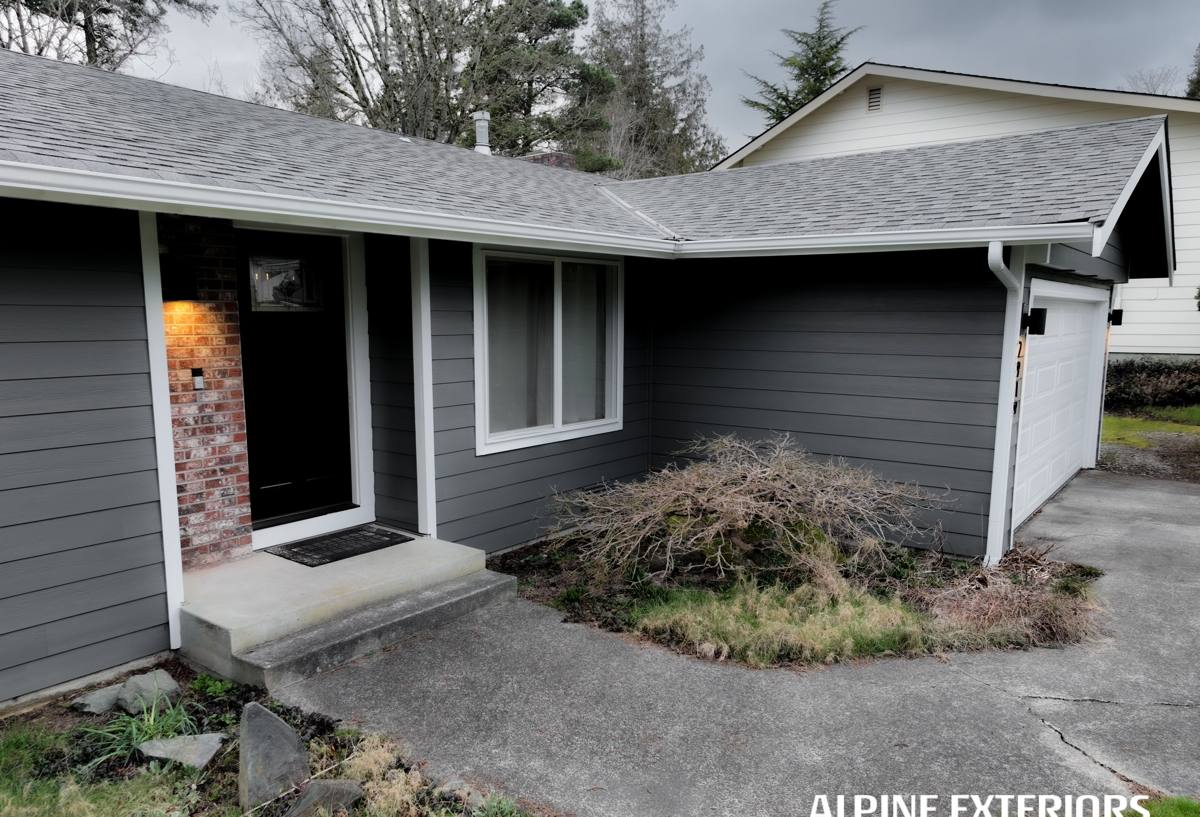
What "Correct" Fiber Cement Installation Actually Involves Here
Fiber cement siding is only as good as the water management behind it. In Larrabee's conditions, we pay particular attention to the details that don't show up in a driveway estimate but decide whether the wall assembly survives its first few wet seasons:
- A weather-resistive barrier installed shingle-style, lapped correctly at every seam, so any water that gets past the siding face still drains out instead of pooling behind it
- Rainscreen or drainage gap detailing on shaded, moisture-prone elevations, giving the wall a way to dry between storms instead of staying saturated
- Stainless or coated fasteners at the recommended spacing and depth — plain fasteners corrode faster this close to salt air, and under-driven or over-driven nails are one of the most common causes of early siding failure
- Proper clearance at grade, decks, and roof lines so siding never sits in standing water or gets buried under mulch and debris
- Factory-primed or factory-finished cut edges sealed in the field, since a raw cut edge is the fastest way for moisture to work into the material
- Correctly flashed and caulked window, door, and penetration details — the majority of siding leaks trace back to flashing, not the siding panel itself
None of this is exotic. It's just disciplined, unglamorous work that has to be done right the first time, because a wall gets closed up and nobody checks behind the siding again for twenty years.
Why We Install Only James Hardie
We don't carry vinyl, LP SmartSide, primed spruce, cedar, or other fiber cement brands like Cemplank or Allura. That's a deliberate standard, not a sales pitch. Vinyl expands and contracts with temperature swings and can warp or crack in cold snaps; wood and wood-based products need consistent maintenance to resist rot in a climate that stays wet most of the year; other fiber cement brands vary in formulation, factory finish quality, and warranty backing in ways that matter over a 20-30 year timeline.
James Hardie is non-combustible, engineered specifically for climate zones like ours through its HZ5 product line, and finished at the factory with ColorPlus technology — a baked-on finish that holds color far better than field-applied paint and comes with its own dedicated finish warranty. For a coastal, wooded, high-moisture lot, that combination of moisture resistance, dimensional stability, and finish durability is the reason it's the only product we put on a home.
HZ5 and Coastal Exposure
Hardie's HZ5 formulation is engineered for regions with more moisture cycling and freeze-thaw pressure than the company's standard HZ10 line. On a lot near the water with heavy tree cover, that engineering difference is worth having — it's built to hold up to exactly the wet-dry cycling that wears out lesser materials here.
Our Process for a Larrabee Fiber Cement Job
1. On-Site Assessment
We walk the property and look specifically at what a generic estimate would miss: which elevations get the least sun and stay damp longest, how close tree cover sits to the walls, where the existing siding or sheathing already shows moisture damage, and whether the current drainage plane needs to be rebuilt rather than patched.
2. Substrate and Moisture Check
Before any new siding goes up, we check the sheathing underneath for rot, soft spots, or trapped moisture. Covering a compromised substrate with new siding just hides the problem — we repair what's underneath first.
3. Weather Barrier and Flashing
This is where most of the long-term performance gets decided. We install the weather-resistive barrier, flashing, and drainage detailing before a single piece of Hardie board goes up, with extra attention on shaded and wind-exposed walls.
4. Installation to Manufacturer Spec
Panels and planks go up at the correct reveal, fastener spacing, and clearance, with all cut edges sealed and joints properly caulked or flashed. We don't deviate from Hardie's published installation requirements — doing so is what voids warranties and shortens the life of the siding.
5. Final Walkthrough
We check trim, caulking lines, and clearances at grade and roof intersections before calling the job finished, and we walk the exterior with the homeowner so nothing is a surprise later.
Choosing the Right Hardie Line and Finish for a Wooded Lot
Not every Larrabee property needs the same product. A sun-exposed wall facing open water has different needs than a shaded wall backed against fir and cedar trees. We factor in:
| Site Condition | What It Means for Siding |
|---|---|
| Heavy tree cover, limited sun | Prioritize drainage detailing and a finish resistant to moss/algae growth over long damp periods |
| Direct salt air exposure | Corrosion-resistant fasteners and trim hardware matter more than on inland lots |
| Wind-exposed elevation | Extra attention to lap and joint sealing where wind-driven rain gets pushed sideways |
| Steep or wooded lot access | Affects staging, material handling, and project timeline more than the product itself |
ColorPlus finishes come in a range of tones that hold up well against the greens and grays of a wooded, coastal palette, and because the color is baked on at the factory rather than field-applied, it resists the fading and chalking that a site-painted finish would show first in a climate this wet.
Cost Factors for a Larrabee Fiber Cement Project
Every home is different, but the line items that actually move the price on a job like this are consistent:
| Factor | Why It Matters |
|---|---|
| Substrate condition | Rot or moisture damage found during tear-off adds repair scope before new siding can go up |
| Home size and wall complexity | More corners, dormers, and trim details mean more cutting, flashing, and labor time |
| Siding profile (lap, panel, shingle) | Different profiles have different material and installation labor requirements |
| Access and site conditions | Wooded or sloped lots can affect staging, scaffolding, and material handling time |
| Trim and accessory scope | Fascia, soffit, and trim work often gets bundled with siding replacement for a consistent finish |
We give real numbers after walking the property, not a phone-quote guess — the substrate condition alone can change a bid meaningfully once we're actually looking at the sheathing.
Living With Fiber Cement Siding in a Moss-Heavy Climate
Correctly installed Hardie siding is low-maintenance, but "low" isn't "none," especially on a shaded lot near Chuckanut where moss and algae have a long growing season. A short annual routine keeps it looking right and catches small issues before they become expensive ones:
- Rinse siding annually, especially on north and west-facing walls that stay shaded longest
- Trim back branches and vegetation that keep siding damp or in constant shade
- Check caulking at trim, windows, and joints yearly and re-caulk any cracked or separated sections
- Watch gutters and downspouts near siding — overflow during heavy rain is a common source of localized water damage
- Repaint or touch up any field-painted trim on the same cycle recommended by the manufacturer, even though the ColorPlus finish itself doesn't need repainting
Why Hiring a Crew That Already Works Larrabee Matters
A crew that hasn't worked this specific stretch of Whatcom County will often underestimate how much shade, salt exposure, and rain volume actually affect a wall assembly here. We've installed in this exact climate enough to know which elevations need extra drainage detail before a homeowner ever notices a problem, and we don't treat a coastal, tree-covered lot the same way we'd treat a dry, open one across the county. That local judgment is what keeps a Hardie installation performing the way it's supposed to for its full service life instead of needing early repair.
If your siding is aging, showing moss buildup that won't rinse off, or you're planning ahead for a replacement, we're glad to take a look and walk the property with you. Reach out for a free, no-pressure estimate — the form below gets you started.