 Chuckanut
 Building New in Samish: Why Window Installation Deserves Extra Attention
If you're framing a new home or a major addition in the Samish area of Chuckanut, the windows are one of the few components that get exactly one chance to be installed correctly. Once siding, trim, and interior finishes go on, the flashing and sealing work behind the window unit is buried. Get it right during rough-in and it stays right for decades. Get it wrong and you're chasing water stains, rot, and mold years down the road — usually after the warranty window has closed.
Samish sits close enough to the water that homes here deal with a combination most inland builders in Whatcom County never have to think about: salt-laden air corroding hardware and fasteners, driving rain that hits window openings sideways during winter storms, and a moss and algae season that runs long thanks to the shade and humidity common in this part of the county. New-construction window installation here isn't just about hanging a unit plumb and level — it's about building a water-management system into the wall assembly from the start.
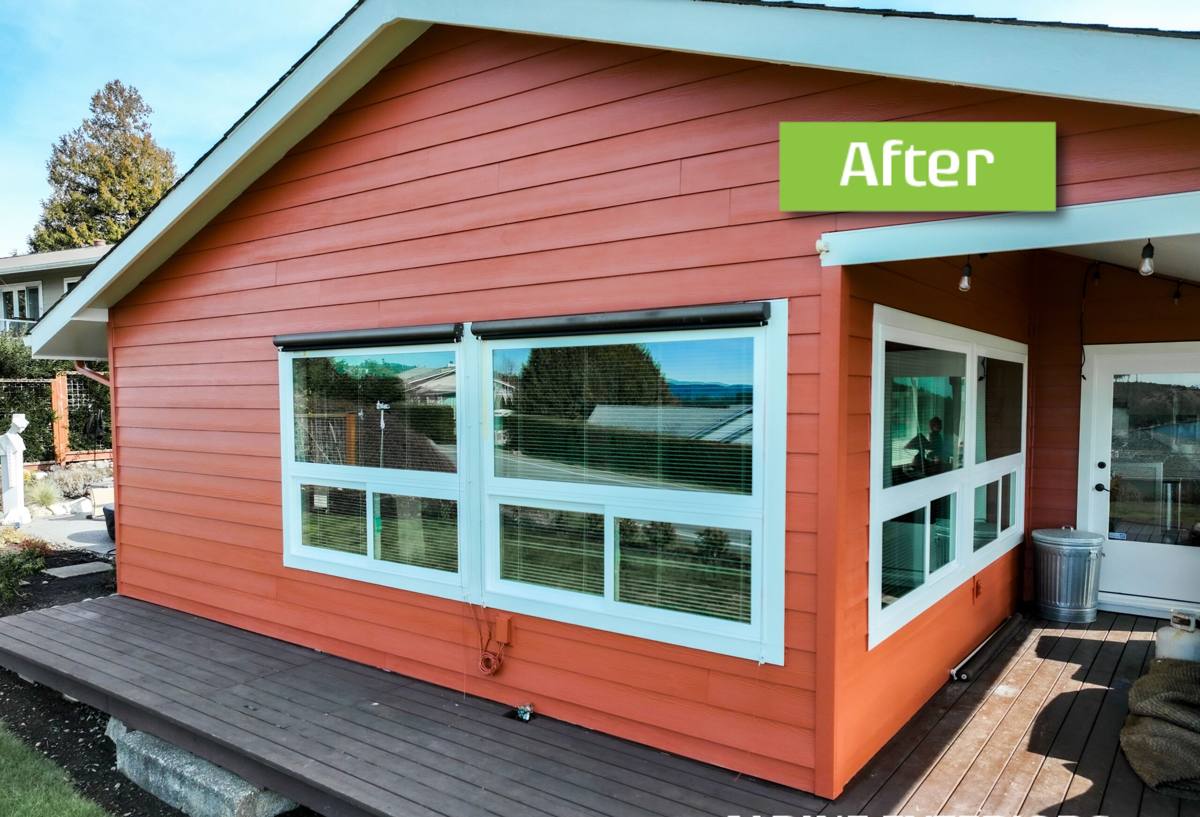
What "New-Construction" Windows Actually Means
New-construction windows are built with a nailing flange (also called a nail fin) that attaches directly to the wall sheathing before siding goes on. This is different from replacement or retrofit windows, which get installed into an existing opening without disturbing the exterior wall. Because we're working with open studs and exposed sheathing on a new build, we have full access to integrate the window into the weather-resistive barrier (WRB) properly — something that's much harder to do correctly on a retrofit.
That access is an advantage, but only if it's used correctly. A new-construction opening gives us the chance to layer flashing tape, sill pans, and house wrap in the correct shingle-lap order so that any water that gets past the window sheds outward and down, never behind the WRB and into the wall cavity.
Core Steps in a Correct New-Construction Install
- Rough opening checked for square, plumb, and correct sizing before the window ever arrives on site
- Self-adhered sill pan flashing installed with back-dam and end dams so any intrusion drains outward, not into the framing
- Window set, shimmed, and fastened per manufacturer spec — not just "nailed until it feels tight"
- Jamb and head flashing integrated in proper shingle-lap sequence with the house wrap or WRB
- Head flashing with a drip cap detail, especially important on any wall facing prevailing wind and rain
- Low-expansion foam or backer rod and sealant at the interior gap — not spray foam alone, which isn't a full air seal on its own
- Exterior sealant joints at the nail fin and trim, using a sealant rated for the surface and our climate
- Final check of reveal, operation, and weep path before siding installation begins
Skip or rush any one of these steps and the window itself can be a premium product and still leak. Most window failures we investigate on newer homes trace back to flashing sequence errors, not the window unit failing on its own.
Why Samish's Climate Changes the Calculus
Chuckanut and the Samish shoreline area get weather that's a step wetter and saltier than much of inland Whatcom County. A few things we plan around on every new-construction job out here:
Salt Air and Hardware Corrosion
Proximity to salt water accelerates corrosion on exposed fasteners, hinges, and cranks. On new builds close to the water, we lean toward corrosion-resistant hardware packages and stainless or coated fasteners at the flashing and trim, rather than standard-grade hardware that's fine forty miles inland but degrades faster here.
Driving, Wind-Driven Rain
Storms coming off the water don't just fall straight down — wind pushes rain sideways into wall assemblies, which is exactly the condition sill pan flashing and proper head flashing are designed to handle. On elevations that face the prevailing weather, we're more conservative with flashing overlap and drip cap projection than code minimums require.
Long Moss and Algae Season
Shade, moisture, and mild temperatures mean moss and algae have a long growing season in this part of the county. This mostly affects roofing and horizontal trim, but it matters for windows too — sills and horizontal trim members that don't shed water cleanly become a growth surface, which holds moisture against wood trim and shortens its life. We detail sills with slope and drainage in mind, not just appearance.
Choosing Windows for a Samish New Build
Product selection matters as much as installation. For new construction near Chuckanut, we typically steer homeowners toward vinyl or fiberglass frames with a solid warranty and proven weather-sealing performance, sized and rated to meet Washington State Energy Code requirements for U-factor and solar heat gain. Wood-frame windows without a clad exterior are a harder sell this close to the water — they look great initially but demand more upkeep to keep the exterior finish from breaking down under salt air and moisture exposure, which is a maintenance burden worth being honest about upfront.
| Factor | What to Look For in This Climate |
|---|---|
| Frame material | Vinyl or fiberglass generally handle moisture and salt exposure with less maintenance than uncladded wood |
| Glazing | Dual-pane, low-E glass sized to meet current WA energy code minimums for our climate zone |
| Hardware finish | Corrosion-resistant hardware on homes within a few miles of the water |
| Sill design | A sill profile that sheds water rather than pooling it, to limit moss/algae buildup |
| Warranty structure | Manufacturer warranty on the unit, separate from our installation warranty — ask what each actually covers |
Coordinating With Your Builder or GC
On most new-construction jobs in Samish, we're one trade among several — framer, roofer, siding crew, and us — all working off the same schedule. Timing matters: windows need to go in after the WRB is on but before siding starts, and ideally during a dry weather window given how much rain this area sees outside of summer. We coordinate directly with your general contractor or builder on sequencing so the opening is ready, the flashing tape and sill pan materials are on-site, and we're not working the exterior water-management details on tape and hope because a rainstorm is closing in.
We also flag any rough-opening issues — out-of-square framing, incorrect sizing, missing blocking — before the window shows up, since catching those early is a lot cheaper than discovering them the day of install.
Our Process on a Samish New-Construction Job
- Plan review and rough-opening verification — we confirm window sizes and opening dimensions against the plans before ordering, and check framing once it's up
- Product selection walkthrough — we go over frame material, glazing, and hardware options suited to a Chuckanut/Samish location, with honest trade-offs on cost and maintenance
- Sill pan and flashing installation — done to manufacturer instructions with attention to back-dam, end-dam, and shingle-lap sequencing
- Window setting and fastening — plumb, level, square, and fastened per spec, with operation checked before we move on
- Head flashing and WRB integration — tied into the house wrap correctly so water sheds outward at every layer
- Interior and exterior sealing — air sealed on the interior, weather sealed on the exterior, with weep paths left clear
- Final walkthrough — we check every opening before siding crews close the wall up, since that's the last point where flashing errors are easy to fix
Why Hire a Crew That Already Works Samish
Window flashing details that work fine in a drier inland climate can underperform right on the water. A crew that regularly works Chuckanut and the Samish shoreline has already seen how wind-driven rain behaves on exposed elevations here, which hardware finishes hold up and which corrode early, and where moss tends to build up on horizontal surfaces if the drainage detail isn't right. That local pattern recognition is hard to replicate on a first job in an unfamiliar microclimate, and it's the difference between a window that's dry in year one and one that's still dry in year fifteen.
We also know the practical side of building here — permitting expectations in Whatcom County, working around the rainy stretches of the calendar, and coordinating with the other trades typically involved in a Samish new build.
Common Questions During Framing
A few things come up on nearly every new-construction job in this area worth planning for ahead of time: window lead times (custom sizes can take several weeks, so ordering early avoids holding up your framing schedule), confirming your energy code compliance path with your builder before final window selection, and deciding on interior trim and sill detailing before drywall goes up, since that affects how the window opening gets finished on the inside.
If you're planning a new build or major addition in the Samish area and want windows installed by a crew that treats the flashing details as seriously as the finished look, we'd be glad to take a look at your plans and walk the site. Reach out for a free, no-pressure estimate — the form below gets you started.