 Chuckanut
 Siding Repair in Larrabee: A Different Set of Problems Than Inland Homes
Larrabee sits close enough to the water and the forested slopes of Chuckanut Mountain that its homes take a beating most inland Whatcom County properties never see. Salt-laden air off the bay, wind-driven rain that finds every gap in a wall assembly, and a shaded, damp growing season that keeps moss and algae active for much of the year — all three work on siding at the same time, year after year. A repair approach that works fine in a dry, sunny neighborhood often falls short here, because it doesn't account for how fast moisture and organic growth can re-establish themselves once a wall has been opened up and patched.
This page is about one thing: repairing siding on Larrabee homes correctly, with an understanding of what this specific location does to a wall over time. We're not going to give you a generic "we fix all siding" pitch. We're going to walk through what actually causes damage here, what a repair needs to accomplish to hold up, and how we handle the job when we're called out to a home in this area.
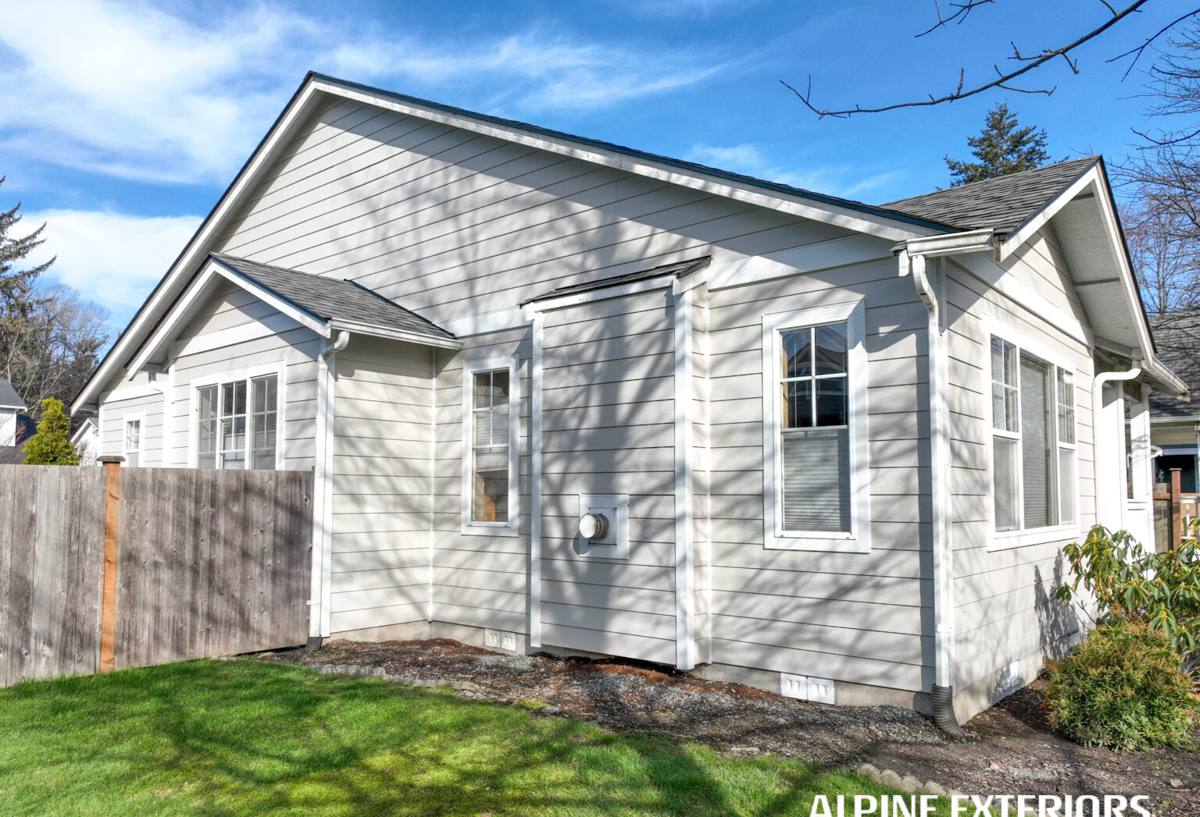
What Salt Air, Driving Rain, and Moss Season Actually Do to Siding
Salt Air
Airborne salt doesn't just sit on the surface — it's hygroscopic, meaning it actively pulls moisture out of the air and holds it against whatever it lands on. On wood-based sidings (cedar, primed spruce, engineered wood products), that means the surface stays damp longer than it would in a salt-free environment, which accelerates paint failure, checking, and eventually rot at seams and butt joints. On metal fasteners and flashing, salt accelerates corrosion, which is often the real reason a "siding" repair call turns out to be a fastener or flashing failure underneath.
Driving Rain
Chuckanut's exposure means rain doesn't always fall straight down — wind pushes it sideways into wall assemblies, especially on gable ends and any wall facing open water or a clearing. Siding systems are designed to shed water down and out, not to be pressure-washed sideways into laps and seams. Homes here need lap siding installed with correct overlap, properly flashed windows and penetrations, and caulking used only where it belongs — not as a substitute for proper flashing, which is a shortcut that fails within a few years in this kind of exposure.
Moss Season
The tree cover and shade around much of Larrabee keep north- and west-facing walls damp well into the months when other neighborhoods have dried out. Moss and algae aren't just cosmetic — they hold moisture against the siding surface continuously, which is a much harsher condition than intermittent rain exposure. Over years, that constant dampness is what pushes wood-based siding past the point where a spot repair is worth doing.
Signs a Larrabee Home Needs Siding Repair
- Soft or spongy spots when you press on the siding, especially near the bottom courses and around window trim
- Visible gaps opening up at butt joints or where boards meet corner trim
- Paint that's bubbling, peeling, or failing faster on shaded, moss-prone walls than on sun-exposed ones
- Dark streaking or persistent green/black growth that doesn't wash off and comes back within weeks
- Nail heads popping or streaking with rust-colored stains — often a sign of corroding fasteners underneath
- Warping, cupping, or visible separation at seams, particularly on walls facing prevailing wind and rain
- Interior signs — musty smell, discoloration on interior drywall, or trim near an exterior wall that feels damp
Any one of these on its own might be minor. Several together, especially on the same wall, usually mean water has been getting behind the siding for a while — which changes what the repair needs to include.
What a Correct Repair Actually Involves
A siding repair that only replaces the visible damaged board is, in our experience, the most common way homeowners end up paying for the same repair twice. If a board rotted or delaminated because water was getting behind it, swapping that board without finding and fixing the water entry point just resets the clock on the same failure.
A repair done right in this area includes:
- Diagnosis before demolition. We open up the damaged area enough to see what's behind it — house wrap condition, flashing at any nearby window or penetration, and whether the framing underneath has taken on moisture.
- Fixing the water path, not just the symptom. If flashing is missing, undersized, or installed incorrectly, that gets corrected as part of the repair, not left in place under new siding.
- Addressing any framing or sheathing damage. Soft sheathing or framing needs to be dried out or replaced before new siding goes back on — covering it up guarantees a repeat call.
- Matching or upgrading the siding material. Where we can match existing material for a small, isolated repair, we will. Where the surrounding siding is showing its age or the damage is more than isolated, we'll tell you honestly when a larger section — or a full re-side — makes more sense than chasing patches.
- Correct fastening and sealing for this exposure. Corrosion-resistant fasteners and flashing details suited to a salt-air, high-rain environment — not whatever happens to be standard in a drier part of the county.
Repair vs. Replace: How We Help You Decide
Not every call needs a full re-side, and we're not going to tell a homeowner with one damaged board that they need to replace the whole wall. But we also won't patch a wall that's clearly failing across multiple areas, because in Larrabee's climate that just delays a bigger job while the underlying moisture problem keeps working.
| Situation | Usually Repair | Usually Replace |
|---|---|---|
| Damage limited to one or two boards, isolated area | Yes | — |
| Failure traced to a single flashing or caulking defect, no spread | Yes | — |
| Multiple walls showing rot, warping, or persistent moss/algae staining | — | Yes |
| Original siding is wood-based and near or past typical service life | Sometimes | Often |
| Sheathing or framing damage found behind more than one section | — | Yes |
| Homeowner planning to sell or wants a long-term, low-maintenance fix | — | Worth discussing |
We'll always give you the honest read on which side of that table your home falls on — including telling you when a repair is genuinely the right, cost-effective call.
Our Process for Larrabee Repair Calls
When we come out for a repair in this area, we look at the whole wall system, not just the spot you called about. That's not an upsell — it's because in a climate this hard on siding, damage rarely stays isolated for long, and a five-minute look at the surrounding area tells us whether a targeted repair will actually hold. We'll explain what we find in plain terms, show you what's driving the damage, and give you options — including doing nothing if that's genuinely fine — before any work starts.
Why We Only Install James Hardie Fiber Cement
When a repair does turn into a replacement — whether it's one wall or the whole house — we install James Hardie fiber cement and nothing else. We used to see other products go on homes in this area: vinyl, LP SmartSide, cedar, primed spruce, other fiber cement brands. Each has a place somewhere. But for a property exposed to salt air, driving rain, and a long damp moss season, we stopped recommending them for a simple reason: fiber cement doesn't rot, doesn't feed moss and algae growth the way organic wood fiber can, and doesn't warp, swell, or become brittle the way vinyl can in temperature swings and coastal wind exposure. Hardie's ColorPlus factory finish is baked on rather than field-applied, which matters directly here — a factory finish holds up to UV and moisture cycling far better than a repaint schedule on wood siding exposed to this much dampness. It's non-combustible, backed by a strong transferable warranty, and it's engineered in regional formulations (HZ5 for our climate) built specifically for wet, high-moisture conditions like ours.
We're not telling you those other products are junk — plenty of homes around the country wear them fine. We're telling you that after years of tearing into walls in this specific environment, we decided we didn't want to keep installing something we'd likely be repairing again in a decade. That's the whole reason we standardized on one product.
What Affects the Cost of a Siding Repair Here
| Factor | Why It Matters |
|---|---|
| Extent of hidden water damage | Rotted sheathing or framing adds labor and material beyond the visible siding |
| Wall exposure | Walls facing prevailing wind/rain or shaded, moss-prone sides often need more thorough repair |
| Access and site conditions | Sloped lots, tree cover, and limited access common in Larrabee affect labor time |
| Material match | Matching discontinued or weathered siding can cost more than a small full-section replacement |
| Flashing and window trim condition | Correcting failed flashing details adds scope but prevents repeat failures |
We give straightforward, itemized estimates so you can see exactly what you're paying for and why — no vague lump sums.
Why Hiring a Crew That Already Works in Larrabee Matters
A contractor who hasn't worked much on properties this close to the water and the trees can miss things that are routine to us: how far moss and algae staining typically extends before it signals real moisture retention, which walls in this specific microclimate take the worst of the driving rain, and where salt-air corrosion tends to show up first on fasteners and flashing. We work in Chuckanut and the surrounding Whatcom County coastline regularly, which means we're not guessing at how this environment behaves — we've opened up enough walls here to know what to expect before we even start.
If you're seeing signs of siding trouble on a Larrabee home, we're happy to take a look, tell you honestly what we find, and lay out your options — repair, partial replacement, or full re-side — with no pressure either way. Reach out for a free estimate using the form below.