 Chuckanut
 Siding Replacement in Columbia: Built for This Stretch of Whatcom County
Columbia sits close enough to the water that its homes take a different kind of weathering than houses a few miles inland. Between Chuckanut Bay's salt air, the steady procession of driving rain off the Pacific, and a moss season that seems to run longer every year, siding here works harder than the manufacturer's brochure ever accounts for. A siding replacement in this part of Whatcom County isn't just a cosmetic upgrade — it's a chance to correct whatever the original installation got wrong and put a system on the wall that's actually built for the conditions it will face for the next several decades.
We work on homes throughout Chuckanut and the surrounding communities, including Columbia, and we've seen the same failure patterns show up again and again: siding that looked fine for ten or twelve years and then went downhill fast once moisture found a way behind it. This page walks through what that failure looks like, what a correct replacement actually involves, and why the material and the installer both matter more here than they would somewhere drier and further from the coast.
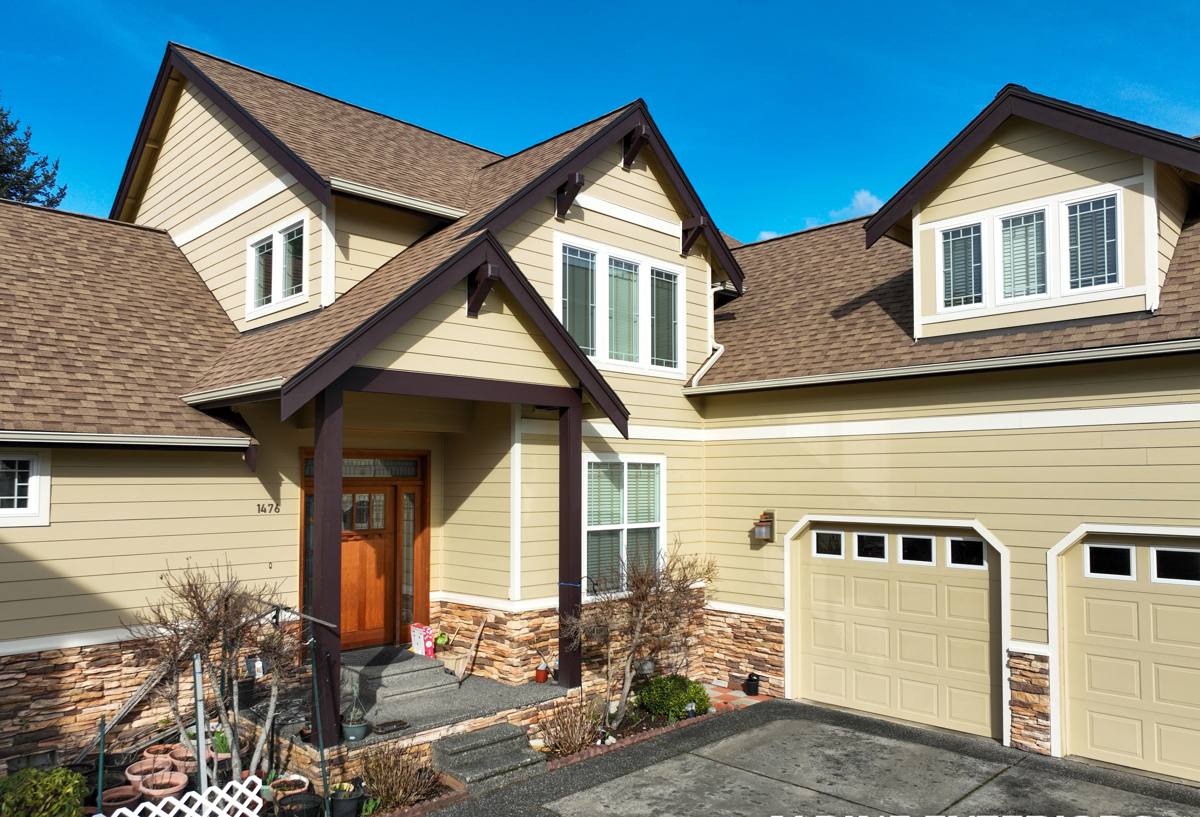
Signs a Columbia Home Actually Needs Replacement (Not Just Patching)
Not every siding problem calls for a full tear-off. But in a marine climate, small problems tend to compound faster than homeowners expect, because trapped moisture doesn't dry out between rain events the way it would in a drier region. Here's what tells us a repair won't be enough:
- Soft or spongy spots when you press on the siding, especially near the bottom courses and around window trim — a sign moisture has already gotten behind the surface
- Persistent moss or algae staining that comes right back within weeks of cleaning, particularly on north- and west-facing walls
- Visible cupping, warping, or delamination, common on older wood-based or engineered wood products once the factory coating fails
- Paint that won't hold — bubbling, peeling, or needing a repaint every 3-5 years instead of every 8-10
- Gaps opening up at seams, corners, or butt joints where caulk has failed and not been maintained
- A musty smell in interior rooms along exterior walls, which often points to moisture intrusion well before it's visible outside
- Rot at the bottom edge of siding boards or around old, unflashed penetrations (hose bibs, light fixtures, vents)
If you're only seeing one or two of these, localized repair may still make sense. If you're seeing several at once, especially rot combined with recurring moss, the siding system as a whole has likely reached the point where patching just delays a bigger bill.
Why Salt Air, Rain, and Moss Change What "Correct" Looks Like
Salt Air
Proximity to Chuckanut Bay and the broader Salish Sea means airborne salt is a real factor here, even a few blocks back from the water. Salt accelerates corrosion on fasteners and metal flashing, and it can degrade lower-quality coatings faster than inland weathering alone would. It doesn't damage every siding material equally — this is one of the reasons material choice matters as much as workmanship.
Driving Rain
Storms rolling in off the water don't just fall straight down — wind-driven rain hits walls at an angle, which puts far more stress on seams, laps, and flashing details than a calm vertical rain ever would. A siding system that's watertight in a still, dry test but wasn't built with wind-driven rain in mind will eventually leak, usually at the weakest joint.
Moss and Algae
Whatcom County's long wet season, mild temperatures, and tree cover give moss and algae a genuine head start on north-facing and shaded walls. Beyond the cosmetic staining, sustained moss growth holds moisture directly against the siding surface for weeks at a time, which is exactly the condition that leads to rot in wood-based products and coating failure in lower-grade composites.
None of these three factors is unusual for the Pacific Northwest. What's unusual is how many of them stack up at once this close to the water — which is why a siding job that would hold up fine in a drier part of the state can fail early here.
What a Correct Siding Replacement Involves
A siding replacement is really several separate systems working together, not just a new outer layer. Skipping or shortcutting any one of these is where most premature failures start.
1. Full Tear-Off and Inspection
We remove the old siding down to the sheathing so we can actually see what's underneath — not guess at it. This is where hidden rot, past water damage, or improperly installed trim gets found and fixed before anything new goes up. Covering over a problem is how a ten-year-old failure becomes a thirty-year-old structural repair.
2. Water-Resistive Barrier
A correctly lapped, sealed weather-resistive barrier is the layer that actually stops bulk water from reaching the sheathing if it ever gets past the siding. In a driving-rain climate, the barrier detailing at seams, corners, and penetrations matters as much as the siding itself.
3. Flashing at Every Penetration
Windows, doors, hose bibs, light fixtures, vents — anywhere something interrupts the plane of the wall is a place water wants to get in. Proper flashing, installed in the correct shingle-lap order with the barrier, is non-negotiable on a home exposed to wind-driven rain.
4. Proper Fastening and Clearances
Fastener spacing, type, and depth all affect long-term performance — and near salt air, fastener material matters even more. We also hold the manufacturer-specified clearance between the bottom of the siding and grade, decks, or roof lines, since tight clearances are one of the most common causes of rot we find when we tear off older siding.
5. Finish and Detailing
Corner boards, trim, and caulking are the last line of defense and the first thing to fail if rushed. We finish these to shed water, not just to look clean on installation day.
Material Comparison for This Climate
Homeowners in Columbia often ask why we don't offer a menu of siding materials the way some contractors do. The short answer is that we've standardized on one product because it's the one we trust to perform in exactly these conditions — but it's worth seeing the comparison laid out honestly.
| Material | Moisture / Rot Behavior | Moss & Algae Resistance | Maintenance | Typical Lifespan Here |
|---|---|---|---|---|
| James Hardie fiber cement | Non-combustible, engineered to resist moisture-driven swelling and cracking | Factory ColorPlus finish resists staining better than field-painted surfaces | Occasional wash; no repainting needed with ColorPlus | 30+ years with correct install |
| Vinyl siding | Doesn't rot itself, but traps moisture behind it if installed poorly; warps in heat | Can stain and is hard to fully clean without damaging the surface | Low, but panels can crack or fade over time | Variable; seams and laps are common weak points |
| LP SmartSide (engineered wood) | Wood-based core is vulnerable if the factory coating is compromised at cuts or edges | Moisture retention at damaged edges can invite moss and rot together | Field-caulked seams need regular inspection | Highly dependent on installation quality and edge-sealing |
| Primed cedar | Natural wood; rot resistance depends entirely on maintenance and coating upkeep | Absorbs moisture readily; needs active moss/algae management | High — repainting/staining on a recurring cycle | Shortest of the group in a wet marine climate without diligent upkeep |
Every material on that list has a legitimate use case somewhere. In a salt-air, high-rainfall, long-moss-season environment like Columbia, though, the trade-offs on vinyl, engineered wood, and cedar are exactly the ones that shorten a siding job's real-world life — which is why we don't install them.
Why We Install Only James Hardie
We're not a multi-brand supplier — we're a Hardie-only installer, and that's a deliberate standard, not a lack of options. Fiber cement is non-combustible, which matters increasingly in Washington's wildfire-conscious insurance environment, and it holds its shape and color far better than wood-based or vinyl alternatives in a wet, salt-influenced climate. Hardie's ColorPlus factory finish is baked on under controlled conditions, which means better UV and moisture resistance than a field-applied paint job can typically match, and it comes backed by a real, transferable warranty on both the substrate and the finish.
Hardie also builds climate-specific product engineering into its HZ (HardieZone) lines, which account for regional moisture and temperature patterns rather than using one generic formulation everywhere in the country. For a home taking on Pacific storms and salt air, that regional engineering is the difference between siding that's rated for these conditions and siding that merely tolerates them.
We'd rather do one product exceptionally well, understand every one of its installation details cold, and stand behind it fully than spread our crews thin across four or five materials with different rules, different failure points, and different warranty fine print.
Our Process, Start to Finish
- Free on-site estimate — we walk the exterior, check for existing moisture damage, and talk through what your home actually needs
- Written scope and cost breakdown — no vague allowances; you see what's included before work starts
- Tear-off and sheathing inspection — any rot or damage found gets flagged and addressed before covering it up
- Weather barrier and flashing installation — the unglamorous layer that determines whether the job holds up in a storm
- James Hardie siding installation — installed to manufacturer spec for fastening, clearances, and joint treatment
- Trim, caulking, and final detailing — the finish work that keeps water moving away from the wall, not into it
- Walkthrough — we go over the finished job with you before calling it done
What Drives Cost on a Columbia Siding Job
Every home is different, so we won't quote a number without seeing yours, but these are the factors that most commonly move the price up or down:
| Factor | Why It Matters |
|---|---|
| Extent of existing damage | Rot found during tear-off requires sheathing or framing repair before new siding can go on |
| Home size and wall complexity | More corners, dormers, and trim details mean more labor and cut waste |
| Siding profile chosen | Lap width, texture, and trim style affect material cost and install time |
| Access and site conditions | Steep grades, tight setbacks, or limited staging area near the water can add time |
| Current siding removal | Multiple layers of old material or hazardous tear-off conditions add scope |
What to Ask Before Hiring Anyone for This Job
- Are you a certified or factory-trained installer for the specific product you're proposing?
- What water-resistive barrier and flashing details do you use, specifically, around windows and penetrations?
- What's covered under the manufacturer's warranty versus your own workmanship warranty, and is either transferable?
- Have you worked on homes in this immediate area before, and do you understand the moisture and moss conditions specific to it?
- Will you show me any hidden rot or damage you find during tear-off before you close it up?
A contractor who hesitates on any of these, especially the barrier and flashing question, is telling you something important about how the rest of the job will go.
Why Hiring a Crew That Already Works in Columbia Matters
Siding failure patterns aren't identical across Whatcom County — a crew that mostly works dry inland neighborhoods doesn't necessarily think the same way about wind-driven rain angles, salt-influenced fastener corrosion, or which walls in a given microclimate will fight moss the hardest. Crews that already work in and around Columbia and the broader Chuckanut area have seen how homes here actually age, which means fewer surprises during tear-off and fewer callbacks after the job is done. That local pattern recognition is worth as much as any single product spec.
If your Columbia home's siding is showing rot, recurring moss, failing paint, or you're just past the point where patching makes sense, we'll come take a look and give you an honest read on what it needs. Reach out for a free, no-pressure estimate — we'll tell you straight whether it's a repair or a full replacement, and walk you through exactly what a correct James Hardie installation would involve for your home.