 Chuckanut
 Columbia sits close enough to Bellingham Bay and the Chuckanut corridor that its homes deal with the same coastal exposure that shapes siding decisions all along this stretch of Whatcom County: salt air rolling in off the water, driving rain that doesn't fall straight down so much as get pushed sideways into walls, and a moss season that can stretch most of the year on shaded sides of a house. We install James Hardie fiber cement siding exclusively, and this page is specifically about what that looks like for a home in the Columbia area — what the climate demands, what a correct installation actually involves, and how our process works from first look to finished wall.
Why Columbia's Location Puts Extra Demand on Siding
Being close to the bay is part of what makes this area desirable, and it's also exactly why siding here takes more abuse than it would a few miles inland. Salt-laden air accelerates the breakdown of finishes and speeds corrosion at fasteners and flashing over time. Storms coming off the water push rain into south- and west-facing walls at an angle, forcing moisture into seams, trim joints, and butt joints that a lesser product or a sloppy installation can't keep sealed. And wherever tree cover or building shade keeps a wall from drying out quickly after a storm, you get the damp, low-light conditions moss and mildew need to establish themselves and spread.
None of that is unique to Columbia specifically — it's the same set of pressures that shapes siding choices across the Chuckanut area and much of coastal Whatcom County. But it does mean a homeowner here can't treat siding as a cosmetic decision. The product and the installation both have to be built for sustained wet-weather exposure, not just a dry summer's worth of curb appeal.
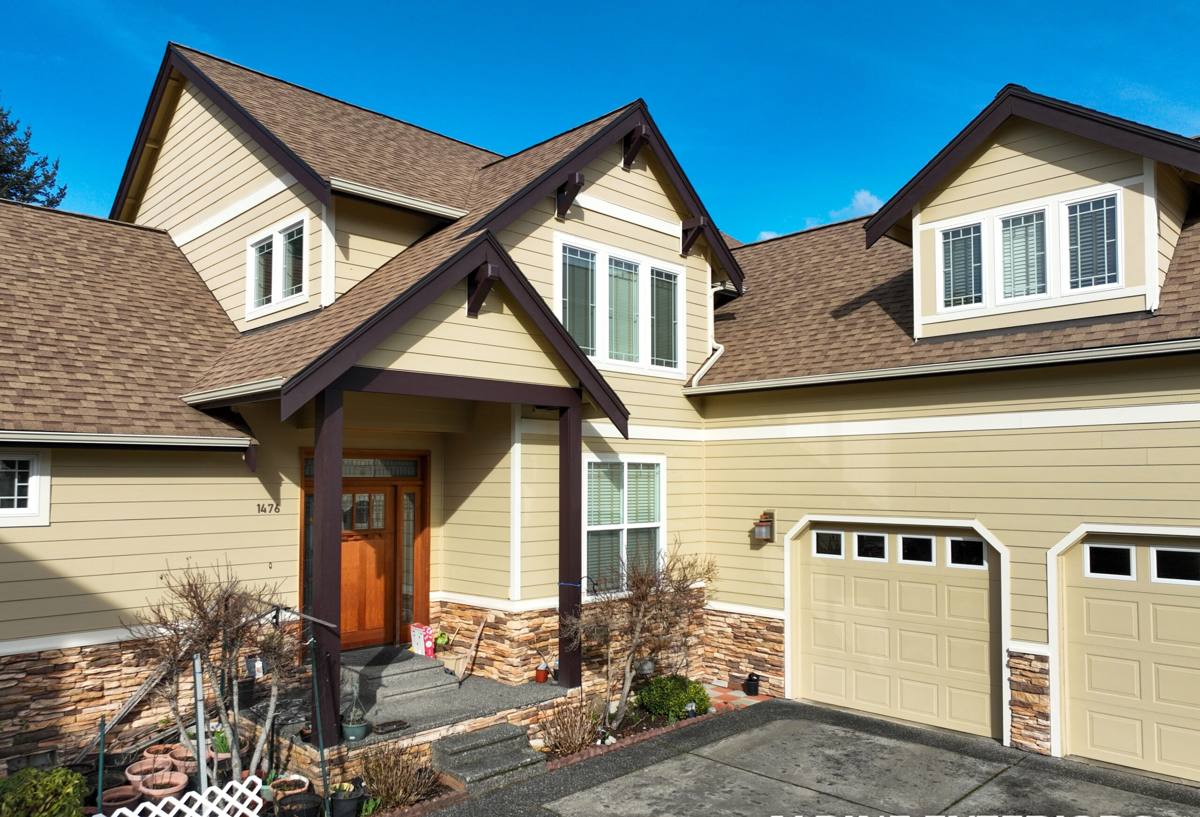
Why James Hardie Is the Right System for This Climate
We standardized on James Hardie fiber cement because it's engineered to handle exactly the conditions Columbia homes face. It has no organic core, so salt air, driving rain, and a long moss season don't have the same foothold on it that they have on wood-based products — it doesn't swell, rot, or delaminate from repeated wet-dry cycling the way an organic substrate can. It's also non-combustible, which matters to us on every home we work on regardless of climate.
Built for Regional Exposure, Not a Generic Climate
Hardie doesn't sell one formulation everywhere. Its HZ product lines are engineered for different regional exposure levels, and homes in a wetter, coastal climate like ours call for a different specification than a product sold for a dry inland market. That distinction matters more here than it would somewhere without Columbia's proximity to open water and driving weather.
A Factory Finish That Holds Up to Salt Air
ColorPlus, Hardie's factory-applied finish, is baked on under controlled conditions rather than brushed or sprayed on-site. That matters in a climate where field-applied paint and stain finishes have to fight salt exposure and near-constant moisture from the day they go up. A factory finish backed by its own product warranty holds color and resists cracking far longer than most site-applied coatings manage under these conditions.
What a Correct Hardie Installation Involves
The product only performs the way it's engineered to if it goes on correctly. Fiber cement siding is not especially forgiving of shortcuts at the details, and in a wet climate those shortcuts show up faster than they would somewhere drier. A correct installation includes:
- Proper clearance between the siding and grade, roof lines, decks, and any other horizontal surface where water and debris can collect
- Correct flashing at every window, door, and roof-to-wall intersection, installed before the siding goes on, not caulked in as an afterthought
- A weather-resistant barrier installed and lapped correctly behind the siding, with rainscreen furring where conditions call for it
- Fasteners rated for coastal exposure, placed at the spacing and edge distance Hardie's installation instructions specify
- Joints and butt seams sealed with a product-compatible sealant, not general-purpose caulk that will fail early in salt air
- Field-cut edges primed or sealed per manufacturer spec, since an unsealed cut edge is one of the more common places moisture gets in
Skip or rush any one of those steps and you can end up with a wall that looks fine for a year or two before a problem shows up behind the surface — usually right around a joint, a corner, or a fastener that wasn't set correctly. Getting these details right the first time is a large part of what separates a Hardie installation that performs for decades from one that needs early repair.
Our Process for a Columbia Siding Project
We run the same disciplined process on every home, adjusted for what your specific property needs:
- Walk-through and assessment. We look at your current siding's condition, sun and shade exposure on each wall, drainage around the foundation, and any trouble spots — areas near grade, under decks, or on shaded sides where moisture tends to linger.
- Product and color selection. We help you choose the right HardiePlank, board-and-batten, or shingle profile and ColorPlus color for your home, factoring in exposure on each elevation.
- Prep and moisture barrier. Old siding comes off, sheathing gets inspected for hidden damage, and a correctly lapped weather-resistant barrier goes on before a single piece of Hardie touches the wall.
- Flashing and installation. Windows, doors, and roof intersections get flashed to spec, then siding goes up with proper clearance, fastener placement, and joint treatment throughout.
- Final inspection and cleanup. We walk the finished exterior with you, check every joint and clearance point, and register your Hardie warranty before we consider the job done.
James Hardie Product Lines: Choosing the Right Fit
Not every Columbia home needs the same product. Hardie offers several siding profiles, and the right choice depends on your home's style, exposure, and your own preference on look and detail.
| Product | Look | Best suited for |
|---|---|---|
| HardiePlank lap siding | Traditional horizontal lap, smooth or cedar-textured | Most home styles; the most common choice for full re-sides |
| HardiePanel vertical or board-and-batten | Vertical panels with battens for a more modern or craftsman look | Accent walls, gables, or homes wanting a distinct architectural look |
| HardieShingle | Staggered or straight-edge shingle profile | Homes wanting a shingle-style look without wood's maintenance burden |
| HardieTrim | Smooth trim boards for corners, fascia, and window surrounds | Paired with any of the above for a finished, consistent look |
We'll walk you through which profile fits your home's architecture and which exposures on your property call for extra attention during installation.
What Drives Cost on a Columbia Siding Project
Every home is different, so we don't quote a number without seeing the property, but a few factors consistently move the price on jobs in this area:
| Factor | Why it matters |
|---|---|
| Current siding removal | Tear-off of old siding, especially if hidden water damage is found underneath, adds labor and sometimes sheathing repair |
| Home size and wall complexity | More corners, gables, and dormers mean more cutting, trim, and flashing detail work |
| Product profile chosen | Lap siding, board-and-batten, and shingle profiles differ in material and labor cost |
| Exposure and access | Homes with difficult access, steep grade, or heavy sun/salt exposure on certain walls may need extra prep or detailing |
| Trim and accent work | Custom trim packages and accent siding add cost beyond a straightforward lap re-side |
A free on-site estimate is the only reliable way to get real numbers for your home — anything quoted sight unseen is a guess.
Why a Crew That Already Works Columbia Matters
Siding installed to spec on paper doesn't automatically mean it's installed right for the site conditions in front of you, and that's where local experience earns its keep. A crew that's worked homes in and around Columbia and the greater Chuckanut area has already seen how salt air behaves on a bay-facing wall, which elevations tend to hold moss longest, and where driving storms off the water tend to find weak spots in flashing and joints. That's the kind of pattern recognition that comes from repeated work in this specific microclimate, not from a general knowledge of siding installation.
It also matters for the practical side of a project — knowing typical permitting requirements in Whatcom County, understanding how local weather windows affect scheduling a tear-off and re-side without leaving a wall exposed, and having a track record in the immediate area that a homeowner can actually check on. When you're inviting a crew to remove your home's weather barrier for several days, that local track record is worth something real.
After Installation: What to Expect
One of the advantages of switching to James Hardie is how little ongoing maintenance it asks for compared to wood-based siding, but "low-maintenance" isn't the same as "no-maintenance." A short annual routine keeps a Hardie exterior performing the way it's designed to:
- Rinse the exterior periodically to clear salt residue and organic buildup before it accumulates
- Inspect caulked joints and trim seams annually, especially after the first heavy storm season
- Keep gutters, downspouts, and grade drainage clear so water isn't sitting against the base of a wall
- Watch shaded, north-facing sections for early moss growth and address it before it spreads
- Trim back vegetation that keeps a wall shaded and damp longer than it needs to be
That routine is a fraction of what a wood or engineered-wood exterior would ask for in this same climate, and it's one of the clearest reasons we made Hardie our standard product.
Get a Straight Answer for Your Home
If you're weighing a siding project for a home in Columbia or elsewhere near Chuckanut, we're glad to come take a look, walk your property's exposure with you, and give you a clear, honest estimate — no pressure, no generic sales pitch. Reach out through the form below for a free estimate.