 Chuckanut
 Why Siding Repair Looks Different in Sehome
Sehome sits close enough to the water and the hillside tree cover that its homes take on a specific mix of weather stress: salt-tinged air moving in off the Sound, driving rain that comes in sideways during winter storms, and a moss season that can stretch from October well into spring. None of that is unique to any one house — it's the baseline for this part of Whatcom County. But it means siding repair here isn't just patching a hole or replacing a cracked board. It's diagnosing why that damage happened in the first place, because the same conditions that caused it will be back next winter.
A repair that only addresses the visible symptom — a stained panel, a soft spot, a gap at a seam — without dealing with the underlying moisture path is a repair that fails again within a year or two. That's the standard we hold every repair job to, whether it's one panel or an entire elevation.
Signs Your Siding Needs Repair
Most siding problems in Sehome show up gradually, which is exactly why they get missed until they're expensive. Here's what we tell homeowners to watch for between now and your next professional look:
- Dark streaking or green-black growth that keeps returning after cleaning, especially on north- and west-facing walls
- Soft, spongy, or crumbling spots when you press on siding near the bottom of walls or below windows
- Paint or finish that's bubbling, peeling, or chalking unevenly across a wall
- Visible gaps, warping, or cupping at board seams and butt joints
- Water stains or bubbling on interior walls that back up to exterior siding
- Caulk that's cracked, shrunk, or pulled away from trim and window edges
- A musty smell in a room that shares a wall with a known trouble spot outside
Any one of these on its own might be minor. Two or three together, especially near ground level or under a roofline with poor overhang, usually means water has been getting behind the siding for a while.
What Correct Siding Repair Actually Involves
Diagnosing the Moisture Path First
Before we replace anything, we figure out how water is getting in. That could be a failed kick-out flashing above a roofline, caulk that's past its service life, a seam that was never properly lapped, or ground-level splashback saturating the bottom course of siding year after year. Swapping a damaged board without fixing the entry point just buys a little time.
Matching Materials and Reveal
Repair work has to match the existing siding's exposure, reveal, and profile, or the patch reads as an obvious patch. On fiber cement especially, getting the coursing and caulk lines consistent matters for both looks and long-term water management — mismatched reveals create tiny ledges where water can pool.
Sealing and Flashing Details
Most repair failures we're called back to fix, on other contractors' work, trace back to flashing and sealant, not the siding material itself. Proper repair includes correcting flashing at penetrations, window heads, and butt joints — not just caulking over the visible gap and calling it done.
How Common Siding Materials Repair Differently
Not every siding material takes a repair the same way, and that affects both what a fix costs and how long it lasts. Here's a general comparison based on what we see across the different siding types in and around Sehome:
| Material | Typical repair difficulty | Repair longevity | Notes |
|---|---|---|---|
| Vinyl | Low — panels snap in/out | Fair; color fade makes patches visible over time | Cracks easily in cold snaps; brittle after years of UV exposure |
| Cedar / wood | Moderate to high | Depends heavily on maintenance history | Rot often extends past what's visible; repairs need honest probing |
| LP SmartSide (engineered wood) | Moderate | Fair; edge swelling is a recurring issue | Cut edges and seams are the most common failure points |
| James Hardie fiber cement | Moderate | Strong when repaired to spec | Non-combustible, doesn't rot, holds paint and caulk well long-term |
We repair what's already on a house whenever that's the right call for the homeowner's budget and timeline. But when a repair area is large enough, or a section of siding is failing broadly rather than in one spot, we walk clients through what replacing that section — or the whole elevation — with James Hardie would look like instead.
Why We Repair (and Rebuild) With James Hardie
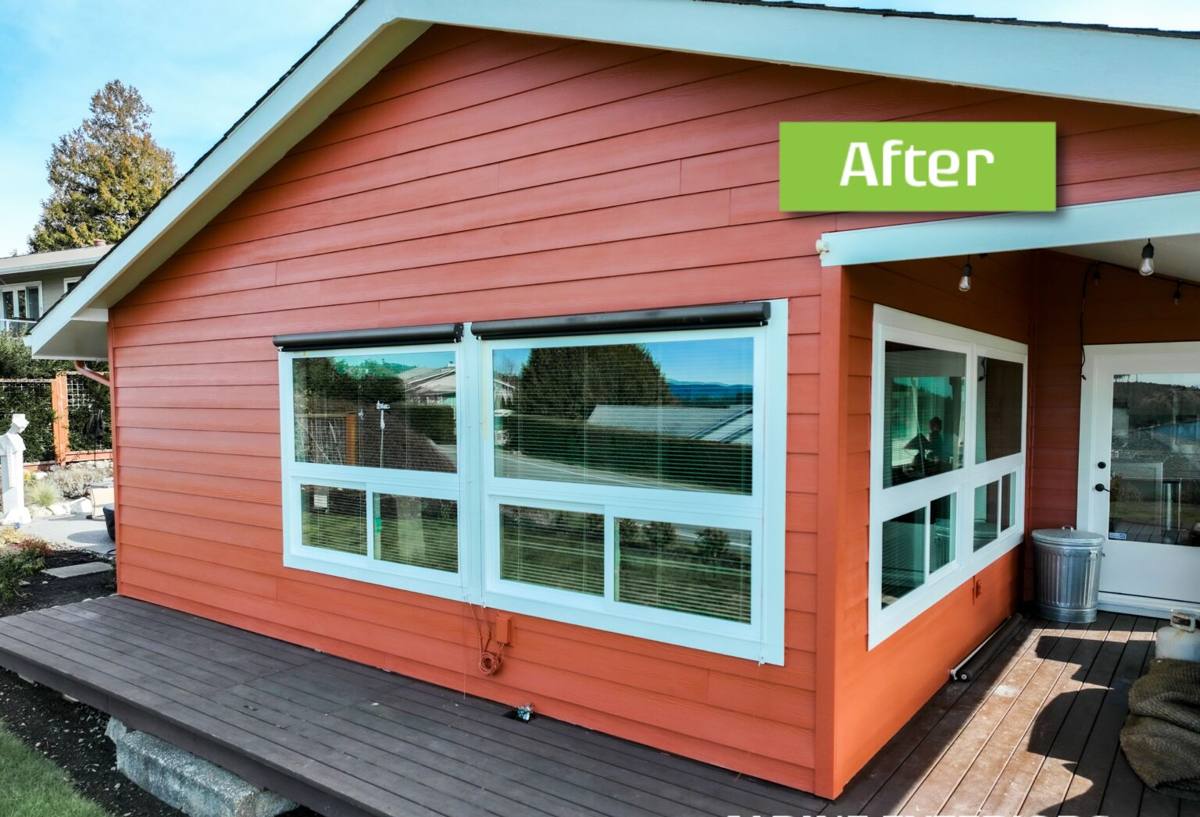
This company installs James Hardie fiber cement exclusively — we don't install vinyl, LP SmartSide, Cemplank, Allura, primed spruce, or cedar. That standard applies to repair work too: when a repair calls for new material, whether it's a single course or a full wall section, we use Hardie product matched to what's already on the house wherever possible, or we recommend a broader Hardie replacement when patch-matching isn't practical.
We landed on Hardie as our standard because it holds up to exactly the conditions Sehome sees the most. It's non-combustible, it doesn't absorb and swell with moisture the way wood-based products can, and the ColorPlus factory finish resists the fading and chalking that shows up fastest on painted siding exposed to salt air and constant damp. Hardie's HZ5 product line is engineered for the freeze-thaw and wet-climate conditions of the Pacific Northwest specifically, which matters when a repair needs to perform for decades, not just pass inspection today.
None of that means other materials are junk — vinyl and engineered wood both have real advantages, mainly upfront cost. But we made a professional call to build our repair and replacement work around the product that gives homeowners the fewest callbacks and the longest service life in this climate, and we stand behind that call.
Our Repair Process
1. On-Site Assessment
We look at the damaged area and the surrounding siding, roofline, gutters, and grading — because siding problems are rarely isolated from those systems. We probe suspect areas rather than guessing from the surface.
2. Honest Scope
We tell you plainly whether it's a spot repair, a section replacement, or something bigger. If a repair would just delay a larger problem, we say so — we'd rather lose a small job than have you pay twice.
3. Matched or Upgraded Materials
For fiber cement repairs, we match existing Hardie product and ColorPlus finish where available. For sections being upgraded from another material, we spec the right Hardie line for that wall's exposure.
4. Correct Flashing and Sealing
Every repair includes fixing the water management detail that caused the damage — flashing, kick-outs, or sealant — not just replacing the visible board.
5. Cleanup and Walkthrough
We walk the finished repair with you, point out what we did and why, and flag anything else on the exterior worth keeping an eye on.
Moss, Salt Air, and Driving Rain: What They Mean for a Repair
Moss doesn't just sit on top of siding — sustained moss coverage holds moisture against the surface far longer than open air would, which accelerates whatever damage is already starting underneath. Repair areas need to address moss-prone zones (typically shaded, north-facing, and under tree cover) with attention to drainage and airflow, not just a fresh coat of paint over cleaned siding.
Salt air speeds up the breakdown of fasteners, caulk, and unprotected finishes, which is part of why factory-applied finishes like ColorPlus tend to outlast field-applied paint in this environment — there's simply less exposed, unprotected material for salt and moisture to work on. And driving rain, especially in exposed or elevated spots around Sehome, tests every seam, joint, and piece of flashing on a wall. A repair that looks fine on a calm day can fail the first time rain comes in sideways if the underlying details weren't corrected.
Repair vs. Replacement: How to Decide
Homeowners often ask us to just make a call, but the honest answer depends on a few factors specific to the house:
| Factor | Leans toward repair | Leans toward replacement |
|---|---|---|
| Extent of damage | Isolated to one or two areas | Spread across a wall or multiple elevations |
| Age of existing siding | Relatively recent, otherwise sound | Near or past expected service life |
| Cause of damage | One-time event (impact, isolated flashing failure) | Systemic moisture or material failure |
| Material on the house now | Fiber cement in generally good condition | Vinyl, wood, or engineered wood showing widespread wear |
| Homeowner's timeline | Needs a fast, targeted fix | Planning ahead, open to a longer-term upgrade |
We'll always give you our honest read on which side of this table your situation falls on — including telling you when a repair is the smarter money.
Why Hiring a Crew That Already Works in Sehome Matters
Repair work rewards local familiarity in a way new installs don't always require. Knowing how a particular block or hillside catches wind-driven rain, how tree cover in a neighborhood tends to feed moss growth, and what typical construction from a given era around here usually hides behind the siding all shape how we diagnose and price a repair. A crew that's worked houses in Sehome and the surrounding Chuckanut area isn't guessing at those patterns — they've seen them.
That local pattern recognition also means fewer surprises mid-repair. We're less likely to open up a wall and be caught off guard by what we find, because we've generally seen similar conditions on similar homes nearby.
Get an Honest Look at Your Siding
If you're seeing streaking, soft spots, or gaps in your siding, it's worth getting a professional opinion before the next round of Whatcom County rain makes the problem worse. We offer a free, no-pressure estimate to look at your siding, tell you honestly what's going on, and walk you through your repair options — including whether James Hardie fiber cement makes sense for the affected section. Fill out the form below to get started.