 Chuckanut
 Why Silver Beach Homes Wear Out Siding Faster Than Expected
Silver Beach is one of the older neighborhoods on Lake Whatcom, and a lot of the homes here were sided decades ago with whatever material was standard at the time — wood lap, older composite panels, or in some cases a first-generation vinyl retrofit. Those materials had a normal service life somewhere else. On a lot that sits close to the lake and takes on salt-tinged marine air moving in from Bellingham Bay, driving rain off the open water, and a moss season that barely lets up between fall and spring, that same siding tends to fail years ahead of schedule. We see it constantly: paint that won't hold past a couple of seasons, panels that have gone soft at the bottom edge, and trim boards that look fine from the street but are rotten behind the surface.
This page is specifically about full siding replacement for Silver Beach properties — not a general overview of exterior services, and not a patch-and-repair conversation. If your siding has reached the point where repair is just delaying the inevitable, here's what a correct replacement actually involves in this climate, how we approach it, and why we install James Hardie fiber cement and nothing else when we do it.
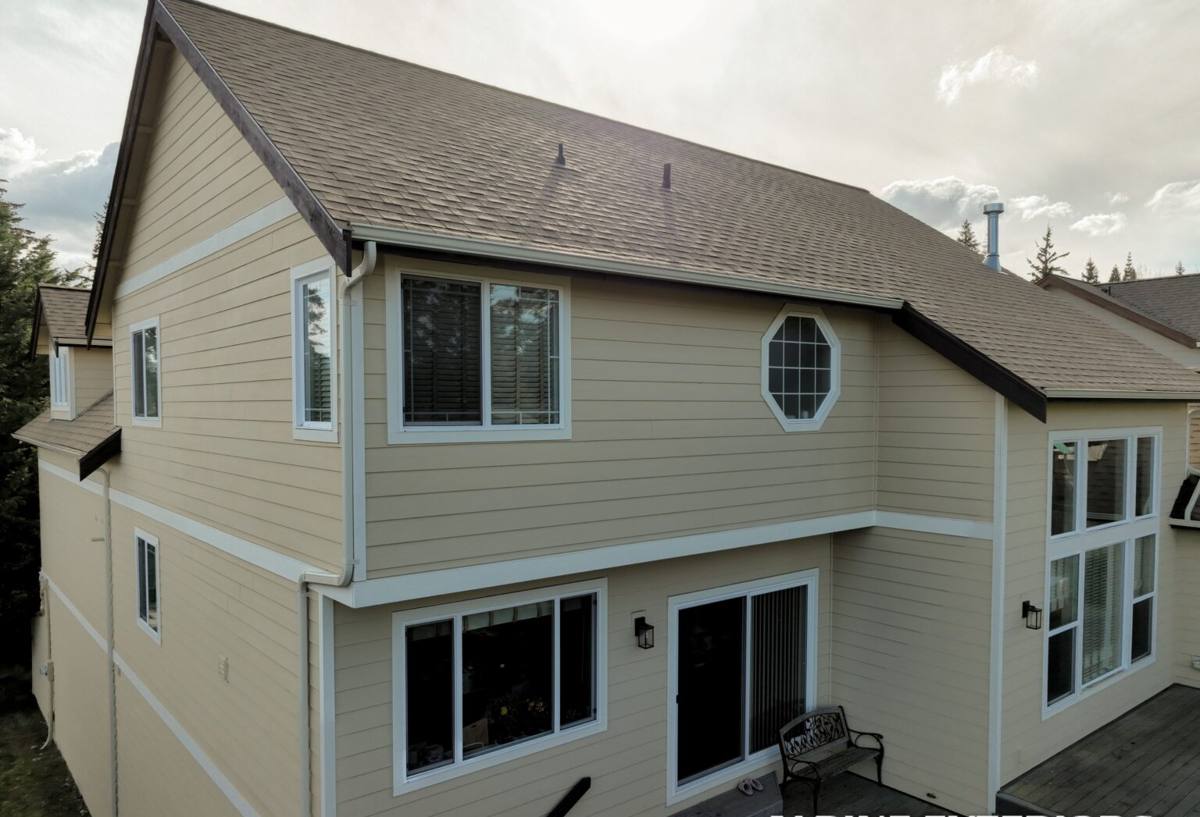
Repair or Replace? Reading the Real Signs
Not every siding problem calls for a full tear-off. A cracked board here, a failed caulk joint there, or isolated damage from a single storm can often be repaired without touching the rest of the house. Full replacement makes sense once the damage stops being isolated and starts being systemic — when the material itself, not just a section of it, has reached the end of what it can do.
- Soft, spongy, or crumbling siding in more than one area of the house, not just around one downspout or corner
- Paint or finish that fails within a year or two of repainting, even after proper prep
- Visible gaps, warping, or panels pulling away from the wall at multiple points
- Moisture staining, bubbling, or a musty smell on interior walls that back onto exterior siding
- Siding that's original to a house built more than 20-25 years ago and was never a fiber cement product
- Persistent moss or black staining that returns within a season of cleaning, no matter how it's treated
- Rot found at multiple window and door penetrations rather than a single isolated spot
If two or more of these apply, you're usually looking at a house where the underlying material has lost the fight with this climate, and patching individual boards just buys a little time before the next section fails.
What Salt Air, Driving Rain, and a Long Moss Season Do to Siding
Salt-Tinged Marine Air
Whatcom County's weather comes off the Pacific, and the air moving inland off Bellingham Bay and the Strait of Georgia carries a mild salt content that reaches well past the immediate shoreline, including a lakeside neighborhood like Silver Beach. Over years, that steady exposure corrodes lower-grade fasteners, breaks down paint films faster than a dry inland climate would, and works into any siding material that isn't engineered to resist it. It's a slow process, which is exactly why it's easy to underestimate until the siding is visibly failing.
Wind-Driven Rain Off the Lake
Lake Whatcom generates its own localized weather to a degree. Wind moving across open water picks up speed and drives rain into lake-facing walls harder than the same storm would hit a sheltered inland lot. That means the wall facing the lake often takes meaningfully more water than the other three sides of the same house, and any weak point in the siding, flashing, or trim on that elevation gets found fast. A siding system and installation detail that work fine on a sheltered wall can still fail on the exposed one if they weren't built for that difference.
A Moss Season That Doesn't Let Up
Between lake humidity, regular Pacific Northwest rainfall, and tree cover on many Silver Beach lots, north-facing and shaded siding runs rarely get a long dry stretch for much of the year. That's the exact condition moss and mildew need to establish themselves, and once they take hold on a porous or textured surface, they hold moisture against the material even longer than the climate alone would. Siding that sheds water cleanly and doesn't give moss a foothold has a real, measurable advantage here over material that absorbs and holds it.
Why Replacement Means James Hardie Fiber Cement — Not Vinyl, LP, or Cedar
We used to install a wider range of siding products. We narrowed that down to James Hardie fiber cement after seeing, repeatedly, which materials held up to this specific combination of salt air, wind-driven rain, and a long damp season — and which ones quietly ran into trouble within a handful of years.
Vinyl is inexpensive and easy to install, and for a lot of climates it does its job fine. In a marine environment with regular wind-driven rain, though, it's a thin material that can warp in temperature swings, and its seams and J-channels give water a path behind the panel if they're not detailed carefully. LP SmartSide is a wood-strand product with a real performance upgrade over old-school hardboard, but it's still an engineered wood product at its core — any breach in the factory coating exposes wood fiber that can swell and deteriorate faster in sustained damp conditions than a cement-based product will. Cedar looks the part for this region, but it's a natural, moisture-absorbent material that needs ongoing staining or sealing to keep performing, and in a climate that doesn't dry out for long stretches, that maintenance schedule gets demanding fast.
Fiber cement doesn't have a wood or vinyl core to swell, warp, or rot. It's non-combustible, it holds paint and factory finishes longer in damp climates than wood-based products typically do, and James Hardie backs it with a strong transferable warranty. That's not a marketing preference on our part — it's the product we're willing to install and stand behind on a lakeside, marine-exposed lot like the ones in Silver Beach.
What a Correct Full Siding Replacement Involves
Tear-Off and Sheathing Inspection
A full replacement starts with removing the old siding down to the sheathing — not siding over the top of what's there. That step matters here more than in a drier climate, because it's the only point where we can actually see what years of moisture exposure have done underneath. Soft or delaminated sheathing, rotted framing around windows and doors, and compromised insulation all get found and repaired at this stage, before anything new goes back on. Covering that kind of damage instead of fixing it is one of the most common ways a siding job fails early.
Weather-Resistive Barrier and Flashing
Once the sheathing is sound, a new weather-resistive barrier goes on, along with correctly integrated flashing at every window, door, and penetration. This is the layer that actually keeps water out if it ever gets past the siding itself, and on a lake-facing wall that takes more wind-driven rain than the rest of the house, it's not a step to shortcut. Flashing has to be lapped correctly with the barrier — installed in the wrong order or sequence, it can direct water into the wall instead of away from it.
Hardie Panels, Fastening, and Finish
We install James Hardie's climate-engineered HZ5 product line, which is formulated for regions with heavy moisture exposure and freeze-thaw cycling rather than hot, dry conditions — a fit for a lakeside Whatcom County property. Fastening pattern, nail spacing, and gapping at butt joints all follow Hardie's published installation specs; those details are what the manufacturer's warranty is actually built around, and skipping them is one of the fastest ways to void coverage without the homeowner ever knowing it happened. Most Silver Beach installations use Hardie's ColorPlus factory-finished panels, which hold color and resist fading and moisture intrusion at the finish layer better than a field-applied paint job typically will.
Our Siding Replacement Process for Silver Beach Homes
- On-site assessment. We walk the whole exterior, note which elevations take the most weather, and identify likely trouble spots before any work starts.
- Written scope and product selection. You get a clear, itemized scope and help choosing the Hardie profile, texture, and color that fit the house and the neighborhood.
- Tear-off and sheathing repair. Old siding comes off, sheathing and framing get inspected, and any damage found gets repaired before we move forward.
- Weather barrier and flashing installation. New house wrap and flashing go in at every penetration, sequenced correctly for proper water drainage.
- Hardie panel installation. Panels go on to manufacturer spec, with attention to the lake-facing elevation and any other high-exposure walls.
- Trim, finish work, and cleanup. Trim, corners, and caulking are finished out, and the site is cleaned up and old material hauled away.
- Final walkthrough. We go over the finished work with you directly and address anything you want a closer look at.
What It Costs — and What Actually Moves the Number
There's no honest single price for a siding replacement without seeing the house — too much depends on size, condition, and access. What we can do is lay out the factors that actually drive the cost up or down, so you know what you're evaluating when you get a quote.
| Factor | Why It Matters |
|---|---|
| Total wall area / house size | More square footage of siding and trim means more material and labor, in a fairly direct relationship. |
| Sheathing or framing damage found | Rot discovered under old siding has to be repaired before new panels go on; the extent of hidden damage is often unknown until tear-off. |
| Number of siding layers to remove | Some older homes have been sided over more than once; each layer adds tear-off time and disposal cost. |
| Trim, corners, and accessory detail | Homes with more windows, dormers, and architectural trim require more precise cutting and detail work. |
| Siding profile and finish chosen | Lap, shingle, and panel styles, plus factory-finished ColorPlus versus field paint, carry different material costs. |
| Site access | Tight lakeside lots, steep grades, or limited staging space can add time and equipment cost compared to open, easy-access properties. |
Why a Crew That Already Works in Silver Beach Matters
A siding crew that hasn't worked this neighborhood before has to learn its particular problems on your house. A crew that already knows Silver Beach knows, before the tear-off even starts, that the lake-facing elevation usually needs closer attention than the others, that shaded and tree-covered walls are the ones most likely to have moss and hidden moisture damage, and that access on some of these lots — narrow driveways, sloped yards, close-set homes — takes planning that a standard subdivision job doesn't. That familiarity shows up in fewer surprises mid-project and a job that accounts for the realities of the site from day one instead of discovering them halfway through.
It also matters for scheduling and sequencing. Whatcom County's wet season is long, and timing tear-off and sheathing exposure around weather windows is part of doing this work responsibly on a lakeside property — leaving open sheathing exposed to a Silver Beach storm for longer than necessary isn't a risk worth taking to save a day of scheduling.
If your Silver Beach home's siding is past the point of patching, we're happy to take a look and give you a straightforward, no-pressure estimate for a full James Hardie replacement — no obligation, just an honest read on what your house actually needs. You can request one using the form below.